Morning Habits Support Movement Before The Day Takes Over
Your first few morning choices can influence how confidently your body enters the day.
Could Five Calm Habits Help Your Body Wake Naturally?
Water, daylight and nourishment can prepare the body for everyday activity.
Dennis Bartram Builds A More Useful Morning Routine
Small actions become valuable when they are safe enough to repeat.
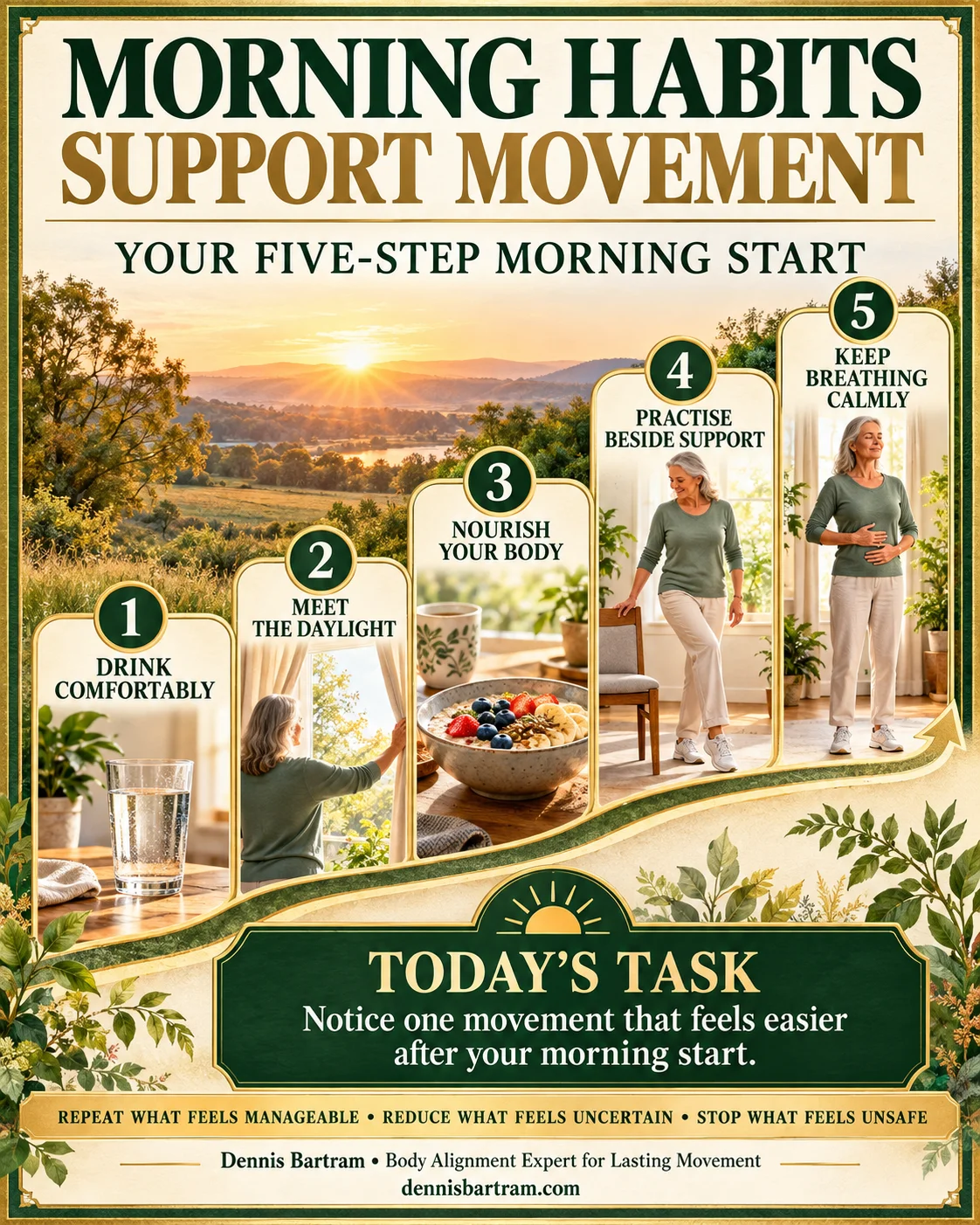
Build A Routine: The Body Can Recognise The order itself; it may become a useful cue. Water signals the beginning. Daylight widens attention. Food prepares the body for the day. A supported movement checks balance and coordination. Calm breathing prevents the practice from becoming a battle. Repetition allows the person to compare today with yesterday without expecting every morning to feel identical.
This is more honest than promising eternal youth. Ageing is real, medical conditions matter, and nobody can guarantee what tomorrow will bring. Yet people can still influence how they meet the day. They can create conditions that make useful movement more likely. They can notice changes earlier. They can practise confidence before the outside world begins making demands.######
Morning Habits Support Movement Without Miracle Promises
The video’s strongest message survives perfectly well without the exaggerated claims. A person can begin the morning with several small acts of self-maintenance.
Drink according to individual needs. Seek natural daylight. Eat a suitable breakfast. Practise balance beside dependable support.
Allow breathing to continue during movement. Then repeat the pattern often enough to make it familiar.
Dennis Bartram’s work reminds us that the body is not a row of separate departments waiting for individual repairs. Hydration, nourishment, vision, balance, breathing, confidence and movement interact throughout the day.
Change one condition, and the movement experience may change too. That is not magic. It is observation applied with patience. The greatest benefit may be psychological as well as physical. Instead of waking and immediately asking, “What hurts today?” the person begins with, “What does my body need today?” That question invites useful action without denying discomfort. It replaces judgement with curiosity and heroic promises with evidence. Over time, the routine may become less about fighting age and more about protecting participation, confidence and independence.
The greatest benefit may be psychological as well as physical. Instead of waking and immediately asking, “What hurts today?” the person begins with, “What does my body need today?” That question invites useful action without denying discomfort. It replaces judgement with curiosity and heroic promises with evidence. Over time, the routine may become less about fighting age and more about protecting participation, confidence and independence.
Morning Habits Support Movement Apprentice Task
Tomorrow morning, create your own five-part movement beginning. Place water where you will see it, then open the curtains or spend a few comfortable minutes near natural daylight. Choose a breakfast that suits your health needs and provides useful nourishment. Stand beside a secure chair and practise one manageable weight shift while keeping both feet available. Finally, repeat one ordinary movement while keeping your breath going.
Write down one sentence: “This morning, my body felt more comfortable when I…” Complete the sentence with what you actually observed. Do not award yourself extra points for removing support, holding your breath or forcing a painful movement. Your task is to collect one piece of honest evidence. Repeat what felt manageable, reduce what felt uncertain and stop anything that felt unsafe. That is how Morning Habits Support Movement: not through dramatic promises, but through calm actions the body can learn to trust.
The evidence behind the grounded version is straightforward: regular hydration is especially important for older adults; natural light helps regulate the sleep-wake system; adequate protein supports older muscle; and strength and balance activities can support mobility and reduce falls risk.
Morning Habits Support Movement Through Useful Nourishment
The third morning habit concerns food, although breakfast has become another subject the internet loves to turn into a courtroom drama. Toast is declared guilty, cereal is marched away in handcuffs, and everybody over sixty is ordered to consume an identical quantity of protein before the clock strikes nine. Real bodies are not quite so obedient. Appetite, medication, body size, activity, health conditions and personal preferences all influence what makes a suitable breakfast. Nevertheless, the useful principle remains: the first meal of the day should help prepare the body for the ordinary movements we want to preserve.
Protein helps maintain muscle, and muscles help us stand, walk, climb stairs, carry shopping and recover when balance is disturbed. Breakfast might include eggs, yoghurt, milk, cheese, fish, beans, nuts or another suitable protein source. However, nobody should treat an online target as a medical commandment. People managing kidney disease, diabetes, swallowing difficulties or restricted diets may need individual professional advice. Morning Habits Support Movement when nourishment suits the person rather than forcing them to follow a fashionable breakfast formula.
Connect Breakfast With The Movement You Want To Keep
The purpose becomes clearer when food connects to everyday independence. The legs need muscular effort to rise from a chair. The hands need strength to open a jar or lift a saucepan. The trunk must organise itself when we turn, reach or carry something across the room. Food does not perform those movements for us, but proper nourishment helps support the body that does. Likewise, protein cannot compensate for complete inactivity. Muscles require both useful nourishment and regular reasons to remain involved.
Dennis Bartram’s whole-body approach asks a more practical question than whether breakfast contains a fashionable ingredient. What will this person need to do today? They may be walking to the shops, gardening, caring for a partner or practising how to reach the floor and return safely. When the day’s food and the day’s movement support one another, breakfast gains a useful job. The aim is not to win a nutrition competition. It is to remain capable of participating in life.
Morning Habits Support Movement With Safer Balance Practice
The next habit is the one most closely connected with Dennis’s work: balance practice. The video suggests standing on one leg, but this should never become a dare performed beside the toaster. Balance doesn’t improve by seeing how quickly someone can reach the kitchen floor. A safer beginning may involve standing behind a firm chair, keeping the hands close to reliable support and gently transferring weight from one foot to the other.
For some people, that weight shift provides enough useful challenge. Once it feels manageable, one heel might lift slightly while the toes remain in contact with the floor. Later, if it remains appropriate, the whole foot might briefly clear the ground. The chair stays available throughout. Removing support does not make the exercise more honourable. It merely removes the support. Confidence grows when someone completes a manageable movement and discovers that their body can organise it safely.
Use The First Attempt As Honest Information
Watch what happens before the foot moves. Does the breath stop? Do the fingers clamp tightly around the chair? Does the body lean sharply towards one side? Does the supporting knee lock while the shoulders rise? These preparations may reveal more than a stopwatch can record. The body may show uncertainty before the balance exercise has properly begun.
If the movement produces panic or obvious instability, reduce it. Restore both feet to the floor, make the weight shift smaller or keep both hands upon the chair. If one side feels different from the other, record the observation without inventing a diagnosis. Anyone experiencing significant unsteadiness, recent falls, new weakness or persistent dizziness should seek appropriate professional assessment. Morning Habits Support Movement when practice builds evidence rather than embarrassment.
Calmer Breathing Can Reduce Unnecessary Movement Effort
The fifth habit involves breathing. The video promotes a strict pattern of inhaling for four counts, holding for seven and exhaling for eight. Some people find counted breathing calming. Others feel uncomfortable, light-headed or anxious when asked to hold their breath. The exact pattern is not compulsory. A gentler starting point is to notice whether breathing disappears whenever an ordinary movement begins.
Sit comfortably and allow the breath to remain quiet. Let the ribs expand without pulling the shoulders towards the ears. Then allow the outward breath to become slightly longer without forcing it. The purpose is not to repair the body before the kettle boils. It is to reduce unnecessary effort and show the nervous system that the next movement does not require an emergency state.
Test Your Breathing During One Familiar Movement
Choose an everyday action such as standing from a chair. Place your feet where they feel secure, use the support you need, and let your breathing continue as your body moves forward and upward. Many people unknowingly hold their breath, tighten the jaw and lift the shoulders before leaving the seat. When the breath continues, the same action may feel calmer and less demanding, even though muscular strength has not suddenly changed.
Stop if breathing practice causes dizziness, distress or discomfort. People with respiratory, cardiovascular or other medical conditions should follow appropriate professional guidance. Breathing exercises are not substitutes for medical care. Used sensibly, however, breathing can reveal how much extra tension has been recruited for a simple job. Dennis’s practical question remains: can the movement be completed with less unnecessary effort?
Consistency Turns Separate Habits Into One Recognisable Routine
The final habit is not another activity to squeeze onto the list. It is the thread joining everything together: consistency. A routine becomes useful because it removes repeated decision-making. The water is ready. The curtains are opened. Breakfast provides useful nourishment. The chair is in position. One calm movement is practised while breathing continues. None of this needs to resemble a military parade. The actions can sit naturally beside one another.
Don’t confuse consistency with perfection. Some mornings begin late. Sleep has been poor. Visitors arrive. The weather objects. The body feels different from yesterday. On those days, reduce the routine instead of abandoning it. Drink comfortably. Meet daylight from the doorway. Keep both feet down during balance practice. Choose an easier breakfast and take one calm breath before standing. Morning Habits Support Movement because they can be adapted without losing their purpose.
Build A Morning Pattern The Body Can Recognise
The order may gradually become its own helpful signal. Water marks the beginning. Daylight widens attention. Nourishment prepares the body for activity. Supported movement checks balance and coordination. Calm breathing prevents practice from becoming a battle. Repetition then allows the person to compare today with yesterday without expecting every morning to feel identical.
This is more honest than promising eternal youth. Ageing is real, medical conditions matter, and nobody can guarantee what tomorrow will bring. Yet people can influence how they meet the day. They can create conditions that make useful movement more likely. They can notice changes earlier and practise confidence before the outside world starts making demands.
Morning Habits Support Movement Without Miracle Promises
The video’s strongest message survives perfectly well without dramatic promises. Begin the morning with several small acts of self-maintenance. Drink according to individual needs. Meet natural daylight. Eat a suitable breakfast. Practise balance beside dependable support. Let breathing continue during movement. Then repeat the pattern often enough to make it familiar.
Dennis Bartram reminds us that the body is not a collection of separate departments waiting for individual repairs. Hydration, nourishment, vision, balance, breathing, confidence and movement participate in the same daily performance. Change one condition and the movement experience may change with it. That is not magic. It is careful observation applied with patience.
The greatest change is the question asked each morning. Instead of waking and immediately wondering, “What hurts today?” ask, “What does my body need today?” That question does not deny pain or difficulty. It simply opens the door to useful action. It replaces judgement with curiosity, heroic promises with personal evidence and another abandoned fitness campaign with something calm enough to repeat.
Open to See This Video, And This Is What’s Already Built,
Trained & Waiting For Your First Command.
Morning Habits Support Movement Apprentice Task
Tomorrow morning, create your own five-part beginning. Place water where you will see it. Open the curtains or spend a few comfortable minutes near natural daylight. Choose a breakfast that suits your health needs and provides useful nourishment. Stand beside a secure chair and practise one manageable weight shift while keeping support available. Finally, repeat one ordinary movement while keeping your breath going.
Write down one sentence: “This morning, my body felt more comfortable when I…” Complete it with what you genuinely observed. Do not award yourself extra points for removing support, holding your breath or forcing a painful movement. Your task is to collect one piece of honest evidence. Repeat what felt manageable, reduce what felt uncertain and stop anything that felt unsafe. That is how Morning Habits Support Movement: through calm actions, the body can gradually learn to recognise and trust.