Protective Movement Habits Remain
Protective Movement Habits Remain After The Original Trouble Settles
The body may continue using yesterday’s safest route.
Could An Old Guarding Habit Still Be Directing Your Movement?
Relief from pain does not always restore the movement you once trusted.
Dennis Bartram Watches What Happens Before The Movement Begins
The breath, hands and feet may reveal hesitation before the first step.
The knee had stopped complaining months ago. The doctor was satisfied; the swelling had disappeared, and ordinary life had supposedly resumed. Yet every morning, the same small ceremony took place beside the armchair. The left foot shuffled backwards. The right hand held the wooden arm. The breath stopped, the shoulders tightened, and the body leaned away from the leg that had previously been painful. Nobody had instructed this routine. It had simply remained on duty. Protective Movement Habits Remain because a movement that once prevented discomfort can become the body’s trusted route, even when the former circumstances may have changed.
This is the awkward moment when recovery looks complete on paper but remains unfinished in everyday movement. The person can walk, climb the stairs and manage the shopping. However, they still shorten one step, turn cautiously in one direction or avoid chairs that look too low. They may describe themselves as recovered because the initial pain has settled. Nevertheless, they still organise their day around the chance that it might return. The injury may have left the building, but the old security guard continues checking every movement at the door.
The Injury Can Leave Before The Guarding Does
 Guarding is not foolish behaviour. When a joint, muscle, or surrounding tissue hurts, changing how we move can be a sensible short-term response.
We transfer weight, reduce the range, slow down or recruit another part of the body to help. This tweak lets us complete the task while protecting a vulnerable area. Problems can begin when that protective route becomes so familiar that the body no longer checks whether it is still necessary. What began as a temporary solution gradually becomes the default setting.
Imagine somebody who hurt their right knee while stepping down from a kerb. During the uncomfortable weeks which followed, they learned to put more weight on their left leg. They used the bannister on stairs, pushed through one arm when standing, and turned toward the side that seemed safer. Each adjustment made sense at the time. Months later, the knee may feel considerably better, yet the same pattern continues. The left leg still carries most of the load, the right step remains shorter, and the hand reaches for support before balance has been tested.
Dennis Bartram’s whole-body approach asks a more useful question than, “Does the knee still hurt?” He also wants to know, “Is the person still moving as though it might?” That distinction changes what we notice. Pain describes an experience happening now. Guarding may reveal an expectation built from what happened before. The person is not pretending, exaggerating or refusing to recover. Their body has retained a movement solution that once earned its trust.
Protective Movement Habits Remain Inside Ordinary Preparations
The clearest evidence often appears before the movement itself. Watch somebody prepare to stand, and the body may announce its expectations several seconds early. The feet move repeatedly without finding a comfortable position. The chin lifts. The breath becomes shallow or stops altogether. One hand grips the chair while the other presses against the thigh. By the time the person begins to rise, the body has already prepared for a struggle. The visible effort during standing may therefore be the final chapter of a story that began while they were still sitting.
This is why Dennis watches the movement before the movement. He notices how somebody approaches a staircase, not only how they climb it. Does the hand reach for the bannister before the first foot moves? Does the person pause and calculate which leg should lead? Do they tighten through the shoulders as though the staircase has personally threatened them? These details do not provide a medical diagnosis. However, they reveal whether the person treats the task as an ordinary movement or a possible danger requiring extra preparation.
The same clues appear during walking. A person may move comfortably across the sitting room but shorten their stride as they approach the front step. They may turn freely towards the television yet stiffen when turning to leave the house. Physical capacity has not necessarily changed in those few seconds. The context has changed, and with it the body’s expectation. Protective Movement Habits remain most clearly when an old response appears before the current situation has shown whether that protection is needed.
Expectation May Add Effort Before Strength Is Tested
Consider two identical chairs placed side by side. One has firm wooden arms, while the other has none. A person may rise easily from the first but hesitate beside the second. Their leg strength has not disappeared during the two-step journey between chairs. What has changed is the available sense of security. The armed chair offers an escape route if the movement feels unsure. The second chair asks the person to trust their feet, balance and forward weight transfer without that familiar insurance policy.
This does not mean the chair arms should be removed or that somebody should be encouraged to prove themselves by refusing support. A useful support remains useful. The clue lies in whether the hand helps with a genuine need or repeats an automatic promise made during an earlier difficulty. Safety should never be sacrificed for symmetry, pride or appearance. Nevertheless, calmly comparing the preparation around two safe versions of the same task can reveal how much effort comes from the movement and how much arrives with the expectation surrounding it.
The distinction is worth remembering: capability describes what the body can currently do, while protection describes what the body currently trusts. Those two things do not always change at the same speed. Muscles may regain strength while confidence remains cautious. A joint may tolerate movement while the person still expects the old warning. Recovery can therefore involve more than repairing or resting a body part. It may also involve giving the whole person enough safe, appropriate experience to reconsider an established movement route.
The Safer Route Can Quietly Become The Only Route
Everyday surroundings can reinforce the habit without anyone noticing. The favourite armchair always provides the same strong armrest. The kitchen worktop offers a convenient handhold. The person leaves the sofa from the same end, climbs the stairs with the same leading foot and turns towards the same side in the bathroom. None of these choices seems important on its own. Together, they allow one protective pattern to be rehearsed dozens of times each day.
This is practice, although nobody calls it practice. Repetition teaches the body which route to prefer. The more reliably that route completes the job, the less reason there appears to explore another option. Eventually, the alternative movement feels unfamiliar, and unfamiliarity may be mistaken for inability. The person says, “I can’t lead with that leg,” when the more accurate observation might be, “I haven’t confidently led with that leg for a long time.” The difference matters because inability closes the conversation, while unfamiliarity creates a question worth investigating safely.
For the independent retiree, the consequences can spread beyond a single awkward movement. A guarded step makes uneven ground less inviting. Difficulty trusting one leg makes the floor feel farther away. Low chairs are avoided, unfamiliar venues require planning, and a missing bannister becomes a reason to stay downstairs. The person remains independent, but only within surroundings arranged around the protective habit. Their world has not closed dramatically. It has become smaller by a chair, a staircase and an avoided path at a time.
Protective Movement Habits Remain Without Meaning Something Is Damaged
Don’t jump from observation to diagnosis. A shortened step or early reach for support does not prove that the original injury has healed, nor does it prove that the movement is purely habitual. Pain can have many causes, and persisting or worsening symptoms deserve appropriate professional assessment. Sudden weakness, numbness, repeated falls, marked swelling or a major change in walking should not be dismissed as an old movement habit.
However, it is equally unhelpful to assume that every cautious movement confirms continuing damage. Fear and avoidance can protect people from genuinely dangerous situations, but they may also interfere with recovery when they remain attached to movements that are now safe and appropriate. Guidance from the United States National Institute of Neurological Disorders and Stroke recognises that fear and avoidance may obstruct recovery from acute pain. The NHS also advises that people worried about movement should become more active gradually rather than forcing activity or abandoning it entirely.
The practical lesson is not “ignore pain” or “push through.” It is to separate today’s evidence from yesterday’s expectation. What is the person feeling now? What do they predict will happen? Which protective action begins before the movement is attempted? Does the pattern change when the task is made calmer, slower or more secure? These questions help distinguish an observed movement from the story automatically attached to it.
Dennis Bartram Separates Observation From Assumption
Dennis does not need to tell somebody that their fear is imaginary or that their body has forgotten how to move. Instead, he can begin with what is visible. The person holds their breath. One foot moves backwards. The right hand takes most of the weight. The body turns away from the previously painful side. These are observations. Saying the knee is weak, damaged or frightened would be an interpretation requiring more evidence.
This separation produces a calmer starting point. Observations can be compared without blame. Does the breath remain held when standing from a higher chair? When both feet feel secure, the hand grip loosens. Does the step become more even after several comfortable movements? A change does not prove why the original pattern appeared. Nevertheless, it demonstrates that the pattern is not completely fixed. The body has more than one possible route available under the right conditions.
That may be the most encouraging message for somebody who feels permanently changed by an old injury. A protective movement can be respected for the job it once performed without being handed control of every future movement. The first task is not to fight it. The first task is to see it clearly. In Section Two, we will examine how to compare protection with present capability using three calm observations, while keeping required support, avoiding forced movement and recognising when professional assessment should come before experimentation.
Research grounding: Fear and avoidance can protect you, but they may also obstruct recovery if they continue unnecessarily. Introduce gentle activity gradually, within your personal limits. National Institute of Neurological Disorders and Stroke, NHS pain guidance.
Protective Movement Habits Remain Until The Pattern Is Noticed
The safest way to investigate an old movement habit is not to launch an immediate campaign against it. The body adopted that route for a reason, and it will not necessarily abandon it because somebody shouts encouragement from the other side of the room. Begin by watching one familiar movement under ordinary conditions. Do not improve it, exaggerate it or perform it for an audience. The first attempt often provides the clearest picture because it shows what the body chooses before conscious correction arrives.
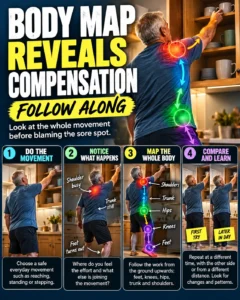
Dennis Bartram looks for three layers of information. First comes the preparation: the feet shuffle, the hand reaches, or the breath stops. Second comes the movement itself: the body leans, turns or transfers weight. Third comes the recovery: the person steadies themselves, exhales, or quickly takes another step. These three layers create a more useful map than simply deciding whether somebody completed the task. Success tells us they arrived. The route tells us how much protection accompanied them.
The First Attempt Reveals The Trusted Route
Imagine somebody standing from their usual chair. Before moving, they slide the left foot backwards and place the right hand firmly upon the armrest. The head lifts, the breath pauses, and the body rocks forwards twice. On the third movement, they rise. The task is complete, but the preparation reveals a carefully organised strategy. That strategy may still be necessary. It may be partly habitual. The first important step is to record what occurred without rushing to remove the hand or reposition the feet.
Now compare rather than correct. After resting, the person can repeat the movement from the same chair with both feet comfortably placed and their usual support available. This time, they notice whether the breath can continue and whether the rocking changes. If the movement becomes calmer without additional pain or uncertainty, the body has demonstrated some flexibility. If nothing changes, that is useful information too. Treat Protective Movement Habits as an observation to explore, not a verdict to fight.
Compare Protection With Present Capability
A simple distinction keeps this process sensible. Ask two separate questions: “What support makes this safe?” and “What preparation appears automatically?” The answers may overlap, but they are not identical. A bannister may give essential stability on the stairs. Holding the breath before touching the first step may be an automatic preparation. A chair arm may be really needed for standing. Tightening the shoulders several seconds beforehand may add effort without adding useful support.
This is the protection-capability comparison. Protection includes the actions the individual uses to feel secure: gripping, bracing, shortening the step, widening the feet or avoiding one direction. Capability describes what becomes possible under safe, calm conditions. The aim is not to eliminate protection. It is to discover whether the amount of protection changes when the task becomes familiar, well supported and unhurried. If it does, the body may possess more movement choice than the first attempt suggested.
One useful rule is worth carrying forward: never remove support merely to test confidence. Instead, keep the safe environment and observe whether unnecessary effort can soften around it. The hand may remain upon the chair while the grip becomes lighter. The bannister may remain available while the breath continues. The person may still turn through several small steps while allowing the shoulders to relax. Safety persists in place while the body explores a less guarded version of the same movement.
Protective Movement Habits Remain Inside The Breath
Breathing offers one of the clearest clues because it changes quickly when effort or uncertainty appears. Somebody may breathe normally while sitting, then hold their breath as soon as they prepare to stand. The held breath can accompany a general stiffening through the trunk, shoulders and neck. This may make the body feel more solid, but it can also make an ordinary movement seem like a major operation requiring full departmental approval.
The answer is not to force a large theatrical breath while standing. That creates another task to manage. Instead, notice whether breathing disappears during preparation. A quiet exhale before movement may help reveal how much tension has gathered, as long as the person is comfortable and secure. If continuing to breathe makes no difference, nothing has been lost. If the shoulders settle and the movement begins with less ceremony, the breath has exposed part of the protective pattern.
Turning Shows Whether Yesterday Still Directs Today
Turning is particularly revealing because people frequently develop a trusted direction after pain or harm. A previously painful knee, hip or ankle may encourage the body to pivot away from one side. Months later, the person still turns towards the kitchen, bathroom or staircase using the same route. Their home quietly supports the habit because furniture, doorways and daily routines repeatedly invite that preferred direction.
To observe the pattern, stand somewhere secure with enough clear space and any normally required support nearby. Turn to one side at a comfortable speed, return to the starting position, then turn to the other. Count nothing at first. Notice whether one direction requires more preparation, smaller steps plus a wider route. Does your head begin turning while your feet stay behind? Does one foot pivot easily while the other appears reluctant to leave the floor?
A difference between directions does not automatically mean something is wrong. Bodies are not manufactured as matching mechanical parts. Work, sport, old injuries and ordinary habits create preferences. The significant clue is whether one direction produces extra guarding, discomfort or avoidance. When Protective Movement Habits Remain, the body may treat one turn as routine and the other as an event requiring negotiation.
Familiar Does Not Always Mean Necessary
Repeated habits can feel correct simply because they are familiar. Somebody who has turned right for several years may describe turning left as weak or unnatural. Yet unfamiliarity is not proof of incapacity. It means the movement has received less practice. The distinction prevents a serious mistake: treating every unfamiliar movement as dangerous and every familiar compensation as essential.
Dennis would not force the less familiar turn to match the preferred side. Instead, he would watch how the whole person organises it. The feet may need more space. Perhaps the eyes move late, leaving the body unsure of the destination. Perhaps the person rushes because they want the uncomfortable moment finished quickly. Slowing the preparation may reveal that the difficulty lies partly in coordination and expectation, not raw strength.
Protective Movement Habits Remain During The First Few Steps
Walking across a room can feel perfectly comfortable once you establish a rhythm. The first two or three steps often tell a different story. One foot moves quickly while the other remains beneath the body. The stride begins short, the arms stay close, and the person looks towards the floor. After several steps, the body relaxes and walking becomes more natural. The capability was present, but protection dominated the opening moments.
Notice which foot moves first and which leg stays behind to support the body. The moving foot draws attention, yet the standing leg may carry the more demanding role. If the same leg always supports the first step, leads upstairs and accepts the workload during a chair rise, a repeated preference is beginning to emerge. One isolated movement offers a clue. The same choice across three different tasks reveals a pattern worth exploring.
This is where the previous body map becomes useful. Rising, turning and walking are not separate departments. They may reveal the same trusted route wearing different clothes. The person pushes through the left hand, turns left and supports their first step on the left leg. The right side may no longer hurt, yet daily movement still protects it. Protective Movement Habits Remain because every successful task confirms that the established route still works.
Success Can Support The Detour
A compensation survives because it succeeds. The person gets out of the chair, reaches the bathroom and climbs the stairs. There is no immediate reason to question the method. Unfortunately, the successful route may place repeated demands on the side doing most of the work while the protected side has fewer opportunities to participate. The body becomes increasingly skilled at the detour and increasingly unfamiliar with the alternative.
This does not mean you must remove every compensation. Some adaptations remain necessary and useful. The decision depends upon present symptoms, safety, medical circumstances and the person’s goals. The worthwhile question is whether the protective habit still solves a current problem or merely repeats an old solution. If it continues preventing pain, instability or genuine risk, it deserves respect and professional assessment. If it appears automatically despite comfortable capability, it may be ready for calm re-examination.
Dennis Bartram Uses Evidence Before Adding Effort
Many people respond to difficult movement by demanding more strength. They purchase resistance bands, repeat chair rises or attempt longer walks. Strength can matter, but additional effort does not automatically change the route that effort takes. Somebody may complete twenty chair rises while pushing through the same arm and avoiding the same leg. They become better trained at performing the compensation.
Dennis begins by improving the information. Where are the feet? Which side receives the weight? When does the breath stop? What happens before the movement begins? Only then does added effort become meaningful. If the pattern changes when the feet feel secure, the breathing continues, and the task is slowed down, the person has learned something more useful than a repetition count. They have discovered a condition under which the body releases part of its protection.
The decision rule is simple: change the conditions before increasing the demand. Make the movement calm, supported and clear. Observe whether the guarding softens without force. If the movement becomes easier, repeat the comfortable version rather than rushing towards a harder one. If pain, instability or uncertainty increases, stop and seek appropriate guidance. Progress should expand movement choices, not prove toughness.
Protective Movement Habits Remain Until New Evidence Feels Trustworthy
The body is unlikely to abandon a successful protective strategy after one good attempt. Trust develops through repeated experiences that feel manageable. A calmer chair rise today, an easier turn tomorrow and several more even first steps later in the week may gradually provide different evidence. The change can be quiet. The grip becomes lighter. The breath continues. The person stops arranging every movement around the side that once caused concern.
That is different from pretending the first injury never happened. The protective habit deserves acknowledgement because it helped the person continue during a difficult period. However, gratitude does not require permanent employment. Once the present situation is properly assessed, the body can begin learning that an old emergency route doesn’t need to direct every ordinary journey.
Open to See This Video, And This Is What’s Already Built,
Trained & Waiting For Your First Command.####
Protective Movement Habits Remain Apprentice Task
Choose one familiar movement: rising from a firm chair, turning in a clear space or taking your first five steps. Use your normal support and do not force, stretch or deliberately correct anything. Perform the movement once at your usual speed. Notice what happens during preparation, movement and recovery. Did your feet shuffle? Did your hand grip? Was your breath interrupted? Did you lean or turn towards one preferred side?
Rest, then repeat the same movement under the same safe conditions. This time, change only one detail. Consider taking a quiet exhale, settling both feet before you begin, or giving yourself an extra moment to feel the direction of the turn. Keep any aid you need. Afterwards, write down what changed and what remained the same. Record observations rather than diagnoses.
If the second attempt feels calmer, with less pain or instability, you have found that the pattern has some flexibility. If it feels worse, stop rather than pushing for improvement. Persistent or worsening pain, sudden weakness, numbness, dizziness, repeated falls or significant walking changes require appropriate medical assessment. The task is not to defeat protection. It is to discover whether yesterday’s safety strategy still matches what your body needs today.