Connected Movement Reduces Strain When The Shoulder Shares The Job
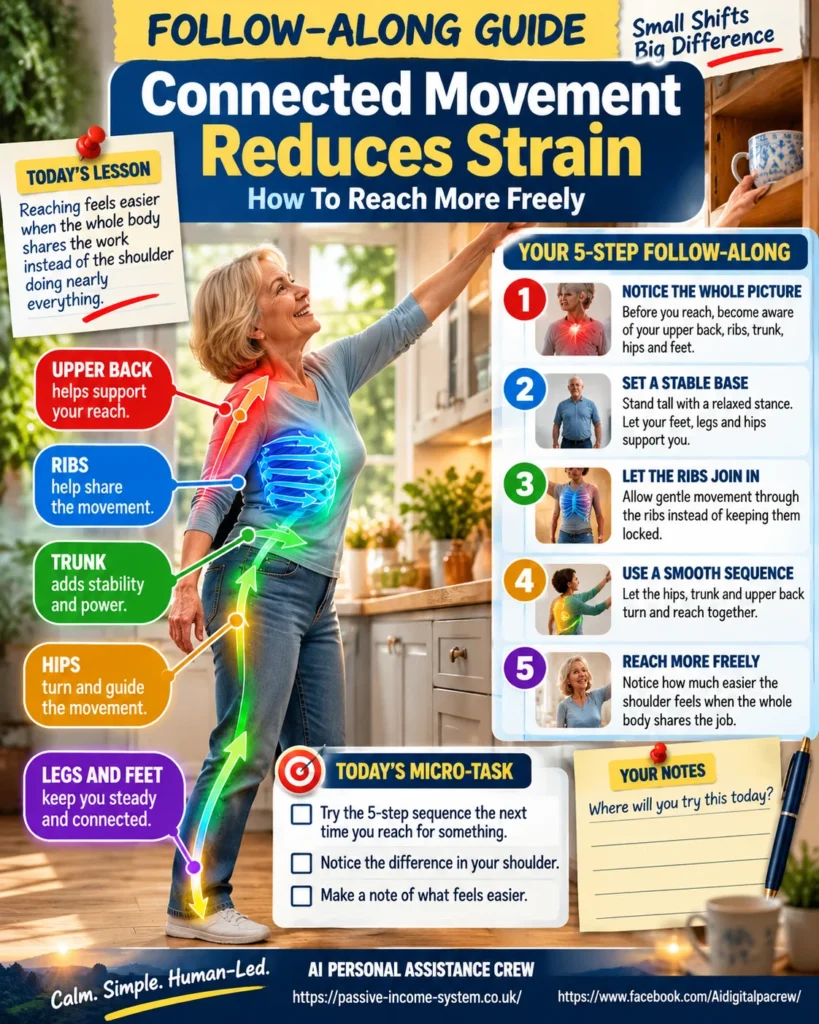
Reaching can feel very different when the whole movement contributes instead of one area doing nearly everything.
Follow The Task Before Blaming The Joint
You may notice effort in the shoulder, but your whole body often carries the movement.
Shared Work Can Look Surprisingly Quiet
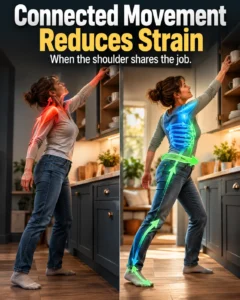
Small contributions from the ribs, upper back, trunk and stance may reduce the need for one area to dominate.
There is something odd about reaching into a kitchen cupboard. Nobody thinks much about it until the shoulder starts objecting. One minute you are reaching for a mug; the next, you are performing what looks like a minor engineering project involving the neck, one raised shoulder and a suspicious amount of effort for something that contains tea bags. Naturally, attention goes straight to the shoulder because that is where the work seems to be happening. Yet the shoulder may be the most obvious worker, not the only one meant to be involved.
That is where Connected Movement Reduces Strain becomes useful. A reach is not simply an arm swinging away from the body. The feet provide a base. The pelvis can shift. The ribs and upper back may turn. The trunk can move towards the target. Then the shoulder and arm finish the journey. If those quieter contributions reduce, the shoulder may appear to do more of the task. That does not prove anything is wrong with the shoulder. It gives us a better question to ask before we start blaming it.
Imagine two people reaching for the same mug on the same shelf. The first keeps the feet fixed, the trunk still, and the ribs almost motionless, then lifts the arm as high as possible. The shoulder rises, and the neck joins in. The second person makes a small turn, shifts weight slightly, allows the upper body to contribute, and then reaches. The hand reaches the same mug. Same destination, same kitchen, same job. The difference is how widely the work appears to be shared.
The Shoulder Should Not Be Treated Like A Solo Worker
An old tradesman would recognise this immediately. Try carrying a twelve-foot length of pipe through a narrow passage on your own, and you quickly learn that one pair of hands cannot comfortably control everything. Put another person at the far end, and the pipe hasn’t suddenly become lighter, but the job is now shared. One person guides, the other adjusts, and the whole operation becomes less dramatic. Everyday movement can sometimes be observed in much the same way.
When several body areas contribute a little, one area may not need to contribute quite so much. That does not mean every joint needs to move more. It means movement can be viewed as a shared workload. The task remains the important part. Reaching for the mug, fastening the seat belt, putting on the coat, opening the car door. The body then decides how it will solve that task on that occasion.
This distinction matters because it keeps us from turning every visible movement into a fault. A rising shoulder may simply be helping. A turning trunk may be helping. A moving foot may be helping. The question is not, “Which part looks wrong?” The question is, “Where is the work being shared, and where does it seem to become concentrated?” That is a far more useful starting point.
▶ Watch Today’s Video Connected Movement Reduces Strain Beyond The Obvious Reach
Take fastening a seat belt. At first glance, this seems like a shoulder job. The hand reaches backwards, finds the belt and pulls it across. But watch more closely, and you may see far more. Does the trunk turn? Do the ribs rotate slightly? Does one side of the pelvis shift? Does the head turn with the hand? Is the shoulder rising immediately, or only as the hand reaches the final few inches?
These details matter because they show how the movement is being organised. Suppose the person reaches for the belt while holding the trunk completely still. The shoulder may then travel farther and work harder to reach the same target. Now suppose the person naturally allows a little rotation through the body. The shoulder may still move, but the movement appears less concentrated around one area.
That observation does not tell us why the strategy changed. It certainly does not diagnose a condition. It simply reveals that the task can be solved in more than one way. Once you see that, the shoulder stops being the entire story. You begin watching how the whole movement contributes.
Shared Movement Often Hides In The Small Stuff
The biggest movement is usually the easiest to notice. A raised shoulder. A large lean. A sharp twist. Those movements attract attention because they are obvious. The quieter movements are easier to miss. A slight change through the ribs. A small shift of weight. A tiny change in foot position. A gentle turn through the upper back. Yet these smaller contributions may change how the workload is distributed.
That gives us a useful working rule: concentrated movement is easy to see; shared movement is often quieter. Once you start looking for those quieter contributions, ordinary tasks become much more informative. Reaching across a kitchen counter may look like an arm movement until you notice the feet. Putting on a coat may look like a shoulder movement until you notice the trunk. Reaching for the seat belt may look like an arm movement until you notice the ribs and pelvis.
This is why the whole job deserves attention. If you only watch what feels busy, you may miss areas quietly helping or failing to join in. The shoulder might be doing more because the task is genuinely demanding. It might be doing more because other parts of the movement are contributing less. Or the movement might be that person’s familiar strategy. Observation comes before explanation.
Do Not Correct The Shrug Before You Understand It
One of the quickest ways to lose useful information is to see a raised shoulder and immediately say, “Keep your shoulder down.” It sounds sensible. The shoulder is high, so lowering it must be better. But the instruction changes the movement before we know what the raised shoulder was doing for the task.
It seems the shrug appears only when reaching above head height. It may occur when the object is far away but not when it is close. Perhaps it disappears when the person takes a small step forwards. Perhaps the shoulder still rises no matter what changes. Each observation tells us something different. If we suppress the movement at first sight, we lose the chance to compare.
A more useful approach is to describe first. “The shoulder rises early.” “The trunk stays very still.” “The feet remain fixed.” “The hand reaches the target.” Those are observations. “The shoulder is the problem” is already a conclusion. Dennis’s observe-first philosophy matters here because good movement understanding starts with what actually happened, not what we expected.
Connected Movement Reduces Strain When The Task Is Shared
Suppose someone reaches for a plate on a high shelf. First, let them reach naturally and watch. Maybe the shoulder rises strongly, and the neck looks busy. Now move the plate slightly closer, or let the person take a small step nearer if it is safe and natural. Watch again. Does the shoulder still rise as early? Is the trunk contributing differently? Does the whole movement look less concentrated?
We are not trying to manufacture a perfect reach. We are comparing workload. The change in task gives us information. If the movement changes when the demand becomes easier, that suggests the strategy is responsive rather than fixed. If it does not change, that is useful information too. Either way, we learn more than we would by simply telling the person to keep the shoulder down.
That comparison is especially useful because it separates effort from blame. The busy area may not be doing anything wrong. It may simply be solving the problem it has been given. A shoulder reaching farther because the body is held still is not automatically faulty. It may be the part of the system willing to take on the extra work.
The Coat Sleeve Test Shows How Movement Connects
Putting on a coat is another wonderful bit of everyday movement theatre. One arm slips into the sleeve without complaint. The second can turn into a wrestling match involving a raised shoulder, a twisted elbow, a backwards lean and possibly a muttered word that would not normally appear in a health article. Yet the temptation is still to blame the shoulder.
Watch the whole task instead. Does the person turn through the trunk? Do the ribs move with the reach? Does the stance change? Do they lean away from the sleeve? Does the shoulder lift before the hand has even found the opening? Does the other hand pull the coat into position? Suddenly the “shoulder problem” looks more like a complete movement strategy.
That is valuable because it gives us something to compare. When a person wears a looser coat, does the movement change? If the sleeve is positioned differently, does the shoulder still rise as early? If they stand rather than sit, does the strategy alter? None of these comparisons proves cause. They reveal how the workload shifts when the job changes.
Shared Work Does Not Mean More Movement Everywhere
Don’t turn this into another rigid rule. Connected movement does not mean every body part must move every time. A highly efficient approach may involve very little trunk movement. An individual may prefer a stable base. Sometimes the shoulder may genuinely need to do most of the task. The point is not to prescribe more movement everywhere.
The point is to notice whether the task appears concentrated in one area or distributed across several. That distinction is much more useful than deciding that more movement is always better. Good observation leaves room for context. A short reach is different from a long reach. A heavy object is different from an empty cup. A seated task differs from a standing one. The movement strategy may change because the task changes.
So the practical rule becomes: watch the job first, then watch where the workload goes. If one area appears to be doing nearly everything, look at what the rest of the body is contributing before trying to change the busy area. That single habit can make ordinary movement far easier to understand.
Connected Movement Reduces Strain By Sharing The Workload
You may notice the effort in your shoulder, but it is rarely the only place worth watching. The feet, pelvis, ribs, upper back, trunk and arms can all influence how a reach is organised. When some contribute less, another may appear to contribute more. When the job is shared, the movement often looks quieter and less dramatic.
That does not mean quieter is automatically better. It means quieter may reveal a more distributed strategy. Once you start watching movement that way, the question shifts from “What is wrong with the shoulder?” to something far more useful: “How is the whole person completing this reach?”
That question keeps us curious. It keeps us from blaming the loudest body part too quickly. And it reminds us of something simple that everyday movement shows again and again.
The shoulder may finish the reach, but it should not automatically be expected to do the whole job.
Connected Movement Reduces Strain When The Sequence Changes
Another layer is worth watching, and it often shows up before the shoulder itself becomes obviously busy. That is the sequence. Two people can reach the same shelf, touch the same object and finish in almost the same position, yet arrive there through completely different routes. One may shift through the feet, turn through the ribs and let the arm follow. Another may lock the body early, lift the shoulder first, then drag the rest of the reach out with the arm. Same finish. Different journey.
This is why the starting order can be more revealing than the final position. Ask a simple question: what moves first? Is the hand leading everything? The shoulder rises prior to the ribs turning. Does the trunk move only after the arm runs out of room? Or does the whole task begin with a small change through stance and body position before the arm joins in? You do not need a slow-motion camera to notice this. Ordinary observation is often enough.
That sequence matters because movement is not just about which parts participate. It is also about when they participate. A region can technically join the task and still arrive late. By then, another area may already have taken most of the workload. That doesn’t explain why the sequence developed, but it gives you something much more useful than a static picture.
The First Movement Often Tells The Story
Watch someone reach behind for a coat hanging on the back of a chair. The hand begins to travel backwards. If the shoulder lifts immediately while the trunk stays almost completely still, the strategy looks concentrated from the start. If the ribs begin to turn, the person shifts slightly through the feet and the arm follows the movement; the job appears more distributed.
Again, neither pattern deserves an instant label of right or wrong. The practical value lies in comparison. Is the same first movement repeated each time? When the coat is moved closer, does it change? Does it change when the person stands rather than sits? Does it change when they know exactly where the sleeve is? These small variations reveal whether the movement strategy is flexible or stubbornly repeated.
That gives us another useful rule: the first adjustment often reveals where the body expects the workload to go. A hand that braces early, a shoulder that rises early, or a foot that shifts early may all clue you into the strategy. They are not verdicts. They show where the body appears to start solving the job.
Connected Movement Reduces Strain Through Better Positioning
Sometimes the easiest way to alter a movement is not to tell the body how to move at all. Instead, change the task slightly. Move closer to the cupboard. Turn the chair a little. Bring the object nearer. Alter the starting position. These changes can reveal whether the extra shoulder work belonged to the movement itself or to the way the job was arranged.
Imagine reaching across the passenger seat of a car for a bag. If the bag sits far away, the person may brace, lift the shoulder, twist through the neck and stretch the arm to its limit. Move the bag closer, and suddenly the whole movement looks calmer. That does not prove the original strategy was faulty. It shows that task demand can shift where effort concentrates.
This is important because people often assume the body must be corrected first. Yet sometimes the clearer lesson comes from altering the environment and seeing what changes naturally. If the shoulder works less when the reach is shorter, that is useful information. If the same pattern persists even with an easier task, that is useful too. The task becomes the test.
Support Can Help Reveal The Real Pattern
Another interesting comparison is to add support rather than remove it. We often think support makes movement less authentic, but support can sometimes make the underlying pattern easier to see. If someone reaches into a high cupboard while lightly resting the other hand on the worktop, does the trunk move more freely? Does the shoulder rise less? Does the reach become smoother?
The support has changed the demand. That gives the body a different problem to solve. Balance may have seemed uncertain previously. The person may have used the shoulder partly to stabilise themselves. Perhaps nothing changes at all. None of those possibilities should be guessed in advance. The value lies in watching what the body does when the task becomes slightly more secure.
This is another reason why removing every aid too quickly can be misleading. A hand on the worktop, a chair nearby or a stable stance may allow more of the movement to emerge. Support does not automatically mean weakness. Sometimes it simply changes the conditions enough for the person to show you a different strategy.
Connected Movement Reduces Strain When The Work Is Spread Earlier
One of the clearest patterns in everyday movement is that late sharing often looks more dramatic than early sharing. If the trunk, ribs or stance don’t contribute until the shoulder is already working hard, the extra movement may look like a sudden twist or compensation at the end. If the work is distributed earlier, the same task may look quieter from the beginning.
Think about lifting a lightweight pan from the hob and placing it onto the side. If the feet stay planted and the upper body stays fixed until the arm is fully extended, the shoulder may carry most of the journey. If the person allows a small trunk turn and shifts weight earlier, the pan travels with the body rather than being dragged away from it.
That is not an instruction to twist more. It is an observation about timing. Shared movement is often easier to see when the contribution arrives before one area is already overloaded.
The Real-Life Task Is The Best Test
Exercises can help, but everyday movement shows whether the strategy shows up when it matters. A person may move beautifully in a carefully prepared exercise and then return to old habits when putting on a coat, lifting a shopping bag or reaching for a saucepan. That is why real-life tasks are such valuable tools for observation.
The coat sleeve, the seat belt, the cupboard shelf, the car door and the washing line all have one advantage. They already belong to daily life. You don’t have to remember an artificial movement sequence. You can watch what happens naturally and compare the same task under slightly different conditions.
A useful real-life test is simple. Choose one familiar reach. Observe it once without changing anything. Then alter only one element. Move closer, change stance, add light support or change the target height. Watch again. The question is not whether the second version looks prettier. The question is whether the workload appears to become more or less shared.
Connected Movement Reduces Strain Without Chasing Perfect Posture
This distinction keeps the idea from becoming another posture rule. The aim isn’t to create one perfect reaching position and repeat it forever. Real movement changes with the task. A heavy object calls for something different from an empty mug. A high shelf calls for something different from a low drawer. A quick movement may look different from a careful one.
Good observation therefore allows variation. The question is not, “Does this person always move the same way?” The question is, “Can the strategy adapt when the demand changes?” A flexible strategy may be more interesting than one ideal-looking position.
That matters especially as people get older, because confidence can suffer when movements become too rigid or too rehearsed. If every reach requires the same setup, everyday life becomes less forgiving. Connected movement is useful because it keeps more than one part of the body available to share the task when circumstances change.
Look For What Becomes Quieter
We often look for what starts moving, but it can be just as useful to notice what becomes quieter when the task is better shared. Should the shoulder stop rising so early? Does the neck appear less involved? Does the hand stop gripping the worktop? Could the trunk move with less sudden effort?
These changes do not automatically mean the movement is better. They show that the organisation has changed. That gives you something to compare over time. It also helps reveal progress that might be missed if you only measure how far the hand reaches.
This is where connected movement begins to link back to the body-map idea we have already used elsewhere. One area quiets down while another steps in more. The workload has shifted. The difference here is that we are now watching whether that shift spreads the task across the movement rather than concentrating it into one region.
Open to See This Video, And This Is What’s Already Built, Trained & Waiting For Your First Command.
Why The Knee Hurts: 7 Whole-Body Clues Most People Miss | Dennis Bartram
Once you watch the whole task, the shoulder becomes easier to understand because it no longer carries the entire story. It remains the busiest part. The trunk or stance may appear to contribute more. Sometimes nothing obvious changes. All three outcomes are useful when they come from observation rather than assumption.
That is really the point of this rung. Connected Movement Reduces Strain is not a slogan about moving everything more. It reminds us to watch how the job is distributed. The better question is not, “How do I fix the shoulder?” It is, “How is this whole movement being organised, and where is the workload becoming concentrated?”
You can carry that question into dozens of ordinary tasks, from fastening a seat belt to hanging washing, reaching for a mug, putting on a coat or opening a cupboard. It keeps the observer curious, and curiosity is useful because it leaves room for the movement to tell you something before you rush to correct it.
Once the upper body starts to share the task more naturally, the next place worth watching is the spine itself, not as a rigid column to be held perfectly straight, but as the central route through which so many of these shared movements are organised.
Apprentice Task: Choose one normal, safe reaching task you already do, such as taking a mug from a cupboard, fastening a seat belt or putting on a coat. Perform it naturally once and notice what moves first, where the effort looks concentrated, and whether the ribs, trunk, stance or feet join the task. Then change only one simple condition, such as moving slightly closer or adjusting your starting position, and repeat the reach without forcing a correction. Compare the two attempts and ask: “Did the workload stay concentrated in the same place, or did more of the movement begin to share the job?”
Connected Movement Reduces Strain How To Reach More Freely
Spread the love
Dennis Bartram
Dennis Bartram is the Director of the Active Balance Home or on the Go System Dennis’ journey began in 1969 when he qualified in Swedish remedial massage and in 1974, he began his practice in remedial sports massage and manipulative
Health Through Integration Exercises For Daily Alignment What Health Through Integration Exercises Help You Improve Feel calmer, move easier, and think more…
Body Map Reveals Compensation Body Map Reveals Compensation Before Independence Begins To Shrink Small movement detours can quietly change what you still…


 An old tradesman would recognise this immediately. Try carrying a twelve-foot length of pipe through a narrow passage on your own, and you quickly learn that one pair of hands cannot comfortably control everything. Put another person at the far end, and the pipe hasn’t suddenly become lighter, but the job is now shared. One person guides, the other adjusts, and the whole operation becomes less dramatic. Everyday movement can sometimes be observed in much the same way.