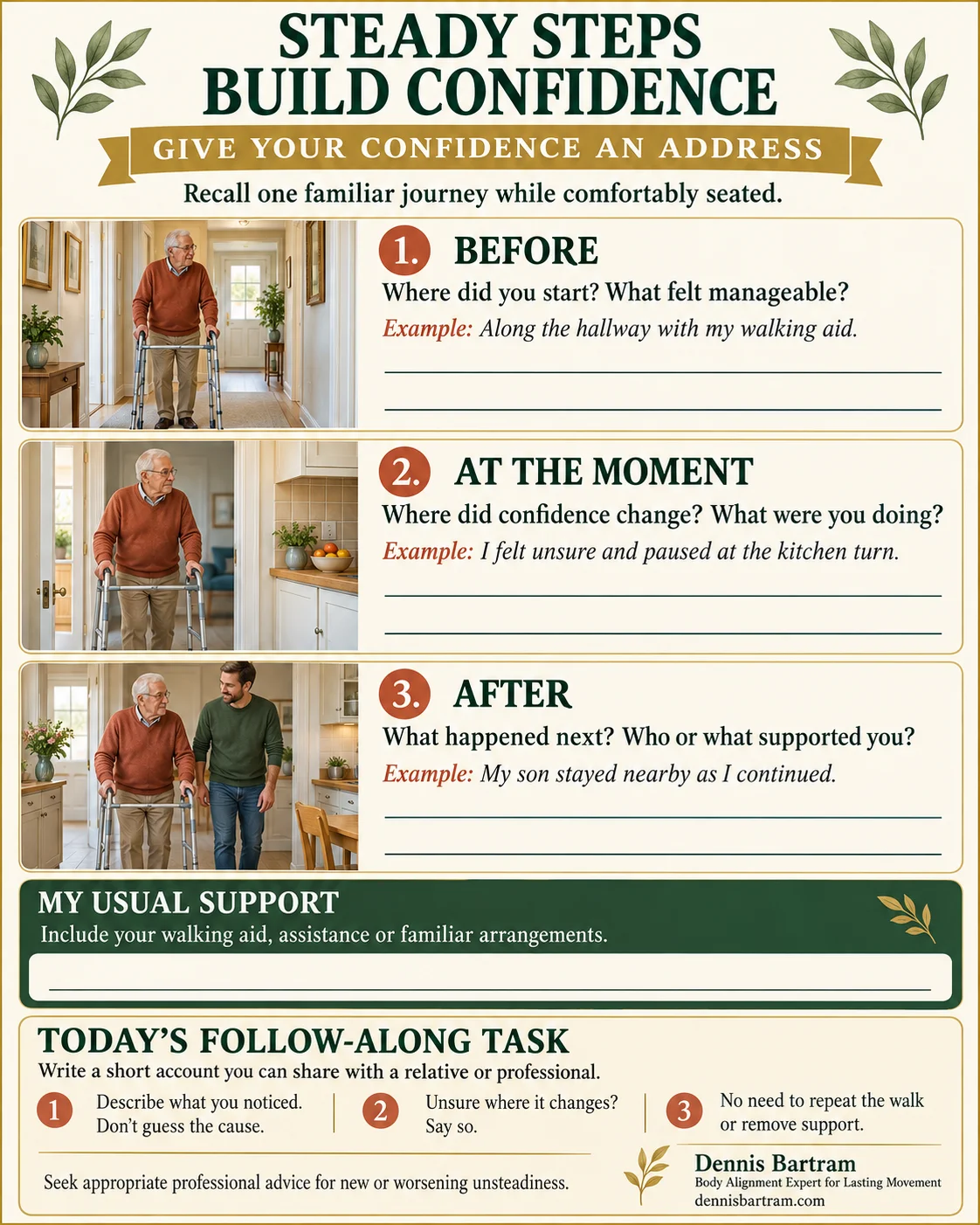
Steady Steps Build Confidence
Give Your Confidence An Address
Describe where a familiar journey begins to feel different.
Steady Steps Build Confidence Through Everyday Experience
A particular moment can tell you more than a general worry.
Name The Place, The Action And Your Usual Support
A clear description gives someone a useful starting point.
The kitchen doorway has been there for years. Nobody moved it overnight, narrowed the frame or placed it halfway up a mountain. Nevertheless, approaching it can feel different on a particular morning. The hallway seems manageable, but the turn towards the table brings a pause. Later, when somebody asks how things are going, the answer comes out as, “I’m nervous about walking.” That may be entirely honest, yet it leaves much of the experience unexplained. Steady Steps Build Confidence is our starting point for looking more closely at familiar journeys and the moments within them. Where does the uncertainty begin? What are you doing when it appears? Which support is already helping? These questions give an ordinary concern a recognisable location, without requiring you to explain what is happening inside your body or prove anything by walking the route again.
A General Worry Can Hide A Particular Moment
 “Walking feels difficult” covers a considerable amount of ground. It might refer to leaving a chair, crossing a room, changing direction or approaching somewhere to sit. However, those moments need not feel the same to the person describing them.
You may remember feeling comfortable along the hallway with your usual support, then becoming uncertain as you turn through a doorway. If the entire journey receives one broad description, that difference disappears. A relative listening to you might reasonably imagine that every part causes equal concern.
Consequently, the help they offer may begin with an incomplete picture. Describing where your experience changes gives them something more specific to understand. It also allows you to acknowledge the stretches that feel manageable while giving the uncertain moment the attention it deserves. Both belong in an honest account of your day, and neither needs to cancel out the other.
Steady Steps Build Confidence: Start With A Familiar Route
Choose a short journey you know well, such as moving from your usual chair to the kitchen table. Think about it from memory while comfortably seated. There is no need to make another trip, remove your walking aid or attempt an awkward movement so that you can produce better evidence. This task concerns how you describe an experience you already know. Picture a few familiar landmarks along the way: the chair, the end of the sofa, the hallway and the kitchen entrance. Then consider whether one place stands out. Perhaps you remember a change clearly. Perhaps the whole journey feels uncertain, or you cannot identify where the feeling begins. Those answers are useful too. The aim is to make your account more accurate, so leave room for uncertainty rather than forcing your memory to deliver a neat explanation.
Give The Concern A Place And An Action
A location becomes more informative when you include what you are doing there. “Near the chair” could mean approaching it, turning beside it or preparing to sit. Similarly, “at the kitchen doorway” leaves several possibilities open. Adding “as I change direction towards the table” gives the listener a clearer picture. You do not need technical terms for this. Ordinary words usually do the job well because they describe something another person can recognise. The important distinction is between identifying the moment and explaining its cause. A doorway may be where you notice uncertainty without being the reason for it. Therefore, keep the description close to your experience: where you were, what you were doing and what you noticed. That information can support a useful conversation while leaving the explanation open for appropriate assessment.
Steady Steps Build Confidence With Support In The Picture
Consider a fictional example. Joan tells her son that she has become nervous about walking to the kitchen. He offers to accompany her, but he pictures a difficult journey from beginning to end. Joan’s memory is more specific. With her usual walking aid, the hallway feels manageable. At the kitchen entrance, she pauses before changing direction towards the table and prefers her son to remain nearby. Once she explains this, he has a better understanding of the moment she is concerned about and the support she values. Nothing in that conversation establishes why the turn feels difficult or which response would suit her best. However, her description now contains useful detail. She can take the same account to an appropriate professional without having to arrive armed with a theory about her joints, muscles or balance.
Before, At And After Give The Moment Context
Joan can organise her account around three simple points: before, at and after. Before the doorway, she remembers moving along the hallway with her walking aid. At the entrance, she prepares to turn, pauses and feels uncertain. Afterwards, her son stays nearby as she continues towards the table. This sequence helps keep the event in order without turning it into a lengthy report. It also prevents one striking moment from swallowing everything around it. If Joan cannot remember what happened afterwards, she can say so. Missing information should remain missing until it can be clarified appropriately. A clear account does not have to be complete to be useful. Its value comes from showing what the person remembers, including the support present, while separating that knowledge from whatever they have not yet worked out.
Steady Steps Build Confidence: Describe What You Actually Notice
Feelings and actions both deserve a place in the account, although they describe different things. “I feel unsure” tells someone about your experience. “I pause before turning” describes what you do. These may happen together, as they do in Joan’s example, but one should not automatically stand in for the other. A relative might notice a pause without knowing how you feel. Equally, your worry does not reveal its physical cause. Try to keep the wording precise enough to preserve these distinctions. “I feel uncertain and pause as I turn” gives more information than a guess that a particular joint must be responsible. You are allowed to report a concern without solving it first. Indeed, leaving the explanation open gives a professional room to ask useful questions rather than having to untangle an assumption from the observation.
Keep The Comfortable Stretches In Your Account
When one moment troubles you, it can become the only part you mention. Nevertheless, the stretches you describe as comfortable help explain the pattern of your experience. Include the conditions that belong with them. “The hallway feels manageable with my usual walking aid” is more accurate than simply saying that the hallway is easy. It shows that support is part of the situation you are describing. At the same time, comfort alone cannot establish that a route is safe or that your balance has improved. Keep the account modest: this is how the journey feels to you, under the circumstances you remember. That leaves space for both confidence and concern. It avoids turning a comfortable stretch into proof that nothing needs attention, while also avoiding the conclusion that one uncertain turn defines every step you take.
A Clear Description Makes Help Easier To Discuss
Your account might now read: “I use my walking aid to go from the sitting room to the kitchen. The hallway feels comfortable, but I become unsure as I turn through the kitchen entrance. I pause there and prefer someone nearby.” This is brief enough to share and specific enough to invite relevant questions. It names the route, the change, the action and the usual support. You don’t need to repeat the journey until the description feels certain, and new or worsening unsteadiness deserves appropriate professional attention. Describing your experience should support that conversation without delaying it. For now, the useful achievement is clarity. Instead of leaving someone else to interpret a broad statement about walking, you have identified the specific moment you want them to understand and kept the rest of your experience in view.
Make Sure The Listener Pictures The Same Journey
The person listening may know your home almost as well as you do, yet still picture the wrong moment. You mention the kitchen doorway, and they immediately think of the threshold. Meanwhile, you are describing the turn after you have passed through it. Both of you are discussing the same entrance, but the concern has acquired two different addresses. This is why a little ordinary detail can be useful. You might say, “I’ve already come through the doorway when I pause. It’s the turn towards the table that concerns me.” That sentence narrows the question without claiming to answer it. You don’t need to demonstrate the movement on demand. A description from your usual chair may be enough to clarify the situation. Before discussing what might help, establish that you are both talking about the same place and action.
Steady Steps Build Confidence Through Clear Communication
Once you have described the moment, explain what you want the listener to understand. Perhaps you want a relative to know why you prefer them nearby. Perhaps you want professional advice about a change you have noticed. These requests differ, and naming yours keeps the conversation focused. “I’d like help understanding why I feel unsure at that turn” leaves the explanation open. “I’d like you to know where I start to worry” helps someone understand your experience. The phrase Steady Steps Build Confidence should never become a demand to sound positive about something that concerns you. Your account can include uncertainty, frustration or a wish for help. A useful conversation begins with what you actually experience, including the parts you cannot explain, rather than a polished version meant to reassure everyone at the kitchen table.
Separate Your Experience From Someone Else’s Observation
A family member may notice something you haven’t mentioned. They might say that you pause before entering the room, while you remember becoming uncertain after passing through the doorway. Keep both accounts identifiable rather than choosing whichever sounds more convincing. “I remember feeling unsure during the turn; my son noticed me pause before the doorway” preserves the difference. It may give a professional something useful to explore. However, neither recollection needs to become a verdict about what caused the difficulty. Memory can be incomplete, and people may be describing different occasions. The purpose is to collect an honest account, not settle a courtroom dispute about the position of your left slipper. If you disagree about the sequence, record the uncertainty. That is more useful than merging two observations into one confident story that neither person actually remembers.
Steady Steps Build Confidence With The Circumstances Included
The same location may feel different on separate occasions. Perhaps someone accompanied you on one journey, or you were carrying out a different task when you reached the doorway. Include a relevant difference if you remember it, but keep its meaning open. “I was alone that morning” records a circumstance. It does not establish why the experience changed. Likewise, a comfortable journey with company does not prove that company resolves the concern. These distinctions help prevent a small amount of information from supporting a larger conclusion than it can. You need only enough context to describe the occasion accurately. You don’t need to keep a detailed diary of every journey or search through the week for a pattern. If a change concerns you, your existing account can provide a starting point for appropriate advice.
Give Uncertainty A Place On The Page
Some readers will picture their route clearly but find no single point where confidence changes. Uncertainty may feel present from the chair to the table, or the memory may be too vague to divide into stages. Write that down. “I feel uneasy throughout this journey” describes a broad experience. “I can’t remember whether I pause before or after the doorway” identifies a gap in the sequence. Neither answer means you have done the task badly. Giving an address to your confidence is a way to clarify what you know, and sometimes the address remains a whole route. Resist the temptation to borrow the doorway example simply because it sounds tidy. Your own account, with its unfinished parts, is what can help another person understand what you want to discuss.
Steady Steps Build Confidence Without Removing Support
Your usual walking aid, assistance or established arrangement belongs within the picture from beginning to end. Leaving it out can make your account misleading, even when the omission seems minor. “I managed the hallway” tells a listener less than “I managed the hallway with my usual aid and someone nearby.” The second statement explains the circumstances in which you completed that part of the journey. There is no reason to remove support to find out whether the first statement would still apply. This task asks you to describe an experience, not create a more demanding one. Similarly, if the assistance differed between two occasions, include that difference before comparing them. The useful question is what happened with the support you actually had. Any decisions about changing that support need individual consideration, not a conclusion drawn from this written exercise.
A Short Account Can Still Contain The Important Details
Once you begin writing, it is surprisingly easy to produce a report long enough to require its own biscuit break. Bring it back to the familiar journey and the moment you want understood. Name where you start and finish, where your experience changes, what you feel or do there, and the support involved. Leave out details that do not help explain those points. Joan’s account, for example, needs the hallway, the kitchen entrance, the turn and her usual aid. It does not need the dining table’s history. Brevity serves a practical purpose: another person can grasp the concern without searching through a long account. If they need more information, the description gives them a clear place to ask. Your first statement only needs to open the right conversation.
Steady Steps Build Confidence Is No Reason To Dismiss A Concern
Feeling more able to explain an experience is worthwhile, but it is different from establishing that the movement itself has changed. A clearer account does not show that balance has improved, a cause has been identified, or a difficulty has been resolved. Keep those conclusions separate. You may finish this exercise with the same concern, but better words to describe it. That is still useful when speaking with a family member or an appropriate professional. New or worsening unsteadiness warrants professional attention, and preparing notes should not delay seeking help. Nor should you use a comfortable stretch to dismiss a difficult moment elsewhere. Both can appear in the same honest account. The goal is to make the concern understandable while preserving the limits of what you know from your own observations and recollections.
Open to See This Video, And This Is What’s Already Built,
Trained & Waiting For Your First Command.
Steady Steps Build Confidence Apprentice Task
While comfortably seated, choose one short journey you already know. Write its beginning and ending, then recall the main landmarks between them. Describe what you remember before, at and after any point where your confidence changes. Add the action taking place, such as approaching a seat or changing direction, and include your usual support. Keep feelings and actions clear: “I feel unsure” and “I pause” can both belong in the account. If no particular moment stands out, say so. Finally, turn your notes into a few sentences you could share with the appropriate person. Read them once and remove any diagnosis or explanation you have assumed. You don’t need to walk the route again for this task. Finish when the account reflects what you remember, including anything that remains uncertain.
A familiar journey contains more detail than the sentence “I’m nervous about walking” can convey. Naming the place, action and support gives another person a clearer starting point. Your uncertainty can remain part of that description. Give the concern an address, then use it to begin a useful conversation.