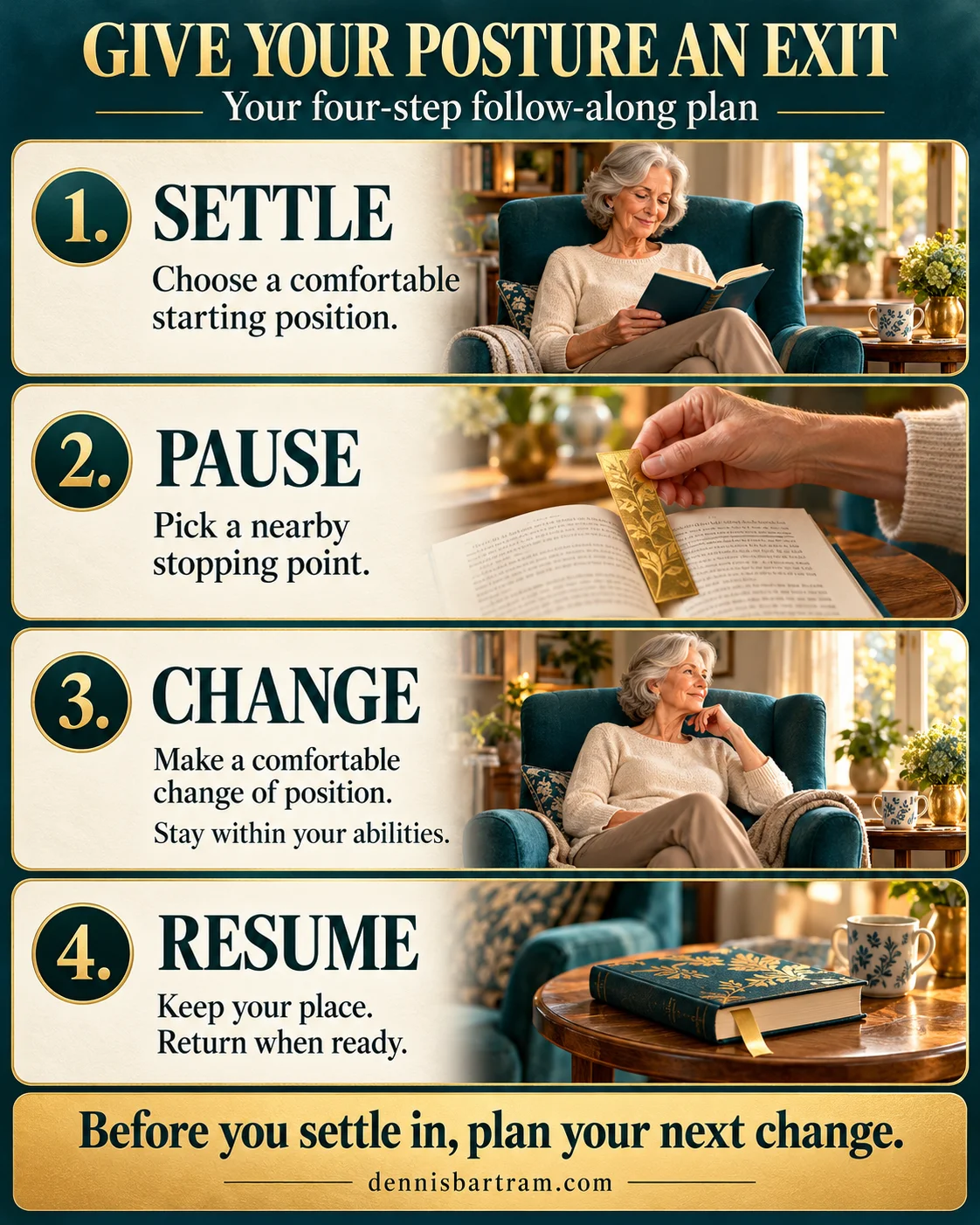
Posture Correction Daily Habits: Your Best Posture Needs an Exit
Comfortable sitting begins with support and a simple plan to change position.
Give Your Favourite Chair a Stopping Point
Use everyday pauses to make a suitable change while reading, watching television or using a tablet.
Settle Comfortably, Pause and Move Within Your Abilities
Choose one manageable change, keep your place and return when you’re ready.
Comfortable Sitting Starts With a Way to Change
Everyday pauses can help you build movement into reading, television and computer time.
Give Your Favourite Chair a Stopping Point
Choose a comfortable beginning, a nearby pause and a simple way to carry on afterwards.
The kettle has clicked off, the breakfast things are cleared, and the detective novel has reached the bit where everybody looks guilty. You settle into your favourite chair. Then a familiar voice arrives from somewhere in your childhood: “Sit up straight.” Up comes the chest. Back go the shoulders. Suddenly, a peaceful morning resembles an inspection parade. For anyone exploring posture-correction habits, that scene raises a useful question. You’ve decided how you ought to sit, but have you decided when you’ll change position? Those are two separate choices, although we often treat the first as the whole job. A comfortable starting position deserves attention. So does the opportunity to leave it. Otherwise, we can spend an entire reading session checking our shoulders while forgetting to put the book down.
Posture Correction Daily Habits Need More Than a Starting Position
“Sit properly” misses several details. Properly for reading a paperback, using a tablet or talking to the person beside you? With your arms supported, or holding a heavy book in the air? For a few moments, or until lunchtime? Without those details, the instruction can become a demand to hold a shape, no matter what you’re doing.
A small, comfortable change is still progress. Give yourself permission to pause, move in your own way and carry on at your own pace.
However, ordinary life involves reaching, turning, pausing and starting again. Your sitting arrangement needs to allow for those moments. Think of it as setting up a job: you consider the task, the support available and what happens when you need to move. The useful question is, “Does this arrangement let me do what I came here to do, and change comfortably when I need to?” That gives you something practical to assess.
“You don’t have to turn every pause into a test. Take a comfortable moment for yourself, then return to something you enjoy.
There’s a useful distinction between support and stillness. A chair back can support you while you read. A cushion or suitable surface might help support the book. Neither arrangement requires you to remain exactly as you were when you opened the first page. Yet it’s easy to confuse feeling well supported with having the whole session sorted. Britain’s Health and Safety Executive includes breaks and changes of activity in its screen-work guidance, with opportunities to move around or change posture. That advice considers how the activity unfolds and where it happens. At home, the same planning question is useful: what happens after you’ve settled? A comfortable chair gives you a starting point. Your routine determines whether there are opportunities to change. Both deserve a place in the plan, whether you’re answering emails or enjoying the sports pages. www.hse.gov.uk
Margaret’s Book Has an Ending. Her Sitting Needs One Too.
Imagine Margaret, a retired reader who likes an hour with a detective novel after breakfast. She’s decided to pay more attention to her posture, so she begins with her shoulders pulled back and checks them whenever she remembers. Unfortunately, the author holds her attention better than her new rule. Another suspect appears, another chapter begins, and her posture checks disappear into the plot. When she remembers them, she feels she’s let herself down. But look closely at the job she’s given herself. Success means remembering to supervise her shoulders throughout an absorbing activity. No planned pause, no clear stopping point and no decision about changing position. Her rule demands attention without organising the session. Before she blames her memory or discipline, she could give herself a task with a clearer beginning and end.
Posture Correction Daily Habits: Plan Your Reading Pause
Now imagine Margaret trying a different arrangement. She settles comfortably, supports her book and chooses a nearby place to pause. At that point, she’ll put in the bookmark, set the book aside and take a short walk into the kitchen, which is comfortable and safe for her in this example. Afterwards, she can return to the story. Nothing here promises to correct a condition or remove pain. The improvement is that her plan now describes something she can actually do. The bookmark has a practical role because it protects her place. She doesn’t have to finish the mystery before leaving the chair. She also doesn’t have to remember the last sentence while doing something else. Making an activity easy to resume can make pausing feel less troublesome. The story will still be waiting when she comes back.
Posture Correction Daily Habits: Make Returning Easy
This gives us a simple test for posture correction daily habits: can you describe the next change before you settle in? “I’ll try to move more” leaves several decisions waiting. You still have to notice the moment, decide what to do and work out how to stop your current task. By comparison, “At the next short section break, I’ll mark my page, put the book down and walk into the kitchen” settles those decisions beforehand. The action must suit your circumstances, of course. Someone who needs to remain seated may choose a comfortable change in their chair, following any guidance they’ve received. The principle is about creating a usable opportunity for variation. Standing isn’t a compulsory pass mark, and copying someone else’s movement isn’t the goal. Your plan should fit the person who has to use it.
Choose a Pause That Actually Arrives
A stopping point is only useful if it turns up. “At the end of the chapter” sounds sensible until the chapter runs on for another forty pages. Similarly, a television programme may lead straight into the next episode, while an online video hands you another before you’ve considered stopping. So focus on the activity you actually do, not the tidy version you imagine. A shorter section, the end of a brief call or a reminder may provide a more workable opportunity. You don’t need to turn reading into a clock-watching competition. However, you do need a boundary that won’t keep the activity moving further away. If your chosen pause repeatedly fails to arrive, adjust the plan. That tells you the stopping point wasn’t useful; it doesn’t establish that you’re careless, lazy or incapable of forming a habit.
Before You Sit Down, Know What Happens Next
For now, choose one familiar activity rather than reorganising your whole day. It might be reading after breakfast, checking messages at the kitchen table or watching the evening news. Notice how you begin, where a pause could fit and what comfortable change would be suitable. Also consider how you’ll return to the task, because an unfinished email or a lost page can make stopping feel inconvenient. Keep the experiment modest enough to use today. You aren’t assessing your entire posture, and you aren’t trying to diagnose the cause of discomfort. You’re giving one part of your routine a clear opportunity to change. Before you settle in, decide how you’ll change position. Once you’ve done that, another question becomes easier to spot: does your usual “break” change what your body is doing, or only what you’re looking at?
Posture Correction Daily Habits: Does Your Break Change Anything?
The book closes, the phone comes out, and we tell ourselves we’ve had a break. Certainly, the detective has been given the afternoon off. But what has changed physically? Perhaps we’re still in the same chair, looking down and holding something in front of us. The entertainment has changed more than the position. This distinction matters when building daily posture-correction habits because the word “break” can mean several different things. A break from concentrating isn’t necessarily a change of position. A change of position doesn’t always mean leaving the room. Instead of judging the pause by what you’ve stopped reading or watching, ask what you’re doing differently. Have you put the object down, adjusted your sitting position or moved somewhere else? That question makes the pause’s purpose easier to understand and the action easier to choose.
Standing Up Doesn’t Have to Become Another Inspection Parade
You can carry the same rigid thinking out of the chair. We stand, pull ourselves into what we imagine is the correct shape and begin another round of shoulder supervision. However, our planned exit aims to make a suitable change, not replace one holding exercise with another. For someone who walks comfortably, an ordinary short trip across the room may fit the moment. For someone who needs to stay seated, a comfortable adjustment may be more appropriate. Follow any movement restrictions or individual advice you’ve been given, and don’t force a position because it looks better in a photograph. Margaret’s walk to the kitchen belongs to Margaret’s imagined circumstances. Your version should belong to yours. The useful measure is whether the action is suitable, practical and easy to include, rather than whether it resembles somebody else’s routine.
Posture Correction Daily Habits Should Survive an Ordinary Afternoon
A plan can look splendid over breakfast and vanish by three o’clock. The telephone rings, a visitor arrives, or the television serves up something unexpectedly interesting. Consequently, a useful routine needs a way back after a missed opportunity. Suppose Margaret reaches her chosen stopping point but carries on because the detective is about to open the locked drawer. Ten pages later, she remembers. There’s no need to punish herself by holding an exaggerated pose or taking an extra-long break to make up for it. She can mark her place and change at the next suitable opportunity. Posture-correction habits become unnecessarily burdensome when every missed pause creates a debt. Treat the missed moment as information. Was the stopping point difficult to notice? Was the action inconvenient? Or was this simply an absorbing afternoon? Each answer suggests a modest adjustment.
Make the Return as Easy as the Exit
One overlooked obstacle is the fear of losing your place. That might mean a literal page in a book, but it can also mean a train of thought. Someone writing an email may resist stopping because they’ve finally worked out what to say. A crossword enthusiast may be halfway through a stubborn clue. Before pausing, leave yourself a small route back: save the draft, jot down the next point or place a pencil beside the clue. These actions don’t change your posture on their own. Their job is to make stopping less disruptive. Consider the difference between abandoning an unfinished task and leaving it ready to continue. The second arrangement gives you less to reconstruct afterwards. You can use that distinction without buying equipment, installing an app or complicating your day. Sometimes practical preparation for movement means making the current activity easier to leave.
Give Your Posture Correction Daily Habits a Fair Review
After trying your plan, check whether it worked. Did you notice the stopping point? Could you set the task aside? Was the chosen change comfortable and manageable? Those questions come before any grand verdict about your posture. If the answer is no, identify the specific difficulty. Perhaps the bookmark was across the room, the reminder arrived halfway through a call, or your chosen activity had no reliable ending. Adjust that part rather than rebuilding everything. For example, Margaret might replace “finish the chapter” with a nearer section break because her author clearly gets paid by the complication. That is a practical revision, not a failed experiment. The purpose of reviewing posture correction daily habits is to make them usable in your actual home and routine. Beautifully worded instructions earn little if they never turn into action.
Notice Comfort Without Turning It Into a Diagnosis
You may also notice how the activity feels, but keep that observation separate from a medical conclusion. “Reading felt easier this afternoon” describes an experience. “This has corrected the cause of my pain” makes a claim that the experience alone cannot establish. Similarly, an uncomfortable day doesn’t prove you’ve chosen the wrong chair or sat incorrectly. This exercise helps you organise opportunities for suitable position changes. It isn’t a test that identifies an injury or explains every symptom. If discomfort persists or worsens, seek appropriate assessment rather than repeatedly forcing yourself into a supposedly ideal shape.
Meanwhile, keep your notes simple: what you were doing, whether you used the planned pause, and anything relevant you noticed. There’s no need to award yourself a posture score. Clear observations are more useful than confident guesses about what they mean.
Your Apprentice Task: Give One Activity an Exit
Choose the seated activity you’re most likely to do today. Keep it specific: “reading after breakfast” is easier to work with than “being better with my posture.” Then complete one sentence: “When I reach this stopping point, I’ll make this suitable change, and I’ll leave my task ready to resume like this.” Fill it with something you can actually picture. For Margaret, that means marking her page at a nearby section break, putting the book down and taking her comfortable walk into the kitchen. Your action may be different. Before you begin, make sure the starting arrangement is comfortable enough for the task, and the planned change fits your abilities. Afterwards, check whether the pause happened and whether anything made it awkward. If necessary, change that one detail. Today’s job is to create a usable opportunity, then learn whether your arrangement supports it.
Let AI Help You Put the Plan Into Words
If choosing the stopping point is the fiddly part, use the reader-facing AI prompt accompanying this post. Describe one activity, where you do it, what keeps you there and any movement limits or guidance you already follow. The AI’s useful job is to help organise those details into a simple plan. Check its suggestions against your circumstances before using them, especially if they assume you can stand or walk comfortably. You still know whether the proposed action fits your day. For example, you may need to adjust a suggestion to pause at the end of a programme if you usually watch long films. You may need to change a suggestion to walk elsewhere if that isn’t suitable for you. The value lies in making the next action clear enough to remember, with a practical stopping point and an easy return to what you enjoy.
Posture Correction Daily Habits Begin With One Usable Change
A comfortable starting position and a clear way to stop should be part of the same plan. Build your posture correction daily habits around one familiar activity, then check whether the planned change is suitable and easy to use. Adjust the stopping point when necessary, without turning a missed pause into a failure. Before you open the book, pick up the tablet or settle down for the programme, ask: “Where is my next comfortable opportunity to change position?”
Open to See Buying Book Options: “Body Alignment Fix Your Pain”:Link.
How Did I Recover from Injury Without Medication? 💪✨
Posture Correction Daily Habits: Your Best Posture Needs an Exit. Small position changes should go hand in hand with a comfortable place to sit.
Posture Correction Daily Habits Your Awesome Hidden Secrets
Spread the love
Dennis Bartram
Dennis Bartram is the Director of the Active Balance Home or on the Go System Dennis’ journey began in 1969 when he qualified in Swedish remedial massage and in 1974, he began his practice in remedial sports massage and manipulative
Whole Body Tensegrity Alignment Matters After Fifty Gentle Practice Within Whole Body Tensegrity Alignment Why Whole Body Tensegrity Alignment Matters After Fifty…

 “Sit properly” misses several details. Properly for reading a paperback, using a tablet or talking to the person beside you? With your arms supported, or holding a heavy book in the air? For a few moments, or until lunchtime? Without those details, the instruction can become a demand to hold a shape, no matter what you’re doing.