
Daily Maintenance Restores Freedom
Daily Maintenance Restores Freedom Through Small Everyday Checks
Ordinary movement can tell you a great deal before everyday tasks start feeling unusually difficult.
Notice The Change Before It Becomes The Story
A small difference in effort, support or timing can be useful information without becoming a diagnosis.
Keep The Movements You Value Ordinary
The best maintenance often protects the everyday things you would rather never have to think about.
Most of us are wonderfully good at ignoring something while it keeps working. The boiler fires up, the car starts, the kettle boils, and the knees get us out of the chair, so nothing seems worth discussing. Then one morning the chair needs an extra push from the armrest, the first stair feels oddly deliberate, or reaching for the cereal suddenly involves a shoulder manoeuvre usually associated with putting on a winter coat in a phone box. Nothing dramatic has happened. Something has become a little less ordinary.
That is where Daily Maintenance Restores Freedom begins to make sense. Maintenance does not have to mean waiting until movement becomes difficult and then launching a grand recovery campaign. It can be much quieter. Standing, turning, reaching, walking and stepping are already woven through the day. Paying attention to how those familiar tasks behave gives you a simple way to notice when the strategy starts changing, before it grows large enough to demand your attention.
The important word is notice. A small difference does not automatically mean something is wrong. Maybe you slept poorly. Perhaps yesterday involved three hours in the garden because one innocent weed somehow turned into a territorial dispute. Perhaps you sat too long watching television. The purpose of a daily check is not to turn every difference into a problem. It is to give today’s movement something sensible to compare with.
Riley’s Wisdom Drop: “Maintenance is not hunting for what’s wrong. It’s noticing when ordinary starts becoming unusual.”
The Best Movement Checks Are Already In Your Day
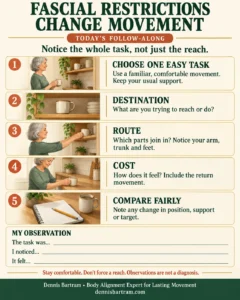 You do not need a special testing room, a clipboard or enough gym equipment to frighten the grandchildren. The most useful checkpoints are often the things you already do without thinking. Your usual kitchen chair can tell you something. So can the first stair. The cupboard where the mugs live. The garden step. The turn you make when reversing the car. Because these movements are familiar, they give you something extremely valuable: a personal reference point.
Suppose you rise from the same chair most mornings. Usually, your feet settle, your body comes forward, and you stand. One morning the right hand goes to the table. That is worth noticing. Don’t panic; just notice. The next morning, does the hand appear again? Is it limited to first thing? Does it disappear after walking around for a few minutes? Does the left hand ever join in? Suddenly you have information rather than a vague feeling that “something seems different.”
This is one of Dennis’s most useful movement principles in action: describe what happened before explaining why. “I used the table when I stood up” is an observation. “My leg has become weak” explains it, but perhaps inaccurately. Many things may have changed the strategy. A daily maintenance check does not need to solve that puzzle. Its first job is to tell you when familiar movement behaves differently.
Daily Maintenance Restores Freedom By Comparing You With You
Comparing how you stand from a chair with the chap next door, your twenty-year-old grandson, or someone demonstrating exercises on the internet while wearing clothing that appears to have been sprayed on has no particular value. Their movement is theirs. The useful comparison is much closer to home. Does your familiar chair feel any different today compared to yesterday? How does your first stair compare with last week? How does the same cupboard reach behave when you are fresh compared with later in the day?
That gives maintenance a calm purpose. You are not chasing perfect posture or trying to perform every movement according to somebody else’s ideal. You are building a picture of what normal currently looks like for you. When the same task starts to require extra support, more hesitation, a larger adjustment or noticeably more effort, you have something worth watching. One unusual moment may mean very little. Repeated change becomes a pattern.
That distinction matters: a single change is an observation; repeated change becomes a pattern. It prevents both extremes. You don’t need to worry because one stair felt awkward this morning, but you also don’t need to ignore a movement that has been changing in the same direction for several weeks. Daily observation gives those small changes somewhere to sit.
Watch Effort As Well As Distance
People often judge movement by whether the job can still be completed. Can I reach the shelf? May I climb the stairs? Can I get out of the chair? If the answer is yes, everything appears unchanged. But success can hide a changing strategy. One can still reach the shelf while lifting the shoulder higher. One may still climb the stairs while pulling harder on the bannister. Still, you may stand from the chair but only after rocking forward twice.
So instead of asking only, “Can I still do it?” add a second question: “How am I doing it today?” That question catches information that distance alone misses. The mug still arrives in your hand, but perhaps the trunk stays unusually still, and the shoulder does more. You still climb the stairs, but perhaps the hand on the bannister shifts from guidance to proper hauling. The job succeeds, yet the workload has been reorganised.
Again, this does not prove what caused the change. It simply makes the change visible. That is maintenance’s proper job. A mechanic hears a new noise before deciding which component is responsible. A heating engineer notices that one radiator is behaving differently before condemning the boiler. Movement deserves the same patience. Observe the system first. Explain it later, if explanation is even needed.
Riley’s Wisdom Drop: “Freedom is often protected by noticing the extra effort before the extra effort becomes normal.”
Daily Maintenance Restores Freedom Without Turning Life Into A Test
There is an obvious danger here. Once people start observing movement, they can become too enthusiastic and turn breakfast into a physical examination. How did I stand? How many degrees did I turn? Was that step different? What did the left elbow do at 8:17? That is not the aim. Maintenance should make ordinary life easier to understand, not make somebody frightened to move without taking notes.
The answer is to keep the checks few and familiar. Choose two or three movements that matter to your daily independence. Perhaps standing from the kitchen chair, stepping onto the first stair and reaching for something from a regular shelf. Let those become your reference points. You do not need to analyse them every time. One calm observation is enough. Was the movement familiar? Did it need more support? Did the way you completed it change?
This keeps the process grounded because the task itself remains ordinary. You are still making tea, going upstairs or reaching for a plate. You’re not performing the movement for an audience. That matters. The minute somebody knows they are “testing” themselves, they often stand differently, concentrate harder and suddenly demonstrate a version of the movement that bears very little resemblance to what happens when the phone rings and they get out of the chair without thinking.
What Changes First Is Often Small
Large movement changes are easy to notice. Small ones are where maintenance earns its keep. A hand that did not previously join the movement. A pause before the first step. A shorter turn. A foot repositioned twice instead of once. An extra lean. A heavier grip on the worktop. None of these proves deterioration, and any one of them may be completely unimportant on its own. The useful question is whether the change keeps showing up.
Think of your favourite pair of shoes. One day the sole looks slightly more worn on one side. You might shrug and carry on. Six weeks later, the same area is wearing much faster than the rest. Now you have a pattern. Observing movement works much the same way. Daily checks create enough repeated glimpses to distinguish a one-off awkward moment from something that appears to be becoming the new strategy.
That is why Daily Maintenance Restores Freedom is less about fixing and more about preserving awareness. If you know what your ordinary movement normally looks and feels like, change becomes easier to recognise. Recognising change early gives you more useful information than waiting until the movement becomes so difficult that you can’t remember the original pattern.
Maintenance Should Also Notice What Is Going Well
Another side of this often gets forgotten. A daily check should not become a search party for decline. It can also reveal the small improvements that ordinary life hides. You stood without reaching for the table. The first stair felt more automatic. Perhaps the shoulder stayed quieter during the cupboard reach. Perhaps your morning stiffness settled sooner than usual.
Those changes matter because progress is often subtle long before it becomes impressive. If you are only looking for faults, you can miss evidence that movement is becoming more familiar, smoother or less demanding. Maintenance therefore works in both directions. It shows you where extra effort is appearing and where effort may be reducing.
And that gives the whole idea a more useful tone. The body is not a machine waiting to fail. It is a moving system worth paying attention to. Some days will be better. Some will feel slower. The aim is not perfection. The aim is familiarity, comparison and enough awareness to notice when something ordinary starts quietly changing.
Daily Maintenance Restores Freedom When Patterns Become Visible
Once you have watched the same few movements for several days, something else useful happens. The movement stops being a collection of isolated moments and starts becoming a pattern. The chair feels notably harder first thing in the morning. The stairs are easier after you have been moving for a while. The cupboard reach feels different when you are tired. None of those observations automatically explains the reason, but together they begin to show you when ordinary movement changes and under what conditions.
This is where daily maintenance becomes more valuable than an occasional check. One observation can mislead. A week of similar observations gives context. If the same movement keeps asking for extra support, thought or effort, that pattern deserves more attention than one awkward morning. Equally, if the movement varies and then settles again, that tells you something different. The point is not to produce a diagnosis. The point is to stop treating every movement as if it appeared out of nowhere.
A simple rule helps here: patterns are more useful than isolated moments. The body changes from day to day. Sleep, activity, fatigue, weather, long periods of sitting and a hundred ordinary things may influence how movement feels. Daily checks give you enough repeated information to see whether a change is passing through or becoming part of the regular strategy.
Do Not Turn Maintenance Into A Daily Examination
A fine line separates useful observation from becoming so interested in every movement that you forget to live your life. The goal is not to inspect yourself from head to toe before breakfast. Maintenance should reduce uncertainty, not create more. If you are constantly asking whether every movement is right, wrong, better or worse, the routine has become heavier than the problem it was meant to simplify.
That is why three checkpoints are usually plenty. Choose movements that matter to you and happen naturally. The same chair. The same first stair. The same reach. Then keep the questions simple. Did it feel familiar? Did it take more effort or require more support? Did the strategy change? You do not need ten measurements. You need enough information to recognise when ordinary has become noticeably different.
This keeps maintenance in its proper place. You are not training for a movement exam. You are staying familiar with yourself. As soon as the process gets complicated, people stop doing it or get anxious about the results. The best system fits quietly into normal life and still gives you useful information.
Daily Maintenance Restores Freedom By Protecting Familiar Tasks
Freedom is often talked about as though it means doing something spectacular. Climbing mountains. Running marathons. Performing movements that would make the average retiree’s hamstrings send a formal letter of complaint. But everyday freedom is usually much more ordinary. It is being able to get dressed without thinking about it. Walk to the shops. Use the stairs. Reach a cupboard. Turn in the car. Get out of bed. Stand from a chair.
These tasks are so familiar that we barely notice them while they remain easy. That’s why they deserve maintenance. If a movement matters to your independence, it is worth watching while it still feels ordinary. You don’t have to wait for it to become a problem before paying attention.
This gives us another strong working rule: maintain the movements you want to keep ordinary. That is more useful than chasing perfect posture or collecting exercises for their own sake. Maintenance isn’t meant to impress anyone. It protects access to the ordinary parts of life that quietly matter every day.
Small Adjustments Can Be More Useful Than Big Corrections
Suppose your usual kitchen-chair stand has begun needing a little more help from the table. The temptation is to make a big correction. Change foot position. Remove the hand. Stand faster. Stand slower. Add exercises. Suddenly, a simple observation has become a home improvement project.
A calmer approach is to change one small thing, if it is safe and appropriate, and compare. Perhaps move the chair slightly. Maybe place the feet where they feel naturally secure. Perhaps try the same task after a short walk. Then observe whether anything changes. You are not trying to force improvement. You are trying to see whether the movement strategy responds to a different condition.
This matters because big corrections can hide useful information. If you change five things at once, you no longer know what altered the movement. One small change makes comparison clearer. The aim is understanding, not performance.
Daily Maintenance Restores Freedom Without Chasing Perfect Movement
Perfect movement is a poor maintenance target because everyday movement is supposed to adapt. You don’t get out of a low sofa the same way you rise from a dining chair. You don’t reach for a heavy pan the same way you reach for an empty mug. You don’t climb the stairs carrying shopping the same way you do with both hands free. Different jobs create different strategies.
That means maintenance should not ask, “Did I move perfectly?” It should ask, “Did this movement behave roughly as I would expect for this task?” A change may be perfectly sensible because the demand changed. The useful observation is whether the strategy fits the job and whether it still feels familiar to you.
This removes a great deal of unnecessary pressure. You do not need one ideal way to stand, bend, reach or turn. You need enough awareness to notice when a familiar task starts asking for something noticeably different.
One Awkward Day Is Not The Whole Story
This is where daily maintenance can protect both confidence and freedom. Without context, one difficult morning can feel bigger than it is. You stand from the chair awkwardly and think, “There we are, everything is getting worse.” Yet yesterday may have been fine, and tomorrow may be fine again.
Routine gives that awkward morning somewhere sensible to sit. It becomes one observation among several, not the final verdict. That does not mean you ignore repeated difficulty. It means you don’t let one moment become a conclusion before a pattern exists.
The same applies to positive days. One effortless reach does not prove everything has changed forever. Enjoy it, notice it, and compare again tomorrow. Maintenance works because it values trends over drama.
Riley’s Wisdom Drop: “One awkward day is information. A repeated change is a pattern. Don’t confuse the two.”
Use Real Life As The Checkpoint
Ordinary tasks matter for a reason. They tell you whether movement still works where you actually need it. A formal exercise may look smooth, but daily life asks different questions. Can you put the coat on? Can you get out of the car? Can you reach the shelf? Can you step over the threshold? That is where freedom lives.
Real-life tasks also expose compensation naturally. A person may not notice they are using the table to stand until the same movement is observed several mornings in a row. They may not realise one shoulder has started lifting during a reach because the mug still arrives safely. Everyday success can hide extra effort.
That is why maintenance shouldn’t just count whether the task was completed. It should notice how the task is being completed. Success matters, but strategy matters too.
Daily Maintenance Restores Freedom By Catching Effort Early
Extra effort often shows up before people start thinking a movement is difficult. A tighter grip. A second attempt. A longer pause. A heavier lean. A hand added for support. These aren’t automatically problems, but they are often the first visible signs the task has become less straightforward.
If you notice those signs early, you can compare them calmly. Does the extra effort appear every time? Only after sitting? Only on one side? Only when tired? That information is far more useful than waiting until the task feels completely unfamiliar.
This is the practical heart of the post. Maintenance does not need to predict trouble. It only needs to help you notice when a familiar movement begins asking for more than it used to.
Positive Change Deserves A Place On The Map Too
People are often much better at spotting what has become harder than what has quietly improved. A daily check can correct that bias. Perhaps you no longer reach for the table every time you stand. Perhaps the first stair feels less deliberate. Perhaps the cupboard reach is smoother. Perhaps the morning stiffness settles faster.
Those changes may be small, but they matter because they show the strategy can shift in a positive direction. That can help confidence, especially when progress is too subtle to look dramatic from the outside.
Maintenance should therefore ask two questions, not one. What has become more demanding? And what has become easier, smoother or more familiar? Both matter.
Daily Maintenance Restores Freedom When The Routine Stays Simple
The strongest daily routine is usually the one you don’t have to remember so hard. Attach observation to things that already happen. Stand from the chair. Notice. Take the first stair. Notice. Reach for the mug. Notice. Then carry on with your day.
You do not need to write a report. You do not need to score yourself. You need enough awareness to know whether today’s movement broadly resembles your usual pattern.
That is what makes maintenance sustainable. It rides on top of life instead of competing with it. The movement was already going to happen. You are simply paying a little more attention to it.
Open to See This Video, And This Is What’s Already Built,
Trained & Waiting For Your First Command.
The Busy Body Part May Be The Worker Rather Than The Culprit

Today’s Apprentice Task: Build One Front Door
Keep The Movements You Value Ordinary
The goal of daily maintenance is not to become obsessed with movement. It is almost the opposite. It is to help ordinary movement stay ordinary for as long as possible. The chair remains a chair, not a test. The stairs remain stairs, not a negotiation. The cupboard remains somewhere you keep mugs, not a daily reminder that reaching has become complicated.
That is why small checks matter. They ke

ep you familiar with your own normal. They help you notice repeated changes without overreacting to one-off variation. They show you positive changes that might otherwise disappear unnoticed. They also keep your attention focused on the movements that actually matter in daily life.
The final rule is simple: maintain the movements you want to keep ordinary, and notice change before change becomes the new normal.
Apprentice Task: Choose three normal, safe movements you already do every day, such as standing from your usual chair, stepping onto the first stair, and reaching for something from a familiar shelf. Observe each once today without trying to correct anything. Notice whether the movement feels familiar, whether it needs more effort or support than usual, and whether the strategy has changed. Repeat the same three checks tomorrow. Do not judge one awkward attempt. Look for what repeats, what improves, and what stays the same.