Dennis Bartram Coaching Courses Became Your Complete Daily Routine
Discover how Dennis Bartram transformed decades of practical knowledge into coaching courses for movement, learning, rehabilitation and self-maintenance.
How Dennis Bartram Coaching Courses First Developed
The early reflex work gradually became a structured approach that other people could study and use.
Why Dennis Bartram Coaching Courses Look Beyond Symptoms
Whole-body organisation can reveal why pain, weakness and restricted movement repeatedly return.
Active Balance Repatterning Became A Teachable System
You can see how observation gradually turned into practical education.
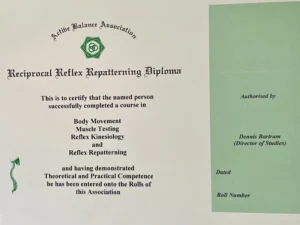
An idea gains value when explained clearly, demonstrated safely, and taught to others. The diploma shows that Dennis Bartram moved from personal experience to developing a structured course that includes theory, practical skills, and recognised standards.
This matters because the method needed more than ideas. Practitioners had to understand movement, observe patterns, test responses, and apply repatterning without reducing the body to mechanical parts. The work required patience, sensitivity, and awareness of relationships.
“Theoretical” and “practical” competence on the certificate are key. Dennis created a system demanding both understanding and application. Memorising information was not enough; a student had to identify movement patterns and work responsibly.
This transition allowed Active Balance Repatterning to be studied, tested, and shared. The certificate marked when lived experience became organised knowledge.
The Repatterning Method Looked Beyond Symptoms
Dennis Bartram Coaching Courses Active Balance Repatterning
Imagine finally exploring why the same problem keeps returning.
Many seek help because something hurts, feels weak, or moves poorly. Their attention goes to the symptom. A painful knee becomes a knee problem. A stiff shoulder becomes a shoulder problem. Poor balance seems like just a leg issue.
Dennis’s work challenged that narrow view. A symptom shows where strain appears, but not always where the pattern starts. The body adapts continuously. One area may be overloaded because another is not contributing.
For example, restricted foot movement can change the way weight travels through the legs. Limited pelvic movement can alter spinal rotation. A protective neck response can influence the shoulders, breathing and balance. The visible problem may therefore be one part of a much wider pattern.
The Active Balance Repatterning Method sought these connections, aiming to understand what produced the symptoms rather than only addressing them. This explains why some difficulties keep returning despite temporary relief.
Changing only the symptom leaves the underlying patterns intact. True change happens when the body’s organisation shifts, improving movement in several areas at once.
Active Balance Repatterning Respected Protection
You may begin to view tension as information rather than failure.
One of Dennis’s most compassionate ideas is that the body rarely tries to sabotage itself. Tightness and compensation are often protective, as the nervous system works with the information and options it has to maintain safety.
This changed the response to stiffness: instead of forcing movement, practitioners could ask why the body is guarding an area, considering past pain, fear, fatigue, or habits.
Forcing the body can worsen protection. Pushing harder or stretching further can make the nervous system more cautious by reinforcing self-defence.
Active Balance Repatterning offered a different approach: gentle, organised movement helped the person feel safe and allowed the nervous system to reduce unnecessary protection.
Not every problem disappears instantly, but the method begins by acknowledging protection and gradually introduces new movement options.
Repatterning Connected The Body And Mind
Notice how physical confidence can influence emotional confidence.
The earlier phrase Tai Jutsu Programming for Freedom suggested that Dennis already recognised a relationship between movement and personal freedom. Tai Jutsu is a Japanese term for unarmed body technique, and in this context, it refers to movement practice. Reciprocal reflex repatterning took that idea further by placing automatic body responses at the centre of the work. (Reciprocal reflexes are automatic movements the body uses to balance and respond to the environment.)
A person who no longer trusts their balance may begin avoiding stairs, uneven ground or crowded places. Someone who expects back pain may brace before bending. Another person may stop turning freely because a previous movement once caused discomfort.
These are not just physical restrictions. They affect confidence, attention, and behaviour. The person’s world shrinks as the body anticipates difficulty before movement starts.
Through the Active Balance Repatterning Method, physical improvement could lead to broader change. When the person experienced easier movement, the mind received new evidence. A task that once felt threatening could become manageable. Confidence could return through direct experience rather than positive thinking alone.
This was body-mind integration in practical form. The body influenced thought, and thought influenced the body. Repatterning helped create a new conversation between them.
Active Balance Repatterning Supported Learning
You can picture movement helping attention become calmer and clearer.
Dennis’s interest in reflex organisation also opened the door to work involving learning difficulties. Reading, writing, concentration and coordination do not happen separately from the body. They depend upon posture, eye movement, spatial awareness, balance and the ability to process information efficiently.
When automatic movement and reflex patterns demand too much attention, less capacity may remain for learning. A child or adult can appear distracted, clumsy or frustrated when their nervous system is working extremely hard simply to remain organised.
The developing Active Balance Repatterning Method offered a way to explore this without blaming the learner. The difficulty might not be laziness or lack of intelligence. It could involve underlying sensory and movement organisation that made ordinary tasks far more demanding.
Gentle movement, cross-pattern coordination, eye work and reflex integration could help the body process information differently. (Reflex integration refers to exercises designed to help neurological reflexes develop and work together.) The aim was not to force performance. It was to reduce interference so that natural ability had more opportunity to appear.
This principle remains central to Active Balance: when unnecessary neurological noise is reduced, the person may think, move and respond with greater freedom.
Repatterning Later Dennis Bartram Coaching Courses Supported Rehabilitation
Notice how recovery can become more than strengthening one injured area.
The same ideas applied to rehabilitation. Injury changes more than tissue. It changes confidence, timing, and strategy. The nervous system remembers pain and may still protect an area after healing.
A person recovering from an ankle injury may place less weight on that side. The pelvis then adapts, the spine compensates, and the shoulders respond. Over time, the original injury may feel better while new discomfort appears elsewhere.
Standard strengthening can be useful, but strength alone may not restore natural coordination. The person also needs to trust the area, sense it accurately and reintegrate it into whole-body movement.
The Active Balance Repatterning Method helped Dennis look at recovery as reorganisation. The question was not only whether the injured part had become stronger. It was whether the person could use it naturally again within walking, turning, reaching or sports.
Rehabilitation, therefore, became less about fixing one part and more about restoring cooperation across the whole person.
Improved Performance Dennis Bartram Coaching Courses
Imagine power increasing because less energy is being wasted.
Athletic performance also depends upon organisation. Golfers, runners and martial artists may possess strength and technical knowledge, yet still lose power through compensation. When one area braces unnecessarily, another area must work harder.
Dennis understood that improved performance often comes from removing interference rather than adding effort. A golfer may achieve smoother rotation when the feet, pelvis and spine move more effectively in unison. A martial artist may become quicker when tension no longer delays the response.
The Active Balance Repatterning Method could therefore support performance by identifying where coordination was being interrupted. Muscle testing (evaluating muscle strength and function), movement observation and reflex assessment (checking reflex responses) offered clues. Repatterning then helped the athlete experience a cleaner option.
This created power without excessive strain. Movement became more repeatable because it relied less upon forceful compensation. The athlete was not simply trying harder. The whole system was working better.
Self-Maintenance Completed Dennis Bartram Coaching Courses
You can feel the value of having simple ways to help yourself daily.
Perhaps the most important development was the move towards self-maintenance. Dennis did not want people to depend permanently upon a practitioner. He wanted them to understand their own movement and have practical ways to support it.
This philosophy grew naturally from repatterning. A new organisation becomes more reliable when it is gently and regularly repeated. Small daily movements can remind the nervous system of better options before old protective habits become dominant again.
The Active Balance Repatterning Method, therefore, evolved beyond assessment and treatment sessions. It became a foundation for exercises, movement resets and body-awareness practices people could use for themselves.
This is where the early certificate connects directly with modern Active Balance. Body movement remains central. Reflexes still matter. Whole-body organisation remains more important than isolated effort. The language has developed, but the thread has remained remarkably consistent.
Why The Dennis Bartram Coaching Courses Method Still Matters
Recognise that the oldest idea may still offer the most modern answer.
Today, many people are encouraged to chase symptoms, buy another device or search for a single exercise that fixes everything. Dennis Bartram’s work offers a calmer and more complete perspective.
The body is connected. Movement is learned. Protection can become habitual. Reflexes influence posture and performance.
The certificate captures the moment when these insights were being shaped into a teachable method. It provides historical evidence that Active Balance did not appear suddenly. It grew through years of martial study, bodywork, observation, testing and practical education.
Most importantly, the work was never about forcing people into a perfect position. It was about helping them recover options.
That may be the simplest explanation of the entire Active Balance Repatterning Method:
When the body discovers a better choice, it no longer has to depend upon the old pattern.
First, you will find our full Body alignment method to help you understand why your body hurts and how to rebalance it. This can improve your overall well-being and energy levels and reduce pain, joint aches, and nerve pressure. This will be shown with written explanations, pictures and QR code links with simple follow-along videos.
Secondly, you will find treatment plans and ‘cheat sheets’ for specific problems that need more in-depth help, such as back pain, neck pain or headaches.
These are just some of the reasons this book is the perfect guide for beginners, professionals or even people with no experience of self-help at all.
About the Dennis Bartram Coaching Courses Team
Dennis Bartram has trained all over the world in many forms of therapy, including Osteopathy, Chiropractic, Acupuncture, Sacro-occipital technique and many more and has over 30 years of training under the Grandmaster of traditional medicine systems, Dr Hatsumi
For over 50 years, Dennis Bartram has treated thousands of people, but he has always wanted to share his knowledge with as many people as possible.
So now, Dennis and the Active Balance team have developed a program that brings all this knowledge together in one place to benefit your life and your family’s. With explanations to help you understand your body and what goes wrong, and simple but powerful treatment routines that can help transform your life, that you can use from home or on the go.
Dennis Bartram is the Director of the Active Balance Home or on the Go System Dennis’ journey began in 1969 when he qualified in Swedish remedial massage and in 1974, he began his practice in remedial sports massage and manipulative
Science of Biotensegrity Explained Becomes Clear Why Movement Changes Understanding Balance Through the Science of Biotensegrity Explained in Daily Life How the…