
Understanding Your Shoulder Anatomy: Why Reaching Matters
Your shoulder is built for remarkable movement, but the important question is how comfortably it supports your ordinary daily activities.
Discover The Muscles That Help You Move
Understanding the shoulder blade, upper arm and rotator cuff makes it easier to appreciate why reaching, lifting and dressing require coordination.
Notice The Movement Before You Try To Correct It
One familiar activity can teach you more about what you experience than forcing your body into an imagined perfect position.
 George had spent much of his working life reaching above his head. As a heating engineer, he had fitted pipes in awkward corners, carried equipment through narrow spaces and stretched towards fittings that never seemed to be quite where he wanted them. Retirement gave him a welcome break from those demands, yet he still relied on his shoulders every morning. He reached for a mug, slipped his arms into a jacket, washed his hair and opened the garden gate. When one of those familiar activities began to feel awkward, his first thought was that his shoulder was simply wearing out. It sounded reasonable, but it was not an explanation. The shoulder is a connected arrangement of bones, joints, muscles and tendons, and a change in how a movement feels does not reveal the cause by itself.
That is why understanding your shoulder anatomy is more useful than memorising a list of muscle names. A shoulder that moves freely is not simply a loose ball-and-socket joint. Its movement depends on the way the upper arm and shoulder blade cooperate, the support provided by muscles and soft tissues, and the wider demands of the task.
George cannot see all these structures working, but he can understand their purpose. If he learns what normally contributes to a comfortable reach, he can describe a difficulty more clearly and ask better questions when professional assessment is needed. He does not have to become his own clinician or force the joint through uncomfortable exercises to benefit from that knowledge.
The Shoulder Is More Than One Joint
How Three Bones Work Together
Start with three familiar bones: the humerus, which is the upper arm bone; the scapula, or shoulder blade; and the clavicle, or collarbone. The rounded head of the humerus meets a comparatively shallow socket on the scapula at the glenohumeral joint. That design allows the arm to move in many directions, including forwards, sideways and into rotation. But the shoulder region also contains the acromioclavicular and sternoclavicular joints, while the shoulder blade moves across the chest wall. The movements are coordinated rather than independent. That is why a simple action such as reaching for a shelf involves more than the ball of the upper arm turning inside its socket.
Imagine George opening a high kitchen cupboard. He may think only about lifting his hand, but the shoulder blade also changes position as the arm rises. The collarbone contributes to the wider shoulder girdle, and muscles help guide and control the movement. A person might be tempted to pin their shoulder blades back and hold them there in the belief that this is good posture. Yet ordinary reaching needs the shoulder blade to move. Rigidly fixing one part of the system can make the task less natural. There is no single position that suits every activity, and shoulder anatomy is a reminder that stability does not mean permanent stillness. It means coordinated support while movement takes place.
Understanding Your Shoulder Anatomy Through Its Muscles
The Deltoid, Rotator Cuff And Chest Muscles
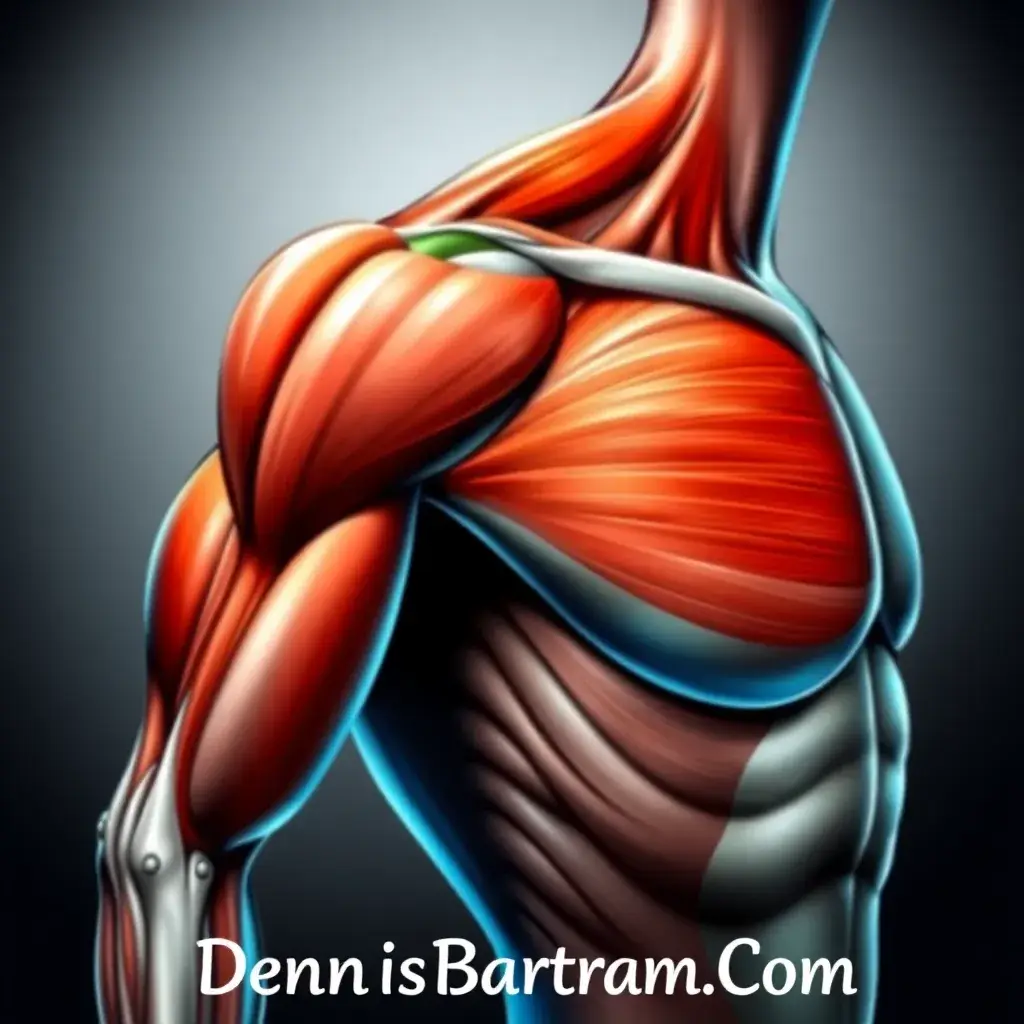
The deltoid forms much of the rounded outline of the shoulder. Its different portions contribute to raising and moving the arm in several directions. Beneath that familiar shape, the rotator cuff includes four muscles: supraspinatus, infraspinatus, teres minor and subscapularis. Their tendons help stabilise the head of the humerus and contribute to lifting and rotating the arm. The pectoralis major across the chest also helps with actions such as bringing the arm forwards and inwards. These muscles do not take turns as isolated performers. During everyday tasks they contribute together, alongside other muscles that position the shoulder blade and support the trunk.
George remembers how easy it was to assume that one painful area identified one faulty muscle. In practice, shoulder pain can have several causes, and symptoms may overlap. Rotator cuff-related problems, joint conditions, stiffness and injuries can affect reaching and lifting. Pain can also alter the way a person moves. Simply feeling discomfort near the front of the shoulder does not establish whether the pectoralis major, rotator cuff, a joint or something else is responsible. An accurate assessment may require a clinician to ask about the history, examine movement and consider whether additional investigation is necessary. A blog can explain anatomy; it cannot examine an individual shoulder.
Watch The Original Shoulder Anatomy Video
See How The Structures Relate To Movement
The video embedded in the original post is retained below. Use it as a visual introduction, then return to the everyday examples in this article. Video content should be checked before publication to ensure it still plays and matches the explanation.
Why Shoulder Problems Need A Sensible Response
Symptoms Are Clues, Not Diagnoses
The original article discussed rotator cuff tears, frozen shoulder, dislocation, tendon irritation and shoulder impingement. All are useful topics, but they should not be presented as conditions a reader can identify from a single description. A rotator cuff problem may affect strength or comfort during arm movement. Frozen shoulder commonly involves considerable stiffness as well as pain, sometimes lasting months. A dislocation or serious injury requires prompt assessment. Tendon-related symptoms can also overlap with other shoulder conditions. Rather than matching yourself to a label on the internet, pay attention to what changed, whether an injury occurred, how the difficulty affects ordinary activities and whether the problem is improving or worsening.
The NHS advises people with shoulder pain to keep gently active where appropriate rather than completely stop moving the shoulder. It also recommends seeking medical advice when pain worsens, has not improved after about two weeks or makes the arm very difficult to move. Sudden severe pain, inability to move the arm, significant swelling or a changed shoulder shape, persistent numbness or symptoms after a fall can require urgent help through NHS 111 or an urgent GP appointment. A suspected dislocation or other serious injury should never be treated by attempting to force the joint back into place yourself. These precautions are not intended to frighten readers. They help keep the line clear between learning about movement and dealing with a potentially serious condition.
Better Movement Begins With Understanding
Choose Support That Fits The Real Problem
For some people, rehabilitation may involve suitable strengthening, gradual movement and help returning to normal activities. For others, the priority may be assessing an injury, controlling pain or adapting tasks while symptoms settle. A physiotherapist or other qualified healthcare professional can recommend an approach based on the actual condition and the person’s circumstances. There is no universal stretch, posture correction or exercise that fixes every shoulder. George finds the distinction useful. He would never repair every heating fault by replacing the same part. Likewise, he should not assume that every shoulder difficulty requires the same exercise or technique. Good movement advice starts with the right question rather than a fashionable answer.
Understanding your shoulder anatomy also explains why ordinary movement is an important goal. George does not need to lift impressive weights above his head. He wants to pull on a coat comfortably, reach familiar cupboards and enjoy activities that matter to him. The shoulder’s generous range of motion makes those tasks possible, while the surrounding muscles and soft tissues help provide control. When something changes, he can observe the difficulty without immediately blaming age or inventing a diagnosis. The practical benefit of learning the basics is confidence in asking informed questions, not the promise that knowledge alone will cure pain or restore lost movement.
Open to See This Video, And This Is What’s Already Built,
Trained & Waiting For Your First Command.
Today’s Reader Task: Describe One Familiar Reach
Notice, Describe And Decide
Think of an everyday shoulder movement you already perform safely, such as reaching for a mug or putting on a coat. Do not deliberately test painful ranges, lift anything heavy or force a stretch. Simply describe in words what the task is like: easy, awkward, restricted or uncomfortable. Avoid diagnosing the cause. If you have a persistent or significant problem, use that description when speaking with an appropriate clinician. Clear observations often make a better starting point than guessing which muscle is at fault.
Riley’s Wisdom Drop: “The shoulder isn’t a single hinge to be straightened. It’s a team of moving parts that works best when the whole job makes sense.”
For more information, explore Dennis Bartram’s existing resources, and see the NHS shoulder pain guidance for practical advice and signs that warrant medical attention.


