Natural Body Alignment Therapy: Understand Your Movement
How you stand is only one part of the story. What matters to everyday life is how comfortably and safely you can move.
Why Looking Straight Is Not The Whole Answer
Your body changes position throughout the day. Understanding those changes is more useful than chasing one supposedly perfect posture.
Find Your Starting Point Without Forcing Correction
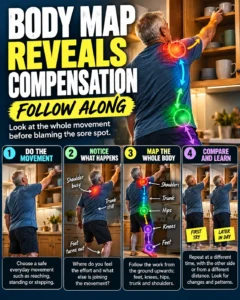
Begin with a familiar, safe movement and notice what it asks of your feet, hips, shoulders and balance.
 George had spent the better part of forty years working as a heating engineer. He could tell when a boiler was running efficiently by listening carefully, observing the controls and checking how the rest of the system behaved. Yet when he looked at his own posture in a mirror, all that experience disappeared. One shoulder looked a little higher than the other. His head seemed to sit forward. He tried pulling his shoulders backwards and standing as straight as possible, but the position felt tiring after a few minutes. Was his posture wrong, or was he asking the wrong question? Natural Body Alignment Therapy offered a useful starting point: observe how you perform everyday activities before assuming that a single frozen position explains every ache.
People often approach posture as though the body should resemble a photograph. They imagine a straight line, level shoulders and a perfectly balanced stance. Real life is more complicated. Reaching for a cupboard changes the position of the shoulder blades and upper back. Walking requires the weight of the body to transfer between the feet.
That is not a flaw. #####
Sitting, standing, turning and bending each involve different combinations of muscular effort and support. No single photograph can show how those movements occur. George’s mirror might reveal a visible difference, but it could not tell him what was causing discomfort or whether that difference had any clinical importance. For those answers, symptoms, health history and a suitable assessment matter far more than appearance alone.
Natural Body Alignment Therapy Looks Beyond Posture
Movement Is A Conversation Between Different Parts
Dennis Bartram’s Active Balance background draws on decades of martial arts, bodywork and movement education. His teaching invites people to consider how their feet, hips, trunk, shoulders and head cooperate during familiar activities. This whole-person viewpoint can be helpful for asking better questions, although it is not proof that a particular technique can identify or cure the cause of every symptom. George recognises the distinction. In his working life, he could not repair a heating system simply by staring at one radiator. But he also knew that a cold radiator did not automatically prove the pump was faulty. Observations were clues that guided further investigation, not substitutes for it.
Consider the familiar task of rising from an armchair. A person may shift their weight forward, place their feet securely and use their leg muscles to stand. Somebody else might use the chair arms because of weakness, pain or a balance concern. The movement can be performed in more than one reasonable way. George doesn’t need to force his knees, hips and spine into a prescribed shape simply because an online diagram describes a ‘correct’ position. If he finds the activity difficult, it is worth thinking about the height of the chair, the availability of support and whether he needs individual advice. Natural Body Alignment Therapy should begin with the person’s actual circumstances rather than a universal promise of perfect movement.
The same applies to walking. Some people naturally have a slightly different step length on each side or move their arms differently. These variations are not automatically a problem. If pain develops, balance changes or an activity becomes unexpectedly difficult, however, those experiences deserve appropriate attention. The goal is not to dismiss symptoms as poor posture, nor to persuade somebody that every small difference indicates hidden damage. George finds this reassuring. He can take an interest in movement without treating himself as a machine permanently out of adjustment.
Notice What Changes Before You Decide What It Means
Comfort, Effort And Confidence Offer Practical Clues
Imagine George sitting at his desk, reading an article about shoulder alignment. After a while, his neck feels uncomfortable. His first impulse is to sit bolt upright and hold his shoulders rigidly backwards. Yet that new position soon feels awkward as well. A more useful response might be to change position, consider whether the screen is conveniently placed and take a comfortable break from the task. If the problem persists, he can seek suitable clinical advice. This is not an attempt to ‘reset’ his spine. It is an ordinary adjustment to the demands of prolonged desk work. Rather than defending one ideal posture, he allows himself to move.
He notices a similar pattern in the garden. When he spends a long time working at one height, changing tasks or resting can make the activity more manageable. On another day, a different movement may be uncomfortable because of an existing injury. He cannot assume that the sensation proves a chain of fascia is pulling from his ankle to his neck. Fascia is genuine connective tissue with important mechanical and sensory roles, but a general description of connected tissues is not a diagnosis. Likewise, claims that fascia stores emotions or that a brief manual technique unlocks a person’s nervous system are not established clinical conclusions. Those ideas should not be presented as certainty to readers seeking help with pain.
This distinction is central to responsible movement education. Body awareness is valuable when it helps somebody recognise changes and describe their experience clearly. It becomes less useful when every observation is turned into an explanation about ‘misalignment’. Persistent pain, progressive weakness, unexplained numbness, repeated falls or new limitations should be assessed by a qualified healthcare professional. Sudden serious neurological symptoms require urgent help. An online article cannot determine the cause of those problems, and comfortable movement practice should never be used to delay appropriate assessment.
What About Gentle Hands-On Therapy?
Understand The Place Of Treatment And Self-Practice
Dennis’s Active Balance teaching describes gentle contact, observation and movement guidance as parts of his approach. Some people find hands-on therapy comfortable or helpful as part of an individually assessed plan. It is important, however, not to promise that treatment will restore a body’s original blueprint, reverse degeneration or cure persistent pain. Evidence differs between techniques and conditions, and a positive experience does not establish how a treatment works. For low back pain and sciatica, NICE advises that manual therapy may be considered as part of a package that includes exercise, rather than as an isolated answer. That is a useful example of why readers should understand both the possibilities and limits of treatment.
George remembers how often customers wanted him to replace one expensive component before he had examined the entire heating installation. He learned to explain what he knew, what still needed checking and what work might reasonably help. People deserve the same clarity when choosing movement support. A good conversation should cover the person’s aims, relevant symptoms, suitable options and any reasons to seek medical assessment first. A practitioner should not claim that every shoulder problem starts in the pelvis or that one session can guarantee lasting freedom. The practical outcome is a clearer plan, with decisions made in partnership with the individual.
Self-practice belongs in that conversation too. The NHS recommends regular physical activity for older adults, including suitable strength and balance work, adapted to individual fitness and circumstances. That does not require somebody to complete complicated stretches without guidance. For George, the useful first step may be returning to a comfortable walking routine or seeking advice about strengthening activities he can manage safely. If an exercise causes troubling symptoms or he is unsure about his balance, the sensible response is to stop and obtain suitable advice. Better movement habits are built around the person, not imposed by an arbitrary timetable.
Three Everyday Places To Notice Movement
The Chair, The Worktop And The Walk
At the chair: Notice whether the seat height and available support make it easy to change position. Do not turn standing up into a timed challenge. If you need to use the arms of the chair, there is no reason to be embarrassed. Practical independence often includes using the furniture and aids that make ordinary tasks safer. George knows that a well-chosen tool can improve a job rather than diminish the person doing it. If rising has become difficult or painful, an individual assessment may help identify suitable ways to manage the task.
At the kitchen worktop: Notice whether you remain comfortable while preparing a drink or meal. There is no need to stand with feet fixed in an artificial position or deliberately shift until you feel unsteady. People make small adjustments during ordinary standing, and those adjustments are not necessarily signs of a problem. George can simply recognise when prolonged standing becomes uncomfortable and change activity appropriately. Someone who feels faint, dizzy or insecure should not practise balance challenges alone. The aim is awareness during a familiar, safe task, not a home test of hidden posture faults.
On a familiar walk: Think about whether the route, footwear and pace suit your current abilities. Does the walk remain enjoyable? Do you need a rest? Have you noticed a new difficulty that deserves attention? A walking aid, when appropriate, can help someone participate in life rather than signalling failure. George no longer judges progress by whether he looks upright in a photograph. He thinks about his ability to visit friends, tend the garden and manage tasks that matter to him. Function provides a more personal purpose than chasing a perfectly straight silhouette.
Natural Body Alignment Therapy: A Better Daily Question
From Forced Correction To Informed Choices
There is a familiar appeal in the idea that the body has one original arrangement waiting to be rediscovered. It promises a clear solution to complicated problems. Yet the body adapts throughout life, and the factors influencing pain and movement are rarely captured by a single alignment rule. Health conditions, strength, joint range, sensation, surroundings, confidence and individual history can all matter. George can still value Dennis Bartram’s interest in whole-body movement without accepting claims that every symptom reveals a lost blueprint. His new question is more grounded: what helps me participate comfortably and safely in the activities I care about?
He begins to see daily movement as a conversation rather than a series of commands. Some days he walks further. Other days he chooses a shorter route because of fatigue or weather. He notices which household tasks he can do comfortably and which ones need a different arrangement. If a symptom persists or changes unexpectedly, he seeks help rather than trying to correct it through sheer determination. That approach may sound less exciting than a promise of instant transformation, but it respects the realities of ageing. It also makes room for the practical benefits of sensible movement, supportive care and individually appropriate exercise.
Today’s Apprentice Task: Build One Front Door
Open to See This Video
,
And This Is What’s Already Built,
Trained & Waiting For Your First Command.
Today’s Reader Task: Notice, Describe, Decide
Choose one familiar activity that you can already do safely, such as sitting at your desk or preparing a cup of tea. Notice one detail about comfort or effort. Describe it in a sentence without guessing the cause. Then decide whether anything needs changing: perhaps a comfortable change of position, a practical adjustment to your surroundings or a conversation with a qualified professional if symptoms are concerning. Do not deliberately provoke pain, test your balance or force your body into a supposed ideal shape. The useful result is a clearer observation, not a diagnosis.
Riley’s Wisdom Drop: “Your body doesn’t need to look like a diagram to deserve sensible care. Start with the movement that matters to your life.”
To learn about Dennis Bartram’s movement background, visit Active Balance. You can also explore the existing coaching information, checking that the details suit your needs before making enquiries. For general guidance, see NHS physical activity advice for older adults and NICE guidance on low back pain and sciatica.