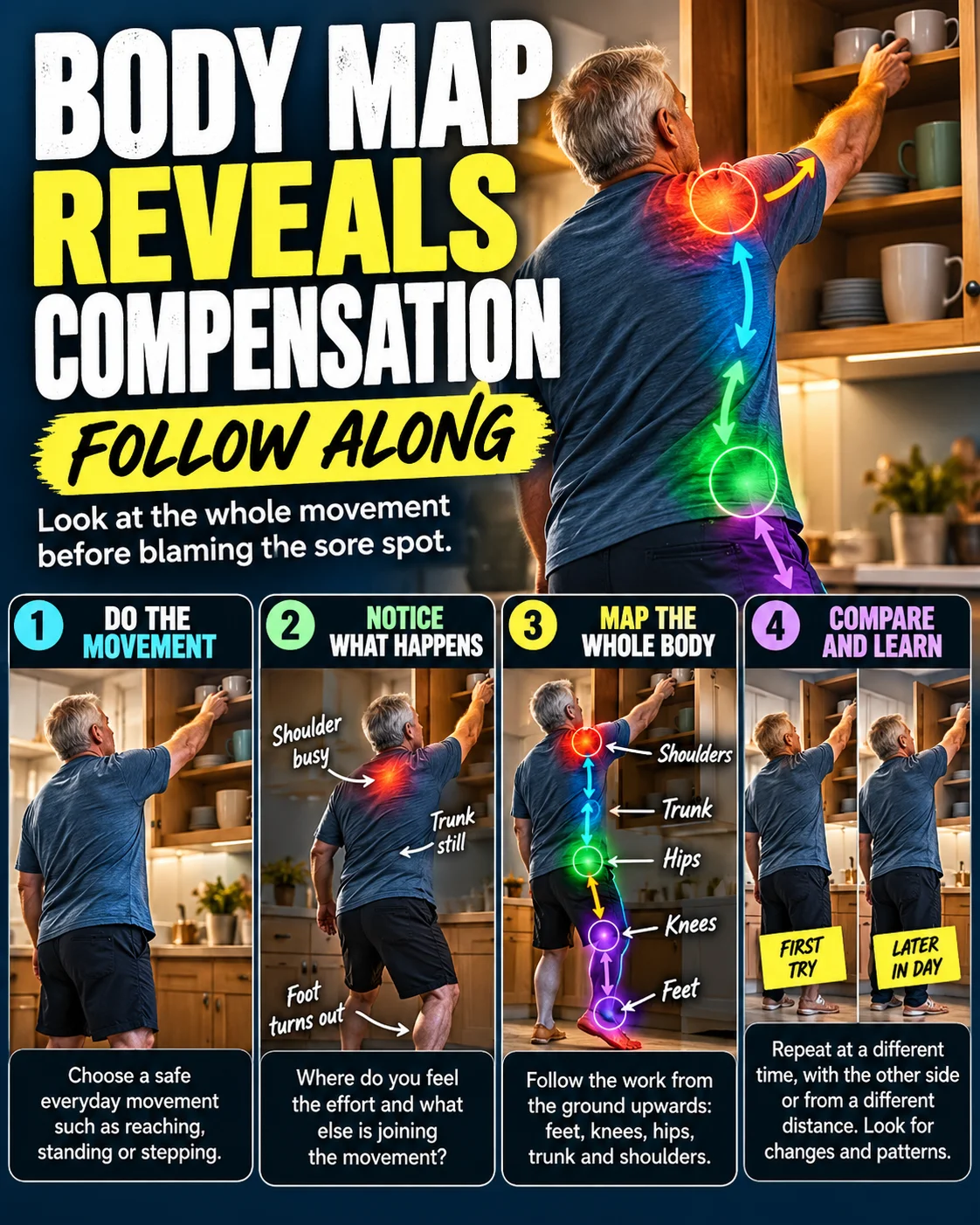
Body Map Reveals Compensation When The Sore Spot Is Doing Extra Work The place making the most noise is not always the place where the movement story began.
The Busy Body Part May Be The Worker Rather Than The Culprit
You may feel the effort differently from how you share the work.
Body Map Reveals Compensation By Showing Where The Job Travels
Before blaming one body part, widen your view and observe how the entire movement organizes itself.
A familiar moment in almost every kitchen is when somebody reaches for the mug that has somehow migrated to the top shelf. The right arm goes up, the shoulder follows, the body leans slightly, and the hand finally arrives at the cupboard looking as though it deserves overtime. If the shoulder feels tight or tired afterward, the conclusion seems obvious: something must be wrong with the shoulder. It is the part we felt. That was the part doing the reaching. It is therefore promoted immediately from employee to chief suspect. Dennis’s way of looking at movement asks us to delay that verdict. Before blaming the noisy worker, have a look at what everybody else was doing.
Watch the same reach again, but this time widen the camera. Was the trunk turning toward the cupboard, or did it stay almost completely still? Are the ribs joining the movement? Did the pelvis shift? Did one foot turn slightly while the other stayed planted? The breath either continued normally or paused as the hand traveled higher. The shoulder may still be where the effort is most obvious, but now it sits within a larger arrangement. That is the practical value behind Body Map Reveals Compensation. It does not tell us what caused the sensation. It shows us that the visible workload can be distributed across several regions, and sometimes one region appears to be doing more because another is contributing less.
The Loudest Worker Does Not Automatically Run The Workshop
Anyone who has spent time around an old workshop understands this immediately. There is always one bloke who appears to be everywhere at once. He carries the fittings, fetches the tools, answers the door, holds the pipe, and still somehow gets blamed when the tea goes cold. Watch him for five minutes, and you might conclude that he is the source of all the commotion. Watch the entire workshop and a different picture can appear. Perhaps he is busy because another job has stalled. Perhaps somebody else is waiting for a part. The whole system has quietly shifted extra work onto the one person who keeps getting things done.
The body can be observed with the same caution. A shoulder may appear busy because the trunk contributes less during a reach. A lower back may appear heavily involved in bending because the hips are taking a smaller share of the movement. A knee may seem to work hard during a step while the foot underneath it follows a different route. None of those observations proves cause and effect. That matters. We are not turning the body into a detective novel where every stiff ankle secretly murders the opposite shoulder. We are simply learning to separate two questions we too often bundle together: where do I feel it, and where is the work actually going?
That one rule can stop a great deal of premature fixing.
Suppose you bend to pick up the laundry basket and feel the lower back doing most of the job. The usual response is to start thinking about the lower back immediately. Stretch it. Rub it. Strengthen it. Protect it. Buy something for it before breakfast. But if you repeat the bend as a simple observation, you may notice that the knees hardly soften, the hips move very little, and the basket sits farther away than it needs to. The lower back is certainly working, but now you have more information. It may still deserve attention, yet the body map shows that the workload belongs to the whole task, not merely to the place where the sensation happened to shout loudest.
This is why Dennis’s approach keeps coming back to observation before correction. If you decide too early what the problem is, you immediately begin looking for evidence that supports the decision. The shoulder hurts; therefore, the shoulder must be the problem. The knee feels stiff; therefore, the knee must need stretching. The back feels tired; therefore, the back must be weak. Once you’ve written that headline, every movement becomes supporting copy. A better movement journalist gets the facts first. Watch the feet. Observe the knees. Observe the hips. Watch the trunk. Watch the shoulders. Notice the breath. Then decide whether there is even enough information to make a useful judgement.
When The Same Task Changes Body Map Reveals Compensation
Instead of the same successful task, it can hide two different maps.The easiest body map does not require coloured anatomy charts or a degree in Latin.###
Choose one ordinary job you already perform safely. Standing from a chair works well. Reaching towards a cupboard works. Stepping onto a curb or bending towards the washing basket works too. Start at the floor and slowly work your attention upwards. What are the feet doing? Does one turn farther out? Does one heel lift? Do the knees travel roughly the same way, or does one take a different route? What happens at the hips and pelvis? Does the trunk rotate, bend, or stiffen? Do the shoulders join naturally, or do they suddenly become the busiest department in the building?
The aim is not to create a checklist of faults. People do not move like matching bookends. One side may behave differently from the other for perfectly ordinary reasons, and a single movement tells us very little about why. The map’s purpose is to make the invisible workload easier to see. Instead of recording only the destination, you begin noticing the route. That is particularly valuable after fifty because familiar movement strategies can become so automatic that we stop recognising them as strategies. “That’s just how I get out of the chair” may involve feet, hands, shoulders, and breath doing far more work than we have ever stopped to notice.
The Same Successful Task Can Hide Two Different Maps
Completion alone does not tell you how the work was shared.
Imagine standing from the same armchair twice. The first time, both hands grip the arms, the feet shuffle backwards, and the shoulders brace before the hips rise. Later, after walking around the house, you stand from the same chair with lighter hand support and less obvious preparation. The chair has not changed. You have successfully stood both times. Yet the two body maps are different. That difference is useful because it shows the movement strategy can change. It does not tell us why, but it stops us from turning one heavily prepared movement into a permanent verdict about age, weakness or what the body can no longer do.
This is where Body Map Reveals Compensation becomes more valuable than simply asking whether something hurts. Pain or effort can attract attention, but comparison gives context. If the same task looks different later in the day, after movement, in another chair or on the opposite side, you have learned that the strategy is not completely fixed. Perhaps the workload shifts. One region may join more easily. Perhaps the hands become less involved. Those are observations, not diagnoses. But they are far richer than the statement, “My shoulder is bad” or “My back is going”. A label closes the file. A comparison keeps the investigation open.
Compensation Is Often A Solution Before It Becomes A Suspect
There is another reason to be careful with the word compensation. People often say it as though something has gone wrong. In ordinary life, however, finding another route is one of the body’s most useful abilities. If a movement feels unfamiliar, awkward or limited, the body may share the job differently and still get you where you need to go. One reaches the shelf. Proceed up the step. You get out of the chair. You pick up the basket. The workaround has succeeded. From that point of view, you can understand compensation first as a strategy rather than automatically as a fault.
The more useful question is whether that strategy appears once, appears repeatedly, or seems to place a noticeable amount of extra work elsewhere. That is where body mapping becomes interesting. If the right shoulder rises on one unusually high reach, there may be nothing useful to conclude. If the same shoulder takes over every time the trunk could have shared the movement, a repeatable pattern starts to appear. Even then, observation does not tell us why the pattern exists. It tells us something simpler: the work is being distributed recognisably. That is enough to justify watching more closely before anybody starts trying to correct it.
Open to See This Video, And This Is What’s Already Built, Trained & Waiting For Your First Command.
Unlocking the Secrets of Foot Reflexology: Pressure Points for Pain Relief
Body Map Reveals Compensation Before You Correct Anything
Instead of compensation is often a solution before it becomes a suspect. The phrase is worth keeping because it changes the order of the investigation. The next time one area feels unusually busy, start there, but don’t stop there. Notice the sensation, then widen the map. Follow the job from the ground upwards and see which other regions appear to contribute. Watch what happens when the task changes slightly. Would bringing the object closer change the workload? Does allowing a natural turn through the trunk alter the reach? Does the same movement look different on another occasion? None of those comparisons proves what caused the original sensation. Their value is that they stop one loud body part from being convicted before the rest of the movement has even been interviewed.
And that is the useful thought to carry into the second half of this lesson: where you feel the work is only one point on the map. The richer question is where the movement travels, which areas appear to share the job, and which area seems to be covering extra ground. Once you look at movement that way, the sore spot stops being the whole story. It becomes one clue inside a much larger picture of how the body is currently getting the job done.
Body Map Reveals Compensation How To See Hidden Work
Spread the love
Dennis Bartram
Dennis Bartram is the Director of the Active Balance Home or on the Go System Dennis’ journey began in 1969 when he qualified in Swedish remedial massage and in 1974, he began his practice in remedial sports massage and manipulative
Retiree Posture Alignment Training and Lower-Back Control Retiree Shoulder Balance Training Fixes Rounded Posture Retiree Posture Alignment Training for Opening the Body…
Restore Natural Body Alignment Stability Through Movement Restore Natural Body Alignment Before Chasing The Pain The painful place may be carrying the…
Calm Your Nervous System Before Tension Becomes Your Normal The body responds to clear information better than stern instructions. Through Slow Rhythmic…
Protective Movement Habits Remain Protective Movement Habits Remain After The Original Trouble Settles The body may continue using yesterday’s safest route. Could…

 Anyone who has spent time around an old workshop understands this immediately. There is always one bloke who appears to be everywhere at once. He carries the fittings, fetches the tools, answers the door, holds the pipe, and still somehow gets blamed when the tea goes cold. Watch him for five minutes, and you might conclude that he is the source of all the commotion. Watch the entire workshop and a different picture can appear. Perhaps he is busy because another job has stalled. Perhaps somebody else is waiting for a part. The whole system has quietly shifted extra work onto the one person who keeps getting things done.