Notice Your Movement Changes Before Difficulty Takes Over
The smallest adjustments in everyday movement may reveal useful changes long before a familiar task becomes noticeably difficult.
The Movement You Don’t Notice May Reveal The Most
Completing an ordinary task is only half the story because the way your body completes it may already be changing.
Small Adjustments Can Tell A Bigger Story
Foot placement, hesitation, breathing and unexpected support can offer clues about how your body organises familiar movement.
There is something rather wonderful about the way we ignore our bodies when everything appears to be working. We get out of bed, find our slippers, head for the kettle and carry on with the morning as though the whole operation requires no particular thought. The knees bend, the feet find the floor, and the body somehow delivers us to the kitchen. Then one morning, something feels slightly different. You may pause before standing. One foot may move backwards. Perhaps your hand reaches for the bedside table without receiving any instructions from headquarters. Nothing dramatic has happened, and breakfast is still on schedule, but your movement may already be telling a different story.
That is where Notice Your Movement Changes becomes a useful habit rather than another instruction to exercise more. Most people judge movement by whether the job was completed. Have you stood up? Have you climbed the stairs? Did you reach the cupboard? If the answer is yes, everything appears satisfactory. Yet the result may conceal small adjustments that deserve attention. You might still stand from the chair, but now need an extra push from the armrest. You might still reach the cupboard, but your shoulder rises earlier. The task succeeds, although the strategy used to complete it has changed.
Consider an experienced heating engineer visiting a house where the radiators are warm, and the boiler appears to be behaving itself. The homeowner sees no problem because there is hot water and the heating works. But the engineer notices a familiar pipe making a different sound or a circulation pump behaving differently than it did at the last visit. He doesn’t immediately condemn the boiler and order a replacement. He observes, compares and asks what has changed. The system is still doing its job, but the way it delivers the result may deserve another look. Everyday movement benefits from exactly that sort of practical thinking.
Notice Your Movement Changes In The First Few Seconds
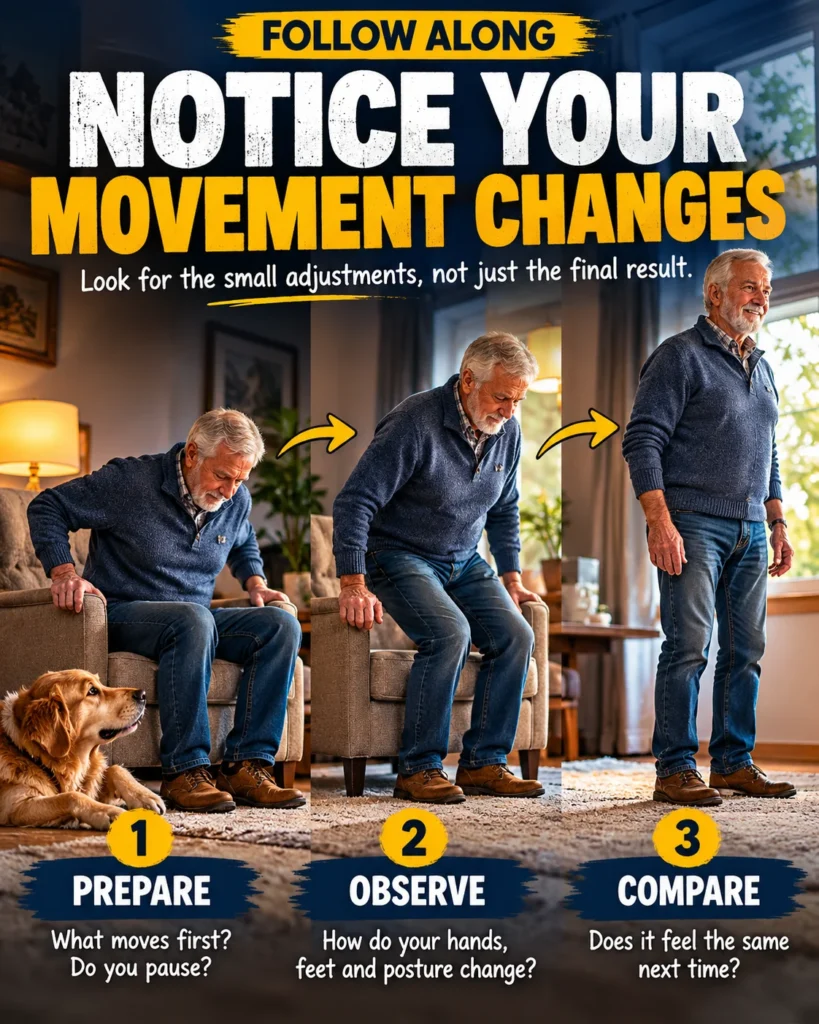
One of the most revealing parts of an everyday movement is often the part nobody thinks to watch. It happens before the main action gets underway. Consider the moment before standing from a chair. The feet reposition, the body leans forward, and the hands may begin searching for support. Someone watching only the final standing position misses nearly everything that made the movement interesting. The person arrives upright, but the preparation may have involved several adjustments that were absent last month. The beginning of the movement can contain information that the successful finish quietly conceals.
The same happens when you step into the garden. You open the back door, look down at the familiar threshold and move outside. One foot always leads. The free hand reaches toward the doorframe. Perhaps there is a brief pause while you judge the step, even though you have crossed it thousands of times. These details may be perfectly sensible responses to the surface, footwear or circumstances. What makes them useful is comparison. Did you always use the doorframe, or has that become a recent addition? Does the hesitation appear every morning or only occasionally?
A key difference exists between being careful and automatically assuming caution signals a problem. Someone may use the bannister because it is there, because they prefer the security or because the stairs are particularly steep. That does not indicate a medical condition. However, if a familiar movement begins requiring noticeably more preparation than before, the change is worth describing. The objective is not to remove the support or force a different movement. The goal is to see whether the person’s normal strategy has changed and whether the same adjustment appears repeatedly.
Riley’s Wisdom Drop: “The finished movement tells you what was achieved. The unnoticed adjustments tell you how the job was done.”
A Familiar Chair Can Reveal Hidden Preparation
There is no need to introduce complicated testing equipment to explore this idea. The furniture you already use can provide a practical reference point. Take the kitchen chair where you sit for breakfast. You know its height, where your feet normally rest and how you usually get up. That familiarity makes it a useful reference point. If you suddenly begin rocking forwards before standing, pressing through one hand or moving a foot into a different position, you have something specific to compare. A familiar chair becomes a useful reference, as long as you observe naturally rather than trying to perform a perfect standing technique.
Now consider what happens when you use a different chair. The low sofa may require a much larger forward lean. A firm dining chair may allow a smoother movement. A garden seat might encourage you to use both hands because its surface is lower or less familiar. These differences do not necessarily represent deterioration or improvement. They demonstrate how the task influences the strategy. Consequently, comparing different furniture without allowing for those differences can lead to misleading conclusions. If you want to observe a change over time, return to a reasonably similar task under reasonably similar conditions.
This is where Notice Your Movement Changes becomes more precise. You are not asking whether you can stand exactly like somebody demonstrating an exercise on television. You are comparing your own familiar movement with the way you usually complete it. Did the hand join earlier? Did the feet settle differently? Was there a pause? Did the effort appear concentrated on one side? These are manageable observations that help you understand the task without turning breakfast into a physical examination. A useful body map begins with the person and the movement they actually perform.
Breathing Can Join The Movement Story
Breathing is another quiet part of movement that’s easy to overlook. People naturally think about their legs when climbing stairs and their shoulders when reaching for something overhead. Yet during a demanding action, you may notice yourself holding your breath, breathing more shallowly or releasing a long breath once the task is complete. These observations can accompany changes in effort, but they do not explain the reason on their own. The question is simply whether breathing changes at a particular point in the movement and whether that response appears consistently during similar everyday tasks.
Imagine reaching for a saucepan from a cupboard. Before the hand moves, the shoulders rise, and the body seems to brace. The breath pauses briefly while the arm reaches upwards. Once the saucepan is safely on the worktop, everything settles. The task succeeded, but several details lay beyond the reach of the arm. Maybe the person stood farther away than usual. The saucepan appeared awkwardly positioned. Perhaps the effort was simply greater than expected. Watching the whole task reveals these possibilities without requiring an instant explanation or a new set of exercises.
Don’t turn breathing observation into another rule about how everybody should move. Some breathing changes are normal responses to effort. What matters is awareness, especially when the response differs from the person’s familiar pattern. If a movement feels unexpectedly difficult, painful or causes unusual breathlessness, the sensible response is not to repeat it in pursuit of a better result. Stop the activity and seek appropriate medical advice when symptoms are concerning. Routine movement checks can improve awareness, but they cannot replace a professional assessment. Learning to Notice Your Movement Changes includes recognising when breathing, balance and effort begin behaving differently during familiar tasks.
Notice Your Movement Changes Without Forcing Correction
One of the quickest ways to lose useful information is to notice an adjustment and immediately try to eliminate it. A bystander notices a shoulder rising during a reach and tells them, “Keep that shoulder down.” A bystander notices a hand on the armrest and insists on standing without help. Someone sees a foot turning outwards and demands that it point straight ahead. These instructions may look like corrections, but they change the task before the original strategy has been understood. The visible adjustment might be helping the person complete the movement safely and comfortably.
Suppose a person uses the doorframe when stepping into the garden. Removing that support does not necessarily demonstrate better balance. It may simply make the task more uncertain. A more useful first question is whether the person has always used the support or whether it has become more important recently. You might also notice whether the same person uses support when stepping across a different threshold. These comparisons reveal patterns without asking anyone to abandon a familiar safety strategy. Observation should make movement easier to understand, not turn ordinary tasks into unnecessary challenges.
That is a central lesson in the Active Balance approach. Observe before labelling, compare before correcting and let the movement tell you what actually happened. The body may use a different strategy because the task demands it, because conditions have changed or because the person has developed a familiar habit. None of those possibilities can be confirmed from one glance. Nevertheless, a calm observation provides a starting point for meaningful comparison. It is often more useful than being handed an instruction before anyone has watched how the movement works.
Riley’s Wisdom Drop: “Don’t rush to correct the movement that catches your eye. First discover what job that movement may be helping to finish.”
The Quiet Adjustments Deserve Attention Too
Most people notice the loudest part of a movement. The knee feels busy, the shoulder appears stiff, or the lower back complains after sitting. Those sensations naturally attract attention. Yet the quieter adjustments surrounding them may reveal more about how the task is being organised. A foot may reposition before standing. The trunk may turn less during a reach. One hand may join the job earlier than expected. A brief hesitation may appear before the first stair. These details help form a more complete picture without suggesting that any particular body part must be responsible.
The useful question becomes, “What changed before I noticed the obvious effort?” Perhaps the shoulder only began working harder after the person stopped turning towards the cupboard. Perhaps the hands became more involved when the chair was lower. Perhaps the first stair required extra preparation after a long period of sitting. These examples show why ordinary movements deserve to be watched as complete tasks rather than isolated joints. Each adjustment belongs to the wider strategy, and the strategy may change even when the task continues to succeed.
That gives us the practical foundation for the rest of this lesson. You do not need to become an expert in anatomy or analyse every movement throughout the day. Choose familiar actions and notice the preparation, effort and support that accompany them. Watch what happens naturally, then compare the same task on another occasion. Some observations will prove unremarkable, while others may reveal a repeated change worth understanding. Either way, Notice Your Movement Changes begins with a simple discovery: the movement you complete without thinking may be the one that has the most to tell you when you finally pay attention.
Notice Your Movement Changes Through Familiar Comparisons
Once you start noticing how you move, you may feel tempted to become a full-time detective in your own sitting room. Every footstep becomes a clue, every shoulder movement deserves an investigation, and getting out of a chair starts to resemble a practical examination. That is not what Dennis Bartram’s approach is about. Good observation should make ordinary movement easier to understand, not more complicated. The trick is to choose one familiar task, watch it happen naturally and compare it with the same task another time. You are looking for a useful pattern, not collecting enough evidence to prosecute your left knee.
Suppose your first few steps towards the kitchen feel slightly awkward each morning. You get out of bed, stand for a moment and begin walking. Perhaps the first step feels hesitant, while the fourth or fifth feels quite ordinary. The same thing happens tomorrow morning. By the weekend, you notice the hesitation appears mainly after getting out of bed, not after rising from your favourite chair in the afternoon. That is useful information. It doesn’t explain why, but it tells you when the movement changes and when it seems to settle.
This is why comparison is more valuable than simply announcing that you feel stiff. Stiffness is an experience, but it doesn’t describe everything happening during the task. Were the feet taking shorter steps? Were you leaning toward the bedside cabinet? Did the shoulders rise? Was there a pause before walking? Once you can describe those details, you have a clearer picture of the movement. You may also begin noticing that some adjustments disappear as the task becomes familiar again. The key is to recognise the pattern without inventing an explanation.
A Completed Task Can Hide Extra Effort
One of the great advantages of ordinary movement observation is that it reveals how much work can hide behind a successful result. Consider carrying a mug from the kitchen into the sitting room. The tea arrives safely, nobody gets scalded, and the household continues functioning. Yet perhaps the person has begun walking more carefully while carrying something. Their steps become shorter, the free arm moves less, and they pause before turning through the doorway. None of those adjustments necessarily means something is wrong. They show how the body has organised the task when an additional demand has been introduced.
Compare that journey with walking the same route empty-handed. Does the pace change? Does the person turn differently? Do they look towards the doorway sooner? Does the free hand reach towards the furniture? The answers may reveal that carrying an object alters the movement strategy. That is hardly surprising, but it is worth observing because the change may be happening without conscious attention. The important comparison isn’t between perfect walking and imperfect walking. It is between two familiar tasks with different demands, and the adjustments that appear when those demands change.
A useful distinction here is between extra effort and unnecessary effort. From observation alone, you cannot always decide which is which. A slower turn while carrying a hot drink may be an entirely sensible precaution. A hand reaching for support may help maintain security. The visible adjustment isn’t automatically a fault that needs correcting. It is part of the strategy being used. Before deciding that an adjustment is unnecessary, you need to understand the job it may be helping to complete. Sometimes the wisest observation is simply recognising that the body has chosen a more cautious route.
Notice Your Movement Changes Before The Main Effort
Imagine a retired tradesman approaching a heavy workshop door that has become reluctant to open. Long before he puts his shoulder against it, he changes his stance, places one foot behind the other and prepares for a little resistance. Those preparations are sensible because experience has taught him what the job may require. Everyday movement can contain similar preparations. The body may adjust its position before the demanding part begins, and those early changes can sometimes reveal more than the effort that follows. The interesting question is whether the preparation reflects the current task or has become an automatic part of the routine.
Watch someone preparing to climb the first stair. Perhaps they move closer to the bannister, reposition one foot and pause briefly before lifting the other. The climb then proceeds without difficulty. Looking only at the climbing action would miss the preparation. However, watching the whole sequence shows that support and positioning were organised before the first step. That observation may become more interesting if the same preparation appears on every staircase or if it only happens when the person is tired, carrying something or approaching an unfamiliar step.
Timing can be particularly revealing because it describes when the workload appears to change. Is the hand reaching for support before the body begins to move? Could the shoulder rise before the arm begins reaching? Does the person hold their breath before standing, or only during the hardest part? These observations don’t prove a cause, but they help describe how the movement unfolds. Instead of recording only that something looked awkward, you can identify the moment when the strategy altered. That makes future comparisons more specific and reduces the temptation to rely on vague impressions.
The Same Movement Can Tell Different Stories
There is a good reason for using familiar tasks as reference points. A movement performed under different conditions may naturally look different. Standing from a high dining chair isn’t the same job as rising from a low sofa. Reaching for an empty mug isn’t the same as lifting a heavy saucepan. Walking through the garden on a dry summer morning isn’t the same as navigating a damp path in October. If the demands change, the strategy may change too. That doesn’t make the comparison useless, but it means you should consider the circumstances before deciding what the difference represents.
Suppose you notice that getting out of the car takes more effort than standing up from a kitchen chair. The car seat is lower, the space is restricted, and you may need to rotate before standing. Those differences can influence how the movement is organised. Rather than deciding one body part is responsible, observe what each task requires. Where do the feet go? Which hand provides support? When does the trunk turn? Does the person pause before rising? These answers begin to explain why the two movements shouldn’t be judged as though they were identical.
A more reliable personal comparison uses the same task under reasonably similar conditions. Notice how you stand from the same chair, cross the same threshold or reach for an object kept in the same place. You don’t need to recreate laboratory conditions, but keeping the task familiar makes the observations easier to interpret. If several things change at once, it becomes harder to know which difference is worth attention. The aim is clarity, not scientific perfection. A straightforward comparison can tell you more than an elaborate test performed differently every morning.
Notice Your Movement Changes Without Chasing Faults
Once people start paying attention to movement, another danger appears. They begin searching for something wrong. Every uneven step becomes suspicious, every shoulder adjustment looks like compensation, and every moment of stiffness seems to demand a correction. That approach can turn useful body awareness into unnecessary worry. Movement naturally varies, and the body often adjusts to the task in sensible ways. Using a handrail doesn’t automatically mean poor balance. Someone who changes foot position before standing isn’t necessarily moving incorrectly. The important question is whether the observation represents a meaningful change from their usual pattern.
This is where Dennis’s observe-first philosophy keeps the whole process grounded. A visible adjustment is information, not an accusation. The raised shoulder may be contributing to the reach. The hand on the armrest may be providing useful support. The wider stance may suit the task. Removing those adjustments before understanding them can change the movement in ways that are neither necessary nor helpful. Better to describe what happens, compare it with familiar experience and remain curious about whether the strategy changes under different conditions.
That approach also makes room for positive observations. The first steps after sitting tend to become more settled. Standing often starts without the usual pause. Perhaps reaching for the cupboard feels less demanding, or your shoulders move with less obvious effort. These changes deserve attention without becoming proof of lasting improvement. They show what happened during that particular task. If similar changes appear repeatedly, you have a more useful pattern to consider. The aim is to notice movement honestly, whether today’s experience feels better, worse or much the same.
Riley’s Wisdom Drop: “Don’t turn every movement into a problem to solve. Sometimes the most useful discovery is simply noticing what your body has changed.”
The Difference Between A Moment And A Pattern
One awkward morning can easily become a much bigger story in someone’s mind. You stand from the chair, feel less steady than expected and immediately wonder whether your movement is deteriorating. Yet the following morning may feel completely ordinary. Perhaps the first attempt happened after a poor night’s sleep or an unusually demanding day. Without comparison, one moment can carry far more importance than the evidence supports. Repeated observation gives that moment context, letting you see whether the same adjustment reappears or disappears under more familiar conditions.
The reverse is equally important. One unusually comfortable movement doesn’t necessarily mean that a lasting improvement has occurred. You may turn more freely after a familiar morning routine, find the stairs easier on one occasion or notice that your shoulder feels less busy during a reach. Those responses can be encouraging, but they are still observations from particular moments. If the change appears again under similar conditions, it becomes more informative. The difference between an immediate response and a repeated pattern is central to sensible self-maintenance, especially when you’re deciding what deserves continued attention.
There is no need to keep an elaborate diary to recognise these patterns. A brief mental comparison may be sufficient. Did the movement start more easily? Was support needed earlier? Did the feet settle in the same way? Was there a noticeable pause? If you prefer writing things down, one short sentence can provide a useful reminder. The purpose isn’t to collect statistics or score your body out of ten. It is to preserve enough information that tomorrow’s observation has something real to compare with.
Notice Your Movement Changes In Everyday Life
Some of the most informative movement tasks are also the least glamorous. Putting on trousers, stepping into slippers, turning towards the kettle or reaching across the kitchen worktop can all reveal subtle adjustments. These movements involve familiar combinations of balance, timing, support and coordination. Because they happen so often, people rarely notice the details. Yet those details can become useful when a task starts to feel different. You don’t need to do an unfamiliar exercise to discover how your body moves. Everyday life already provides plenty of opportunities.
Consider putting on socks while sitting on the bed. The right foot is easily within reach, but the left requires a slight lean back and an extra pull through the hands. Perhaps it has always happened that way. It may only appear after a long day. Perhaps the movement changes when you sit on a firmer surface. None of those observations proves why one side behaves differently. However, they help you see the whole task rather than focusing solely on whichever hip or knee happens to draw your attention.
Even the journey to the garden can become informative. You rise from a chair, walk towards the back door, turn the handle, step across the threshold and continue outside. Each part of the journey asks the body to organise a slightly different movement. Perhaps the first steps feel hesitant, but walking becomes smoother. Turning at the doorway may require more preparation than walking in a straight line. Perhaps stepping outside produces an extra hand movement towards the frame. The observations become useful when you compare the same journey over time without deliberately changing how you perform it.
Small Changes Deserve Calm Attention
Remember that observation has limits. A changed movement pattern doesn’t reveal what is happening inside a joint, muscle or nerve, and it cannot tell you whether an underlying medical condition is present. If movement suddenly becomes difficult, weakness appears unexpectedly, balance changes abruptly, or new severe symptoms develop, seek appropriate medical assessment rather than keep repeating a home observation. Persistent or worsening changes also deserve professional attention. Everyday movement awareness can help you describe what you’ve noticed, but it should never replace care when care is needed.
For normal, comfortable daily activities, however, a little attention can be surprisingly useful. Recognising the difference between a task that feels familiar and one that now requires extra preparation. Notice whether support appears earlier, whether pauses have grown longer, or whether the workload seems to be shifting. You may also discover that some adjustments fit the task and have been there for years. That knowledge helps prevent needless correction, because not every difference needs fixing and not every movement needs improving.
The real skill is learning to observe without rushing towards a verdict. You don’t have to decide immediately whether a movement is good, bad, correct or incorrect. You can describe what happened and compare it with what you normally experience. That leaves room for the next observation to add useful information. It also keeps the task itself central. Standing, walking, reaching and stepping are ordinary parts of life, not competitions in which every movement must earn approval from an imaginary judge. When you Notice Your Movement Changes over several days, those small observations can begin revealing patterns that a single movement might never show.
Keep Your Attention On The Unnoticed Adjustments
Return to that familiar chair for a moment. The person still stands successfully. The kettle still gets filled, breakfast still happens, and nobody else notices anything unusual. Yet perhaps the feet move differently now, the hands join in earlier, or the effort begins after a longer pause. Those details may be more informative than the final standing position because they reveal how the task is currently being solved. They are not a diagnosis, and they need not become a worry. They are simply the part of the movement that might otherwise have remained invisible.
The same principle applies to the staircase, the garden doorway, the cupboard and the car. Each task has a beginning, a sequence and a finish. Each may involve quiet adjustments that help the person complete the job. As you begin to recognise those adjustments, you develop a clearer understanding of your normal movement patterns. You can notice when something changes, when it stays familiar and when a repeated difference deserves closer attention. That is a much more useful skill than judging movement solely by whether the task was completed.
Notice Your Movement Changes isn’t an invitation to examine every step or chase a perfect technique. It reminds us that ordinary movement contains useful information long before someone starts explaining what it means. The body may change its strategy while still performing familiar tasks successfully. Seeing those changes requires patience, comparison and a willingness to describe what happened before deciding why. Sometimes the most interesting observation isn’t the adjustment that catches your attention, but the quiet preparation that happened before you noticed anything at all.
Riley’s Wisdom Drop: “The body can change its route without changing its destination. Learn to notice the journey, not just the finish.”
Today’s Reader Task: Notice The Journey
Open to See This Video – And This Is What’s Already Built, Trained & Waiting For Your First Command.
Choose one safe, familiar movement you already perform comfortably, such as standing from your usual chair, stepping through the garden doorway or reaching for an object from a regular shelf. Complete it naturally without trying to improve your technique. Notice how you prepare, what moves first, whether breathing changes and where your hands or feet provide support. Then carry on with your day. The next time you perform the same task under similar conditions, compare the movement without forcing a correction or removing support. Did the preparation remain familiar, or did something change?
You don’t need a dramatic discovery. You don’t need to find a fault. One honest observation is enough to begin seeing familiar movement more clearly. If a difference appears repeatedly, it may deserve closer attention. If the movement remains comfortable and familiar, that is useful information too. The purpose is to understand how you complete everyday tasks, rather than waiting until one becomes difficult enough to demand an explanation.
Remember the rule: the job getting done tells you the result; the way it gets done tells you the movement story.
Notice Your Movement Changes How To Spot Hidden Clues
Spread the love
Dennis Bartram
Dennis Bartram is the Director of the Active Balance Home or on the Go System Dennis’ journey began in 1969 when he qualified in Swedish remedial massage and in 1974, he began his practice in remedial sports massage and manipulative
Micro‑Movements in Pain Relief The Hidden Power of Balance The Hidden Power of Micro‑Movements in Pain Relief Small, intelligent movements unlock deep…
Subtalar Joint Body Balance and Natural Resetting Understanding the Subtalar Joint: The Quiet Foundation of Human Balance Most people believe balance begins…


 There is no need to introduce complicated testing equipment to explore this idea. The furniture you already use can provide a practical reference point. Take the kitchen chair where you sit for breakfast. You know its height, where your feet normally rest and how you usually get up. That familiarity makes it a useful reference point. If you suddenly begin rocking forwards before standing, pressing through one hand or moving a foot into a different position, you have something specific to compare. A familiar chair becomes a useful reference, as long as you observe naturally rather than trying to perform a perfect standing technique.