Restore Your Natural Breathing Before Making Every Breath Another Job. Discover why everyday breathing can require unnecessary muscular effort, and how simple awareness can help.
Your Breathing Pattern May Be Working Harder Than Necessary
Learn how shoulder tension, chest movement and postural habits can influence breathing comfort.
Natural Breathing Begins With Noticing Effort
Understand why observing your breathing may be more useful than forcing bigger breaths.
Your Breathing Pattern May Be Working Harder Than Necessary
Your shoulders, ribcage and stomach can reveal the difference between comfortable breathing and unnecessary muscular tension.
Natural Breathing Begins With Noticing Effort. Before taking bigger breaths or correcting your posture, discover what your body is already doing. The human body is remarkable. It can keep breathing while its owner sleeps soundly, reads the morning newspaper or wonders where on earth the television remote control has disappeared. Nobody needs to instruct the diaphragm before breakfast, and the lungs don’t need a reminder to keep working while we watch the evening news. Yet somewhere between childhood and retirement, many people acquire muscular habits that make ordinary movement feel more complicated than necessary. They stand with their shoulders pulled backwards, keep their stomach unnecessarily tight or hold their chest in a position they believe represents good posture. These habits can feel so familiar that you stop noticing them.
Nevertheless, when we begin to restore your natural breathing, the first useful discovery is that breathing automatically and breathing comfortably aren’t necessarily the same thing. The important question isn’t whether you can take a bigger breath. It’s whether you’re adding effort that the activity doesn’t require.
For generations, people were encouraged to stand up straight, pull their shoulders back and hold their stomach in. Those instructions were often delivered with the conviction of a schoolteacher inspecting a classroom before morning assembly. Unfortunately, some people interpreted them as permanent orders rather than occasional reminders. Their shoulders stayed pulled back, their abdominal muscles remained tight, and their chest became something to hold in place rather than let move comfortably. Of course, an upright posture can be useful, and the body needs muscular support to maintain balance. However, standing comfortably upright and holding yourself rigid are two quite different arrangements. One lets the body make the small adjustments needed for balance and movement. The other may add unnecessary effort before anything demanding happens. This is particularly worth examining in later life, when comfortable movement matters more than achieving an impressive military appearance.
Restore Your Natural Breathing Without Forcing Bigger Breaths
One of the most common reactions to noticing uncomfortable breathing is to take a much bigger breath. When someone notices their chest feels restricted, they lift their shoulders, expand their upper chest and draw in as much air as possible. They may repeat the exercise several times, believing that a larger inhalation must represent better breathing. Yet breathing more forcefully isn’t necessarily the same as breathing more comfortably. During quiet resting breaths, the diaphragm does much of the work. As it contracts, it moves downwards, helping the chest expand so air can enter the lungs. The ribs and surrounding muscles contribute, while the abdominal wall accommodates the changing pressure. The whole arrangement normally works without conscious supervision.
Start Your Active Balance Journey. Treat Yourself
Restore Your Natural Breathing. When the body needs more air during physical activity, additional respiratory muscles can assist. However, recruiting those muscles unnecessarily during ordinary rest may increase the sensation of effort rather than reduce it.
Consider what happens when somebody sits quietly in a comfortable armchair. Their body isn’t climbing a flight of stairs, carrying heavy shopping or hurrying across a car park. Its immediate physical demands are relatively modest. Breathing should generally continue without deliberate muscular effort, although individual breathing patterns naturally vary. Now imagine that same person repeatedly lifting their shoulders with every inhalation, tightening their neck and holding their abdomen rigid. Those movements don’t automatically indicate a medical problem, and appearance alone cannot establish whether breathing is healthy or efficient.
Nevertheless, they provide useful observations. Are those additional muscles helping because the activity requires them, or are they participating because the body has developed a habit of holding tension? That distinction gives us a much better starting point than prescribing another breathing technique. Before changing anything, we need to understand what’s actually happening.
The principle behind restoring your natural breathing is therefore surprisingly straightforward. Rather than asking the body to move more, we first check whether it can move without unnecessary interference. Think about an experienced tradesman examining a machine that appears to be working harder than expected. He doesn’t immediately turn up the power and hope for the best. He observes the mechanism, checks what is moving and looks for anything creating unnecessary resistance. Human breathing is far more complicated than machinery, but the observation principle still works. We can notice our shoulders, ribcage and abdominal muscles without deciding beforehand that something must be wrong. We can compare comfortable positions with those that introduce tension. Most importantly, we can distinguish normal muscular support from the extra effort that long-established postural habits sometimes require.
How Shoulder Tension Affects Efforts To Restore Your Natural Breathing
Picture a retired gentleman standing beside his kitchen worktop on a quiet Sunday morning. He’s recently become interested in maintaining good posture, so before starting his daily routine, he stands tall, pulls his shoulders back and tightens his stomach. He believes he’s preparing his body correctly. At first, everything feels familiar. However, after a while, he notices his upper chest feels unusually fixed. His shoulders gradually rise as he breathes, and his neck begins to feel tense. He immediately inhales more deeply. He lifts his chest even higher, draws in more air and attempts to maintain the upright position he’s been taught to admire. Unfortunately, this extra effort doesn’t make him feel more comfortable. The interesting part of this example isn’t that standing upright was a mistake. It’s that he may have confused comfortable postural support with unnecessary muscular holding.
Instead of trying another exaggerated inhalation, our gentleman decides to investigate. He keeps his feet comfortably positioned and uses the nearby worktop for support if needed. Then he lets his shoulders settle without deliberately rounding them or pulling them back. He stops consciously drawing his stomach in and permits his ribs and abdomen to move naturally. Nothing dramatic needs to happen. No complicated breathing counts, no demands to fill his lungs, and no instructions to hold his breath. He observes whether ordinary breathing feels different when he’s no longer maintaining so many muscular commands. Perhaps his breathing becomes more comfortable. Perhaps the difference is hardly noticeable. Either way, he gains useful information about his experience. However, neither proves that his original breathing pattern was harmful or establishes the cause of any symptoms.
This illustrates an important distinction in the effort to restore your natural breathing. Muscular activity isn’t automatically unnecessary merely because we can feel it. The body needs different levels of support during different activities. Getting out of a chair, climbing stairs and carrying shopping all require posture adjustments and muscular effort. Breathing may naturally become quicker or deeper as physical demand increases, and muscles around the upper chest and neck can help when greater respiratory effort is required. The question is whether the effort matches the task. Someone walking briskly uphill isn’t expected to breathe the same way they would while relaxing with a newspaper. Equally, someone sitting quietly shouldn’t deliberately brace every muscle to maintain an imagined perfect posture. What matters is adaptability, because comfortable movement depends on the body’s ability to respond appropriately rather than remain fixed in one position.
Three Questions To Restore Your Natural Breathing Without Extra Effort
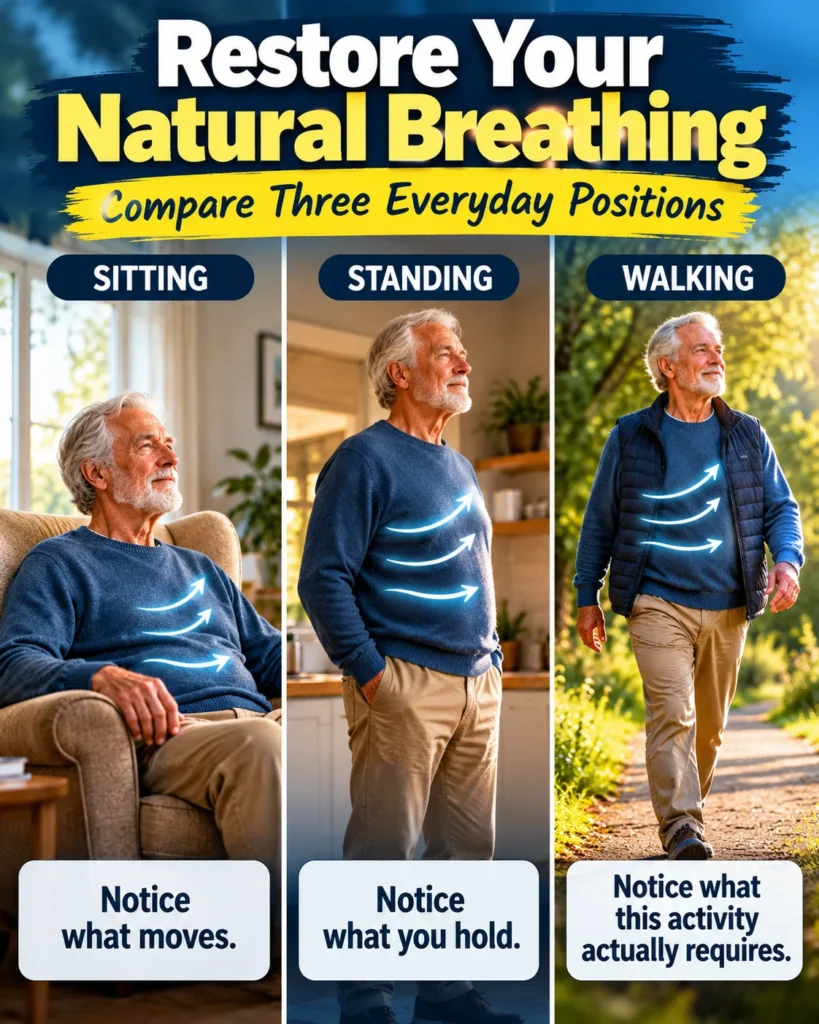
A useful way to start noticing these habits is to ask three questions: What is moving? What am I holding? What does this activity actually require? The first encourages you to notice what happens during ordinary breathing. Do your shoulders rise repeatedly? Is there comfortable movement around your ribcage? Does your abdomen remain deliberately tight, or does it accommodate the natural movement of breathing? The second question examines muscular holding rather than breathing volume. Perhaps you’re pulling your shoulders backwards, clenching your jaw or tightening your stomach without realising it. The third question puts those observations into context. Standing beside the kitchen worktop has different physical demands from lifting something heavy, and walking gently around the house differs from climbing stairs. These questions aren’t a medical diagnostic test. They’re a practical way to recognise habitual effort and consider whether the activity actually requires it.
This approach becomes clearer when we examine everyday movement rather than Restore Your Natural Breathing in isolation. Think about somebody rising from their favourite chair. Before moving, they may instinctively tighten their abdomen, raise their shoulders or briefly hold their breath. Some additional muscular support is normal during physical effort, and particular health conditions may affect how someone breathes during activity. But what happens after they finish standing? Do their shoulders settle, or do they remain lifted? Does their abdomen relax from unnecessary bracing, or does the tension continue? Has the effort ended with the activity, or has part of it carried forward into the next movement? These observations can reveal habits that people rarely notice because their attention is usually directed towards completing the task. Breath becomes a useful clue to muscular behaviour, rather than another bodily function to be consciously controlled.
There is also a danger in becoming too enthusiastic about correction. Once somebody discovers a possible breathing habit, they may spend the remainder of the day checking every inhalation, adjusting their shoulders and worrying about whether their abdomen is moving correctly. That defeats much of the purpose. Breathing is automatic, and constant supervision can make it feel less natural. Not every visible movement of the upper chest is a mistake. Not every change in breathing requires intervention. Some people will discover that their ordinary breathing already feels comfortable and needs no change. Others may notice a small amount of unnecessary muscular tension that settles when they stop deliberately holding themselves in position. Either observation is useful because it replaces assumptions with direct experience. The objective is greater comfort and awareness, not creating another demanding daily routine.
For readers working to restore their natural breathing, the most practical lesson is that the body doesn’t need to demonstrate perfect posture before it deserves to move comfortably. It needs sufficient support for the activity, freedom to make natural adjustments and the ability to respond when demands change. Awareness may reveal where a habitual muscular command has remained active long after it has served its purpose. However, breathing awareness must never replace appropriate medical assessment. Discuss new, persistent or unexplained breathlessness with a healthcare professional and seek emergency help for sudden, severe breathing difficulty. For ordinary, comfortable activities, start simple: observe before trying to correct. That sets up a useful comparison between sitting, standing and walking, where the aim isn’t to manufacture better breathing but to see whether our muscles are doing more work than necessary.
Riley’s Wisdom Drop
“Your body needs enough support for the job, not maximum tension for every job. Notice the effort before you try to change the breathing.”
Restore Your Natural Breathing By Comparing Three Everyday Positions
The simple sitting, standing and walking comparison that reveals how your breathing responds to ordinary movement.
One of the most useful things about investigating breathing habits is that you don’t need expensive equipment, an exercise programme or a complicated collection of instructions. Your own home offers enough everyday situations to start noticing how your body responds. The comfortable chair beside the window, the kitchen worktop and the short walk between two rooms all place slightly different demands on your muscles. Those differences can reveal something that a single breathing exercise might miss. A person may feel relaxed while sitting but introduce unnecessary tension when standing. Another may stand comfortably until they focus on their posture, at which point their shoulders rise, and their stomach tightens. Someone else may find that walking naturally helps their body settle into a more comfortable rhythm. To restore your natural breathing, compare these experiences without deciding beforehand which breathing pattern must be correct.
The comparison begins with a simple distinction between observation and correction. Observation means noticing what happens before deliberately changing it. Correction means attempting to produce a result that you’ve already decided is desirable. When breathing is involved, that distinction matters because people often alter their breathing the moment they start paying attention. They take deeper breaths, push their stomach forward or try to slow their breathing to an imagined standard. Unfortunately, those changes can conceal the very habits they wanted to examine. A more useful approach is to observe comfortable breathing during familiar activities and notice where muscular effort changes. You aren’t trying to discover how much air you can inhale or how slowly you can breathe. You’re examining whether your shoulders, chest and abdomen appear to be working appropriately for the activity you’re performing. The purpose is understanding, not passing a physical examination.
Start With Comfortable Sitting Before Changing Anything
Begin in a supportive chair with both feet resting comfortably on the floor. There’s no requirement to sit like a soldier on parade or hold your spine in an artificially straight position. Let your back receive whatever comfortable support the chair provides, and let your shoulders settle without deliberately pulling them back. Then spend a short period noticing how ordinary breathing feels. You may notice gentle movement around the lower ribs or abdomen. You may notice some movement through the upper chest. These observations describe what your body is doing, not evidence that one pattern is automatically better than another. If breathing feels comfortable, there’s no reason to manufacture a different rhythm. In fact, the less you interfere, the more useful your observation may become. The aim is to discover what happens when your body isn’t being asked to perform anything beyond ordinary sitting.
Now consider the difference between movement and holding. Your ribcage naturally moves as you breathe, while the diaphragm and surrounding structures support the process. However, you may also notice muscular tension that doesn’t seem necessary for sitting comfortably. Perhaps your shoulders stay slightly raised, your jaw is clenched, or your stomach feels deliberately pulled in. None of these observations indicates a medical problem, and everyone develops their own postural habits for restoring natural breathing.
Nevertheless, they provide information worth considering. If your shoulders are held backwards because you believe that represents correct posture, what happens when you allow them to settle? If your abdomen is deliberately tightened, does it feel more comfortable when you stop maintaining that instruction? There’s no need to push, stretch or exaggerate the breath while investigating. You are exploring the relationship between muscular effort and comfort, not attempting to achieve a particular appearance.
The next stage is standing, which introduces a different physical requirement. Your muscles must now maintain balance while supporting your body against gravity. Stand beside a stable worktop or other appropriate support, especially if your balance is uncertain. Position your feet comfortably and let yourself settle before checking your breathing. Avoid immediately pulling your shoulders back or tightening your stomach simply because you’ve stood up. Instead, notice what your body does naturally. Does your breathing feel comfortable? Have your shoulders moved into a fixed position? Are you holding your abdomen more firmly than you were while sitting? Standing naturally requires more postural activity, so the goal isn’t to eliminate all muscular effort. The goal is to recognise whether you are adding deliberate tension that doesn’t seem necessary to stay comfortably upright.
Why Good Posture Helps Restore Your Natural Breathing Comfortably
A key difference exists between standing tall and standing rigidly. A comfortable upright position lets the body make small adjustments through the feet, ankles, hips and spine as balance shifts. The chest and ribcage also need enough freedom to breathe. A rigid position, by contrast, may involve holding several muscles firmly even when the immediate activity requires only modest support. Imagine somebody standing with their chest lifted, shoulders pulled backwards and abdominal muscles tightened. From across the room, their posture might appear impressively upright. Yet appearances cannot tell us whether that person feels comfortable or whether the muscular effort is appropriate. The useful question is whether they can maintain balance, move naturally and breathe without deliberately holding themselves in one fixed arrangement. Good posture should support ordinary activity rather than turn standing into an endurance test.
This becomes especially interesting when someone has spent years trying to correct their appearance. They may believe that relaxing their shoulders means slouching, or that letting the abdomen move naturally means abandoning postural control. Neither conclusion necessarily follows. The body can stay upright without maximum muscular tension and still provide extra support when the task becomes more demanding. The objective isn’t to become completely relaxed while standing, because balance requires ongoing muscular activity. Instead, it’s to allow enough effort for stability without deliberately adding more. That distinction helps restore your natural breathing without turning posture correction into another set of rigid commands. When people stop trying to look perfectly positioned, they may begin noticing how their body actually responds to comfortable standing. Those observations are more useful than judging posture by appearance alone.
After comparing sitting and standing, gentle walking offers a third opportunity to observe. Choose a familiar, safe route around the room or through the house, as long as walking is already comfortable for you. There’s no requirement to increase your speed or challenge your fitness. Walk at an easy, normal pace and let your breathing respond naturally. Your breathing may become slightly quicker or deeper because your muscles are now doing more work. That’s an expected response to physical activity. What matters is whether you add habits on top of that natural adjustment. Do you lift your shoulders unnecessarily? Does your abdomen remain deliberately braced? Are you concentrating so hard on maintaining posture that walking begins to feel less comfortable? Equally, you might find breathing easier during gentle movement because you’re no longer trying to hold yourself in a particular standing position.
The three-position comparison isn’t designed to produce identical breathing in every situation. That would misunderstand how the respiratory system responds to changing physical demands. Sitting quietly, maintaining balance while standing and walking all require different levels of muscular activity. The value lies in recognising the relationship between effort and task. If your shoulders remain comfortable while sitting but become unnecessarily tense whenever you stand deliberately upright, that observation may reveal a postural habit worth examining. If you find yourself holding your breath when rising from a chair, you can notice whether the habit continues after the movement ends. If walking feels comfortable without any special breathing instructions, that’s useful information too. The body doesn’t need one perfect breathing pattern for every activity. It needs the freedom to adapt appropriately.
Restore Your Natural Breathing Without Turning Awareness Into Another Chore
A common mistake is noticing a breathing habit and immediately starting to monitor every breath throughout the day. Somebody notices that their shoulders occasionally rise, so they start checking their posture whenever they sit down. They become concerned about whether their stomach is moving correctly, whether their ribs are expanding sufficiently and whether each inhalation is deep enough. Before long, breathing becomes an activity requiring constant supervision. Yet the original purpose was to recognise unnecessary effort, not to add another layer. Most ordinary breathing happens automatically, and repeatedly forcing adjustments offers no benefit when breathing already feels comfortable. The practical approach is to make occasional observations during familiar activities, notice meaningful differences and then return your attention to everyday life. Awareness should make movement easier to understand, not another demanding responsibility.
Imagine our retired gentleman returning to his kitchen the following morning. Previously, he began his routine by standing as straight as possible, drawing his shoulders backwards and tightening his stomach. This time, he follows a different approach. He stands comfortably, lets his shoulders settle and avoids deliberately holding his chest in one position. Then he observes his ordinary breathing for a short period. He notices that when he stops consciously tightening his abdomen, he feels less muscular effort around his middle. That doesn’t prove his breathing has become medically healthier, and it doesn’t mean everyone should stand the same way. It simply shows him that one habit affects his comfort. Rather than adopting a complicated new breathing routine, he now has a practical observation he can apply whenever he notices himself becoming unnecessarily rigid.
This example offers another useful lesson. Not every discovery demands immediate action. Suppose our gentleman repeats the comparison and finds no noticeable difference between his usual standing position and a more relaxed arrangement. He hasn’t failed an exercise, and he doesn’t need to search for a problem until he finds one. Comfortable breathing doesn’t have to look identical from one person to another. Individual anatomy, fitness, posture and health conditions can influence respiratory movement, while ordinary activities naturally change breathing demands. The observation matters because it lets people decide based on what they notice rather than what they assume should happen. Sometimes the appropriate decision is to reduce unnecessary holding. Sometimes it’s to seek professional advice about persistent discomfort. Sometimes the right response is to carry on because nothing seems to require changing.
Your Everyday Breathing Awareness Apprentice Task
Use one ordinary movement to discover whether muscular effort continues after the job is finished.
Today’s apprentice task doesn’t involve learning a specialised breathing technique. Choose one familiar activity you can do comfortably, such as sitting in your favourite chair, standing beside the kitchen worktop, or walking gently between two rooms. Start by letting your breathing continue naturally. Then ask yourself three questions: What is moving? What am I holding? What does the restore your natural breathing activity actually require? Notice your shoulders, ribcage and abdomen without trying to create a particular result. If you notice you’re deliberately holding unnecessary tension, see whether letting it settle changes your comfort. Avoid taking forced deep breaths, holding your breath or attempting to control your breathing rhythm. The aim is to compare ordinary experiences, not perform a physical challenge. If your breathing already feels comfortable, don’t interfere.
For a little extra insight, compare the same three questions while sitting and then standing, provided both positions feel safe and comfortable. You may find your shoulders stay relaxed in the chair but tighten when you stand. You might notice your abdomen tightens automatically when you try to maintain an upright posture. Alternatively, you may find that your breathing feels comfortable in both positions and that nothing needs changing. Record the observation in a sentence if it helps you remember. For example, you might write, “When I stand and deliberately pull my shoulders back, my chest feels more restricted than when I stand comfortably.” That statement describes a personal experience without turning it into a medical conclusion. Over time, occasional observations may help you recognise which postural habits feel comfortable and which introduce effort that doesn’t appear necessary.
One boundary must remain clear throughout this activity. Breathing awareness is not a substitute for medical assessment, and changes in breathing shouldn’t automatically be attributed to posture or muscle tension. New, persistent or unexplained breathlessness deserves professional attention, particularly when it occurs during previously comfortable activities. Sudden severe breathing difficulty, especially when accompanied by chest pain, fainting or other serious symptoms, requires emergency help. Anyone with an existing heart or respiratory condition should follow their healthcare team’s advice rather than treating general breathing observations as personalised rehabilitation. This exercise is limited to recognising everyday muscular habits during comfortable activity. It should never encourage somebody to push through symptoms, delay treatment or assume that relaxing their shoulders will resolve a medical breathing problem.
A Simple Rule To Carry Into Tomorrow
Today’s lesson’s lasting value is the ability to distinguish necessary effort from unnecessary holding. Your breathing naturally responds when you walk, climb stairs, carry shopping or perform another demanding activity. Your muscles also need to provide appropriate support when you stand, move or maintain balance. None of that effort is automatically wrong. However, a muscular command that stays active after the task ends may be worth noticing. Perhaps your shoulders stay lifted after you’ve put down the shopping, or your abdomen remains tightly braced while you’re simply standing at the kitchen worktop. You don’t need to diagnose the habit or develop an elaborate correction programme. Instead, notice whether your body can return to comfortable movement without deliberately maintaining that extra tension. When working to restore your natural breathing, understanding that difference may prove more useful than chasing an imagined perfect breath.
The next time you catch yourself standing like a soldier awaiting inspection, remember that your body wasn’t designed to remain frozen in one impressive position. It was designed to respond to changing demands through movement, balance and natural adjustments. Breathing is part of that process, and comfortable breathing doesn’t require a permanent set of conscious commands. Let your posture support ordinary activity, and avoid adding unnecessary effort by following an old instruction to stand straight. If a small adjustment makes breathing feel more comfortable, you’ve learned something worth remembering. If nothing changes, there’s no reason to force a different result. Notice the effort before you try to change your breathing. That’s a simple observation worth carrying into every comfortable movement throughout the day.
Riley’s Wisdom Drop
“Good posture isn’t a position you hold until you’re tired. It’s the freedom to stand, breathe and move with the effort the job actually needs.
Today’s Apprentice Task: Build One Front Door
Open to See This Video And This Is What’s Already Built,
Trained & Waiting For Your First Command.
And This Is What’s Already Built,
Trained & Waiting For Your First Command.
The apprentice’s final question: Am I letting my body do the job comfortably, or am I making it work harder than necessary?
Restore Your Natural Breathing 7 Powerful Hidden Clues
Spread the love
Dennis Bartram
Dennis Bartram is the Director of the Active Balance Home or on the Go System Dennis’ journey began in 1969 when he qualified in Swedish remedial massage and in 1974, he began his practice in remedial sports massage and manipulative
Fascia Supports Better Movement And Everyday Balance Fascia Supports Better Movement by helping the body’s muscles, joints, and tissues work as connected…
Everyday Movements Reveal Progress Everyday Movements Reveal Progress You Might Otherwise Miss An ordinary morning can contain a useful change. The Chair…
Better Movement Through Balance, Mobility, and Daily Self-Maintenance Fascia Supports Better Movement Throughout Your Whole Body Your connective tissue forms part of…


 One of the most common reactions to noticing uncomfortable breathing is to take a much bigger breath. When someone notices their chest feels restricted, they lift their shoulders, expand their upper chest and draw in as much air as possible. They may repeat the exercise several times, believing that a larger inhalation must represent better breathing. Yet breathing more forcefully isn’t necessarily the same as breathing more comfortably. During quiet resting breaths, the diaphragm does much of the work. As it contracts, it moves downwards, helping the chest expand so air can enter the lungs. The ribs and surrounding muscles contribute, while the abdominal wall accommodates the changing pressure. The whole arrangement normally works without conscious supervision.