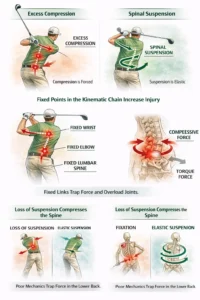
Elite Golf Movement Performance Begins Before The Swing
Your body creates the swing long before the club starts moving.
Why Elite Golf Movement Performance Starts With Organisation
Better movement organisation creates better movement outcomes.
How Elite Golf Movement Performance Improves Consistency
When the body works together, performance becomes easier to repeat.
Elite Golf Movement Performance Through Active Balance Integration.
The most efficient swing comes from the most organised body.
Elite Golf Movement Performance. Most golfers spend years searching for the perfect swing. They buy training aids, watch instructional videos, take lessons, and spend countless hours on the driving range. Yet many still struggle with inconsistency. One day, the ball flies beautifully. The next day, the same swing seems to disappear.
The reason may have very little to do with the swing itself.
Dennis Bartram’s Active Balance approach begins from a completely different starting point. Instead of focusing on the movement you can see, he focuses on the movement system that creates it. Before the club moves. Before the shoulders rotate. Before the hips turn. The body must first organise itself to perform the task efficiently.
When the body is organised, movement becomes easier. When movement becomes easier, performance becomes more repeatable. This simple principle sits at the heart of Elite Golf Movement Performance.
Why Elite Golf Movement Performance Begins With Organisation
The body must organise movement before it can optimise performance.
Golf is one of the most demanding movement skills in sport. The swing appears simple when watching professionals, but underneath that appearance lies a highly coordinated chain of events involving balance, timing, force production, mobility, stability, and neurological control.
Every segment of the body has a role to play.
The feet connect to the ground.
The legs create stability.
The hips generate rotation.
The spine transfers force.
The shoulders guide the club.
The eyes provide feedback.
The nervous system coordinates the entire sequence.
If even one part of that chain struggles to perform efficiently, another part will attempt to compensate. Initially, this compensation may not be noticeable. In fact, many golfers continue playing successfully for years while hidden compensation patterns slowly develop beneath the surface.
Eventually, the body begins paying a price.
Distance decreases.
Consistency drops.
Recovery takes longer.
Small aches become regular companions.
The golfer often assumes ageing is responsible. In reality, the body may simply be working harder than necessary to achieve the same result.
Active Balance seeks to identify these compensations and restore a more organised movement system.
Golf Movement Performance Requires Coordination First
The body performs best when every part knows its job.
Many golf programmes focus heavily on technical positions. Grip. Stance. Swing plane. Club path. These are important, but they only represent the visible outcome of a much deeper process.
Dennis often teaches that movement quality begins long before movement is visible.
Coordination is the body’s ability to organise multiple actions into a smooth sequence. During a golf swing, dozens of muscles and joints must work together with precise timing. If timing becomes disrupted, efficiency suffers.
Imagine an orchestra.
Even the finest musicians will struggle to produce beautiful music if they all play at different times. The problem is not individual skill. The problem is organisation.
When coordination improves, movements feel lighter. Effort reduces. Timing improves. The golfer experiences a sense of flow rather than force.
This is one reason why some players appear effortless despite producing tremendous power. Their bodies are organised efficiently.
The Active Balance approach develops this coordination through movement awareness, balance challenges, neurological integration exercises, and specific movement patterns designed to improve communication throughout the body.
The goal is not simply to move more.
The goal is to move more intelligently.
Elite Golf Movement Performance Depends On Alignment
Alignment allows force to travel efficiently through the body.
Most golfers think of alignment as aiming the clubface or setting up correctly to the target. Dennis uses the word differently.
In Active Balance, alignment refers to the organisation of the body’s structure itself.
When joints are positioned well and movement pathways are functioning efficiently, force can travel through the body with less resistance. Energy flows from the ground upward through the kinetic chain.
When alignment becomes compromised, force leaks occur.
The body compensates.
Additional muscular effort becomes necessary.
The swing becomes harder work.
Over time, these compensations may affect both performance and physical well-being.
This is why Dennis places such importance on foundational areas often overlooked by traditional training systems.
Feet.
Balance.
Walking mechanics.
Postural organisation.
Vestibular function.
Ground connection.
Many golfers are surprised to discover that improving these seemingly unrelated areas can produce noticeable improvements in their swing performance.
The reason is simple.
A stronger foundation creates a more reliable platform for movement.
When the body is aligned effectively, it requires less effort to achieve the same result.
That efficiency becomes increasingly valuable as golfers move through their fifties, sixties, and beyond.
Golf Movement Performance Starts From The Ground Up
The ground is the first source of power in every swing.
One of the strongest themes throughout the Active Balance golf programme is ground connection.
Every powerful golf swing begins with the interaction between the body and the ground.
The feet provide information.
The legs create stability.
The body generates force.
The swing transfers that force into the club.
When golfers lose effective ground connection, they often attempt to compensate by swinging harder with the upper body. This usually increases effort while reducing efficiency.
Active Balance works to improve the golfer’s interaction with the ground.
Better balance.
Better stability.
Better awareness.
Better force transfer.
Rather than creating power through excessive effort, the golfer learns to access power through improved organisation.
This creates a swing that feels smoother, more controlled, and more repeatable under pressure.
It also lays the foundation for the next stage of performance development: mobility, stability, and neurological integration working together as a single, complete system.
Elite Golf Movement Performance Requires Mobility With Control
Freedom of movement creates opportunity for better performance.
Many golfers believe mobility simply means stretching more. While flexibility has value, mobility is much more than touching your toes or increasing your range of motion.
Mobility is the body’s ability to initiate movement when needed and control that movement throughout the entire action.
Golf places unique rotational demands on the body. The hips must rotate. The thoracic spine must rotate. The shoulders must rotate. The body must transition smoothly between backswing and downswing while maintaining balance and stability.
When mobility is restricted, the body immediately begins searching for alternatives.
The lower back may rotate more than it should.
The shoulders may work harder.
The neck may become involved unnecessarily.
The knees may absorb forces they were never designed to handle.
The golfer often feels these compensations as stiffness, discomfort, inconsistency, or loss of power.
The Active Balance approach develops targeted mobility through integrated movement patterns rather than isolated stretching routines. The objective is not to create excessive movement but appropriate movement.
When the correct segments move efficiently, the swing becomes smoother and less physically demanding. Rotation becomes easier. Force transfer improves. Energy waste is reduced.
This is one reason many golfers discover they can generate more clubhead speed while feeling as though they are trying less.
The body is no longer fighting itself.
Golf Movement Performance Needs Stability To Transfer Force
Power requires a stable platform from which to operate.
Mobility without stability creates instability.
Stability without mobility creates restriction.
Elite Golf Movement Performance requires both.
One of Dennis Bartram’s long-standing principles is that stability is not simply about muscular strength. True stability comes from organisation. It comes from the body’s ability to position itself effectively while remaining adaptable to changing demands.
Think about a golfer standing over a shot.
The body must remain balanced while preparing to create rotational force. During the swing, multiple forces travel through the feet, legs, pelvis, spine, shoulders, and arms. If stability is poor, energy is lost along the way.
The result is often inconsistency.
One shot feels effortless.
The next feels forced.
The golfer cannot understand why.
The answer may not lie in the swing mechanics at all. It may lie in the body’s ability to support those mechanics.
Active Balance develops stability through improved balance, postural organisation, neurological awareness, and movement integration. The body learns to create a stronger platform from which movement can emerge naturally.
When stability improves, confidence often improves alongside it.
The golfer feels more secure.
More balanced.
More connected.
More capable of repeating the same movement under pressure.
Elite Golf Movement Performance Depends Upon Neurological Integration
Movement quality begins inside the nervous system.
This is perhaps the area that separates Active Balance from many conventional performance programmes.
Most training systems focus primarily on muscles, joints, and physical conditioning.
Dennis places enormous importance on neurological integration.
The nervous system acts as the body’s communication network. Every movement depends upon information flowing accurately between the brain and body.
When that communication becomes disrupted, movement quality suffers.
Timing becomes inconsistent.
Coordination decreases.
Balance becomes less reliable.
Compensations increase.
The golfer may possess excellent strength and mobility, yet still struggle to perform consistently because the body’s movement software is not functioning efficiently.
The Active Balance system uses specific exercises and movement challenges designed to improve communication throughout the body.
The aim is not simply to move more.
The aim is to improve how the body organises movement.
Dennis often describes this as reducing unnecessary noise within the system.
When noise levels decrease, the body becomes more efficient.
Movement feels clearer.
Responses become quicker.
The golfer develops greater awareness of how the body is functioning during movement.
This creates a platform for more precise, repeatable performance.
Golf Movement Performance Reduces Compensation
The body always compensates, but compensation always carries a cost.
One of the most powerful concepts within the brochure is adaptation.
The body is remarkably intelligent.
Whenever one area becomes restricted, weak, unstable, or inefficient, another area steps in to help. This allows the golfer to continue functioning despite underlying problems.
Initially, this seems beneficial.
The golfer can still play.
Still compete.
Still enjoy the game.
However, every compensation introduces additional physical cost.
Extra effort becomes necessary.
Efficiency decreases.
Movement quality declines.
Consistency becomes harder to maintain.
Over time, the golfer begins working harder to achieve the same result.
This is where many performance plateaus originate.
The golfer focuses on changing the swing, while the real issue lies in the movement system that supports it.
Active Balance seeks to uncover these compensations and restore more efficient movement strategies.
Rather than forcing better performance, the system creates the conditions that allow better performance to emerge naturally.
Elite Golf Movement Performance Creates Long-Term Durability
Headache Migraine Relief Targeting Specific Pressure Points
Dennis Bartram is the Director of the Active Balance Home or on the Go System Dennis’ journey began in 1969 when he qualified in Swedish remedial massage and in 1974, he began his practice in remedial sports massage and manipulative
Frequency and Neurological Recovery Through Active Balance. Discover how clearer sensory information may help your body move with greater confidence. Why Frequency…
Shoulder Blade Movement Matters Fixed Post When Shoulder Blade Movement Starts Changing Why Shoulder Blade Movement Matters Before Ageing What Shoulder Blade Movement…


 The body performs best when every part knows its job.