Body Map Reveals Compensation
Body Map Reveals Compensation Before Independence Begins To Shrink
Small movement detours can quietly change what you still choose to do.
Could Everyday Detours Reveal Where Your Effort Really Goes?
The hand, foot or hip working hardest may expose the hidden pattern.
Dennis Bartram Maps The Workload Before Chasing The Pain
The painful place may be carrying a burden created elsewhere.
The staircase had not become steeper overnight. There were still thirteen steps, the same wooden bannister and the familiar squeak near the top. Yet the person standing at the bottom now paused before beginning. One hand reached for the rail. The stronger foot prepared to lead, and the body leaned slightly towards its trusted side. Nothing dramatic had happened. No alarm sounded, and nobody watching would have called it a crisis. However, Body Map Reveals Compensation begins with precisely these quiet moments. Independence rarely disappears in one theatrical scene. It can become smaller through dozens of movement decisions that gradually require more planning.
Most people do not dream of becoming Olympic athletes in retirement. They want to rise from a chair without launching themselves from both armrests. They want to climb the stairs, carry a shopping bag, work in the garden and walk across uneven ground without searching for something to hold. They want to keep doing ordinary things for themselves. That desire is not vanity. It is dignity expressed through movement. When a familiar task begins demanding unusual preparation, the most useful question may not be, “Which part is getting old?” It may be, “What route has my body started using to complete this job?”
Body Map Reveals Compensation Through Everyday Detours
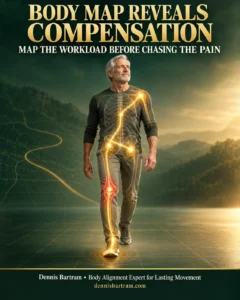 Compensation is not automatically a fault. It is often the body’s practical solution to a difficult situation. If one knee feels uncomfortable, weight shifts towards the other leg. If balance feels uncertain, a hand reaches for the furniture.
If bending towards the floor seems risky, the feet widen, and the back stiffens. These adjustments may help someone finish the task and keep the day going. The difficulty begins when the temporary detour becomes the body’s preferred road. The original problem may settle, but the altered movement can remain, quietly redistributing effort every time the person stands, walks or turns.
This is why Dennis Bartram watches the whole performance rather than staring only at the place making the loudest complaint.
A painful right knee may be doing too much work because the left foot is no longer accepting weight confidently. An aching hip may be controlling a sideways lean created during every step. A tired shoulder may be helping the legs whenever the person pushes out of a chair. The painful area certainly deserves attention, but it may be the hardworking messenger rather than the original troublemaker. Chasing the pain without mapping the workload can mean repeatedly treating the busiest employee while ignoring the department creating all the extra work.
The Painful Side May Be The Hardworking Side
Imagine someone who always starts climbing stairs with the same foot. The preferred leg pulls the body upwards while the other leg follows. At first, the choice seems harmless. After all, the person reaches the top. However, the same preference may show up when standing up from a chair, stepping off a kerb or getting out of the car. One leg repeatedly becomes the leader while the other behaves like a reluctant apprentice. The stronger side may eventually complain because it has accepted more than its fair share of the workload. The pain points towards the overworked side, but the body map reveals the partnership has become uneven.
The map is not a medical scan, and it should not be treated as a diagnosis. It is a collection of visible clues showing how the body completes familiar tasks. Which foot presses hardest into the floor? Does one knee move farther forwards? Does the pelvis shift towards one side? Does the trunk twist to create momentum? Does a hand arrive at the chair before it is genuinely needed? One clue may mean little on its own. When the same detour appears during several different movements, it becomes a pattern worth noticing. Observation comes first. Interpretation follows carefully, without turning every uneven shoulder into a catastrophe.
Body Map Reveals Compensation From The Ground Up
Dennis often begins with the feet because they provide the body’s conversation with the ground. If one foot does not feel secure, the structures above it must respond. The ankle may stiffen, the knee may change direction, the pelvis may shift, and the trunk may lean to keep the head upright. The final complaint could appear several floors above the original adjustment. This does not mean every neck problem begins in the foot or every painful knee is innocent. It means that movement travels through a connected person. Looking only at one joint can miss the route that effort followed to reach it.
Walking makes these routes easier to see because the same decisions repeat with every step. One stride may be shorter. One arm may swing less freely. One foot may turn out while the other points ahead. The person may move beautifully across a clear room but shorten every step when approaching an uneven path. That difference matters. It suggests the movement is being shaped not only by muscles and joints, but also by confidence, balance and the surroundings. Body Map Reveals Compensation: Compare what changes when the task, surface or expectation changes.
Your Body Map Is Written In Repeated Choices
The clearest clues often hide inside habits that no longer feel unusual. A person always carries the shopping bag in the same hand. They turn in one direction when leaving the kitchen. They sit on the same end of the sofa because standing feels easier there. They avoid kneeling in the garden, then gradually stop working near the ground altogether. None of these choices proves that something is seriously wrong. Together, however, they may show that movement options are narrowing. The body has found a successful routine, but success now depends upon arranging the world so the preferred pattern is never challenged.
This is how independence can shrink while somebody still appears completely independent. They continue managing the house, driving, shopping and meeting friends, but more tasks require planning. Chairs are judged by their height. The availability of handrails dictates routes. Uneven paths are quietly removed from the day. The person has not lost the ability to move, yet their confidence in certain movements is fading. The private thought is rarely, “I need perfect biomechanics.” It is much simpler: “I don’t want my world gradually becoming smaller.” That is the human reason for noticing compensation before it becomes the organiser of daily life.
Map The Workload Before Chasing The Pain
A useful body map follows effort rather than hunting for a villain. Begin at the ground and watch what happens above it. Notice where the feet settle, which knee accepts weight, whether the pelvis travels evenly and how the trunk and head respond. Then compare the same pattern during another ordinary action. If the body leans right while standing from a chair, turning and taking the first few steps, the repeated direction is more informative than a single awkward movement. It remains an observation, not a diagnosis, but it gives a professional or the individual a clearer question to investigate.
The same principle can help somebody recovering from an earlier injury. The damaged tissue may have healed, yet the protective movement learned during recovery can remain. A shortened stride, guarded turn or reluctance to load one leg may once have been entirely sensible. Months later, the original need for protection may have changed while the habit continues. The body is not being foolish. It is repeating a solution that previously worked. Progress begins by recognising that old solution and calmly exploring whether a more balanced option is now available, preferably with suitable professional guidance when pain, injury or uncertainty is involved.
Body Awareness Should Create Choices, Not Anxiety
There is no benefit in studying every step as though preparing evidence for a court case. Body mapping should clarify movement, not make someone afraid of moving incorrectly. Human beings are naturally uneven, and no one needs to stand like a shop-window mannequin. Useful clues include repeated changes that affect comfort, confidence or everyday capability. Persistent or worsening pain, unexplained weakness, numbness, sudden balance changes or difficulty completing normal activities should receive appropriate medical assessment. A body map can organise observations and help somebody describe what is happening, but it cannot replace professional diagnosis.
Dennis Bartram’s whole-body approach therefore begins with curiosity rather than correction. Before strengthening the sore side, stretching the stiff place or blaming another body part, watch how the job is being done. The body may be revealing an intelligent compensation that has simply remained on duty for too long. In Section Two, we will use three familiar movements to expose the repeated detours: rising from a chair, turning and taking the first few steps. Together, they can show where effort goes, which side repeatedly takes charge, and whether a quiet movement habit is beginning to limit an otherwise independent life.
Research grounding: The National Institute on Ageing provides expert-reviewed guidance on physical activity and maintaining physical abilities as people grow older. Its resources support regular, appropriate movement while recognising that individual health needs and limitations differ. National Institute on Ageing exercise resources.
Body Map Reveals Compensation During Three Ordinary Movements
The body does not require a treatment room, white coat or expensive machine to reveal its preferred movement route. It provides clues during the ordinary jobs repeated every day. Rising from a chair, turning around and taking the first few steps can show which side accepts the workload, where momentum replaces control and when a hand arrives to provide extra security. These movements do not diagnose an injury or explain every pain. However, when the same adjustment appears in all three, it becomes more than an isolated wobble. Body Map Reveals Compensation by collecting repeated observations rather than judging one imperfect performance.
The first rule is simple: watch the first attempt. People often organise themselves differently once they know they are being observed. The second chair rise becomes smoother. The third turn becomes more deliberate. By then, the person may be demonstrating how they believe they should move rather than showing what usually happens. The unprepared movement often carries the most useful information. Did the feet shuffle backwards? Did one hand grip the armrest? Did the body rock several times before standing? These details show how the person prepares for the task before muscular effort carries it forwards.
The Chair-Rise Test Shows Where The Work Begins
A chair rise looks like one movement, but it contains several connected decisions. The feet must find the floor, the body must move forward, and the legs must bear enough weight to lift the pelvis from the seat. If the feet are too far forwards, the person may create momentum by rocking. If one leg feels more dependable, the body may drift towards it. If balance feels uncertain, the arms may push before the legs have fully joined the job. None of these actions is automatically wrong. They are practical solutions, and the Body Map Reveals Compensation by showing which solution is repeatedly chosen.
Watch the hands without telling the person to stop using them. An armrest may be entirely appropriate, particularly when pain, weakness or poor balance is present. The clue lies in the timing and distribution of effort. Does one hand push much harder than the other? Does the person pull upon nearby furniture even though the chair itself is stable? Does the hand reach down before the feet have settled? That early grab may reveal uncertainty rather than a simple lack of leg strength. The body is making the task feel safer by creating another point of contact with the world.
Body Map Reveals Compensation Before The First Step
Standing upright does not complete the chair-rise story. The next few seconds may reveal even more. Some people reach standing and immediately set off, using forward momentum to carry them into the first step. Others stand, pause and search for their balance before moving. One foot may step confidently while the other stays planted like a reluctant passenger. The head may move forwards, the shoulders may stiffen, and the eyes may search for the nearest secure surface. These are not signs of personal failure. They are clues showing how the nervous system, balance and physical structure are cooperating to manage uncertainty.
The first step matters because it transfers the body from a broad, fairly stable standing position onto one supporting leg. That brief moment demands trust. If the person repeatedly begins with the same foot, the opposite leg may be the one they trust to carry their weight. The moving foot gets all the attention, but the supporting side may be doing the harder work. This is another reason not to assume that the most visible movement identifies the source of the pattern. The body map follows weight and effort, not merely the limb travelling through the air.
The Supporting Leg May Tell The Bigger Story
Imagine somebody who always steps forwards with the right foot. It would be tempting to call the right side dominant. Yet during that first step, the left leg remains beneath the body and provides the platform. If the person quickly moves the right foot because standing on the left feels secure, the left side may actually be the trusted side. Alternatively, the right foot may move first because the person is eager to remove weight from it. The same visible action can therefore have two different explanations. Observation identifies the pattern, but you need careful comparison before you suggest what it means.
This is where rushed advice can create confusion. Telling somebody to lead with the opposite foot may change the appearance without addressing the reason for the original choice. The movement could become less safe, more uncomfortable or simply more awkward. Dennis Bartram’s approach does not begin by correcting every difference. It begins by asking whether the pattern appears elsewhere. Does the same leg lead upstairs? Which foot steps off the kerb? Which leg accepts the body when turning? A repeated preference across several tasks provides a stronger clue than one carefully staged exercise.
Turning Exposes Compensation That Straight Walking Can Hide
Straight walking can look remarkably comfortable because the person has practised it for a lifetime. Turning interrupts that familiar rhythm. The feet must adjust direction, the pelvis and trunk must reorganise, and the head must remain balanced while the destination changes. Some people turn through several small steps. Others plant one foot and swing the body around it. One direction may appear smooth while the other resembles a delivery van attempting a three-point turn in a narrow street. When Body Map Reveals Compensation during turning, it often exposes a preference that straight walking has learned to disguise.
Small turning steps are not automatically a problem. They may be sensible on a slippery floor or when balance feels uncertain. The useful comparison is between directions. Does turning left require more steps than turning right? Does one foot pivot while the other remains rigid? Does the upper body begin turning before the feet are ready to follow? Perhaps the person looks towards the destination but leaves the pelvis behind, twisting through the middle to complete the job. These differences help trace how movement moves from the ground upward.
Compare The Pattern Instead Of Chasing Perfection
The purpose of comparing left and right is not to make both sides mechanically identical. Human bodies develop preferences through work, sport, injury, habit and the practical business of living. A retired joiner may have spent decades standing with one foot forwards. A golfer may rotate more comfortably towards one side. Somebody who carried children upon the same hip may still favour that position years later. The important question is whether the preference remains useful or has begun creating extra effort, discomfort or avoidance. A body map should reveal choices, not manufacture worry about natural differences.
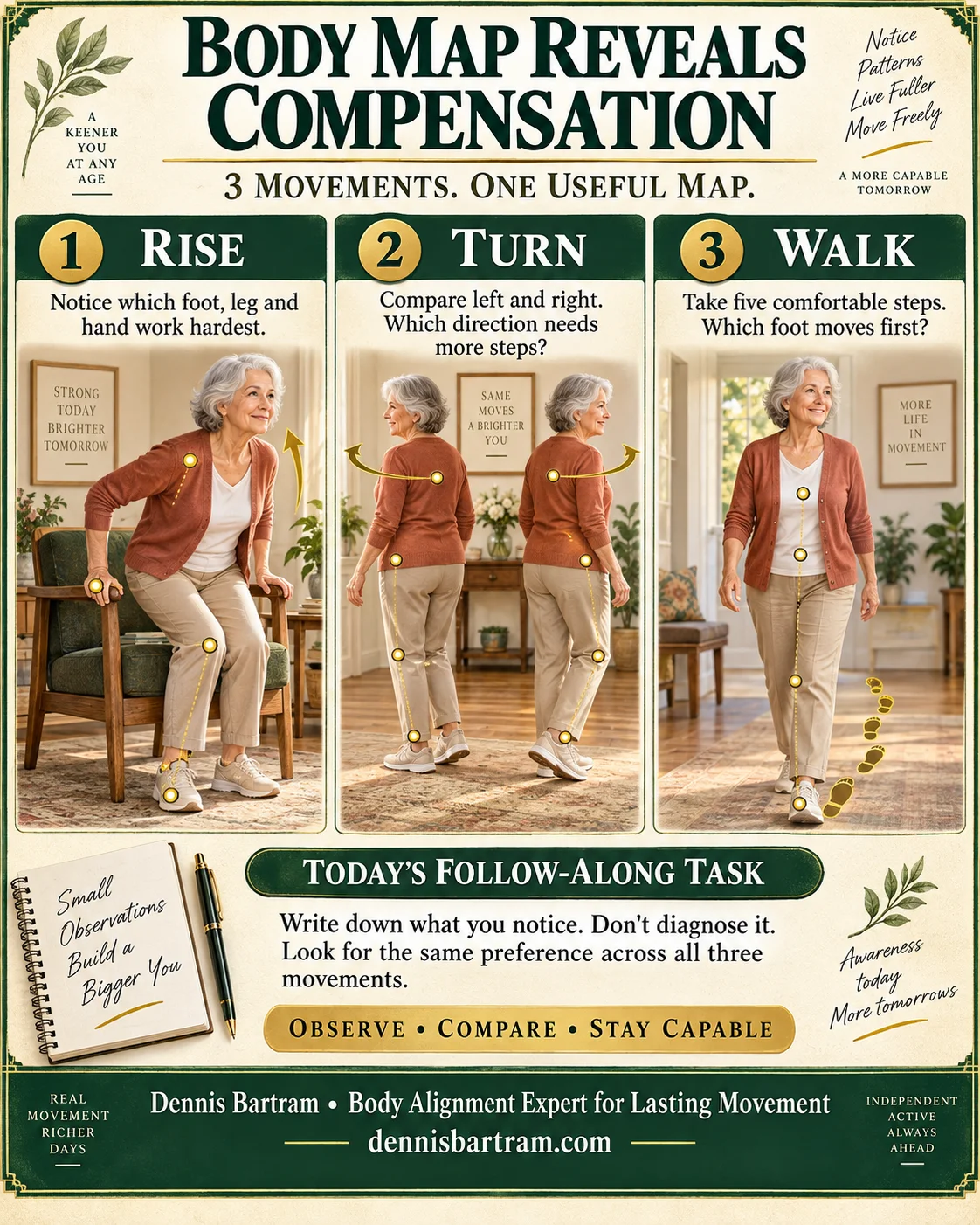
Three movements now provide three pieces of evidence. During the chair rise, notice which foot and hand contribute most. During the turn, observe which direction requires more preparation. During the first steps, watch which leg accepts the supporting role. If each task produces a different answer, there may be no obvious pattern. If all three shift the workload towards the same side, a more consistent compensation may be present. This still does not identify a medical cause. It does, however, provide clearer information than simply saying, “My knee hurts when I move.”
Body Map Reveals Compensation Without Blaming The Body
Language matters when people are trying to remain confident movers. Describing a leg as bad, a back as ruined, or a hip as worn out can sound dangerous before it begins. The body may then approach every task expecting difficulty. A calmer description keeps possibilities open: one side currently accepts less weight; one turn feels less certain; one hand contributes more during standing. These statements describe what happened without pretending to know why. They also provide something useful to compare later, particularly after gentle practice, professional treatment or a change in everyday habits.
This matters to the independent mover who has quietly begun arranging life around a preferred side. They may still complete every task, but the furniture provides convenient handholds, the stronger leg always leads, and ground-level garden jobs are repeatedly postponed. The real concern is not whether the movement would impress a fitness instructor. It is whether the person retains enough options to continue living as they choose. Body Map Reveals Compensation before those options become so narrow that one missing handrail or unusually low chair turns an ordinary outing into an obstacle course.
Small Observations Can Protect Everyday Independence
The most valuable change may be noticing a pattern early enough to discuss it clearly. Instead of reporting that everything feels stiff, someone can explain that they push harder through the right hand, avoid loading the left foot and require extra steps when turning left. That information can help an appropriate healthcare or movement professional observe the relevant tasks. It can also prevent the person from chasing a different remedy for every complaining joint. The knee, hip, shoulder and back may be part of one repeated strategy rather than four unrelated mysteries.
Self-observation must remain within sensible boundaries. Sudden weakness, unexplained numbness, severe or worsening pain, repeated falls, dizziness or a marked change in walking requires appropriate medical attention. Nobody should deliberately remove a support they currently need or force weight through a painful limb merely to make both sides appear even. Safety comes before symmetry. The aim is to understand how the body currently completes the task, not to prove bravery or undo years of adaptation in one enthusiastic morning.
Dennis Bartram Turns The Body Map Into A Practical Starting Point
Dennis Bartram’s method begins with the person’s real life. The chair they use, the stairs they climb and the routes they walk matter more than an impressive movement performed once under perfect conditions. If somebody wants to continue gardening, getting onto the floor may deserve attention. If their priority is walking to the shops, turning, stepping off kerbs and carrying a light bag may provide the more useful map. The best movement assessment connects directly with the independence the person wants to protect. It answers not only, “How does the body move?” but also, “What does this movement allow the person to keep doing?”
That is the larger lesson behind Body Map Reveals Compensation. Pain may identify the place carrying the burden, while everyday movement reveals how that burden arrived. Compensation may have begun as an intelligent act of protection before becoming a restrictive habit. By watching several familiar tasks, following the workload from the feet upwards and separating observation from assumption, we gain a calmer picture of the whole person. The objective is not perfect posture or matching left and right sides. It is to preserve useful choices, confident movement and the quiet dignity of continuing to manage ordinary life.
Open to See This Video, And This Is What’s Already Built,
Trained & Waiting For Your First Command.
Body Map Reveals Compensation Apprentice Task
Choose a firm chair that you normally use and keep any necessary support within reach. Rise once at your usual speed without deliberately changing your technique. Notice which foot, leg and hand appear to contribute most. After you are standing securely, turn once in each direction and observe whether one turn requires more steps or preparation. Finally, walk five comfortable steps and notice which foot moves first. Write down only what you observed. Do not diagnose the reason or label either side as good or bad. Your task is to discover whether the same movement preference appears across all three activities.
If no clear pattern appears, that is useful information. If the same side repeatedly takes charge, you have found a question worth exploring rather than a fault demanding immediate correction. Keep the notes for comparison and seek suitable professional guidance if the movement is painful, worsening or affecting your safety. The goal isn’t to force your body into somebody else’s idea of perfection. It is to understand how you currently move so that everyday independence remains something you practise, protect and continue to enjoy.
➡️⭐⭐⭐⭐⭐⭐👉