Restore Natural Body Alignment Stability Through Movement
Restore Natural Body Alignment Before Chasing The Pain
The painful place may be carrying the burden of a problem elsewhere.
Restore Natural Body Alignment From The Ground Up
Your feet can influence the way your knees, hips and back respond.
Restore Natural Body Alignment And Reduce Hidden Strain
Better organisation may help the whole body move with less effort.
Restore Natural Body Alignment Through Calm Self-Maintenance
Gentle daily attention can often achieve more than forceful correction.
There is a familiar routine in homes across Britain.
The knee begins to ache, so we rub the knee. The lower back stiffens, so we stretch the lower back. The heel complains when we first step out of bed, so we roll it over a bottle, pull the toes backwards and hope it settles before breakfast.
Sometimes it does.
Then, a few days later, the same pain quietly returns.
After more than fifty years of working with the human body, Dennis Bartram began to notice something that changed the direction of his work. Local treatment often helped, but the results appeared to last longer when the body was first brought into better alignment.
The sore muscle still mattered. The tender joint still deserved attention. Yet the painful area was not always where the original problem had begun.
That distinction lies at the heart of Restore Natural Body Alignment.
It asks us to stop viewing the body as a collection of separate parts and begin looking at it as one connected, adaptable structure.
Natural Body Alignment Before Treating The Sore Spot
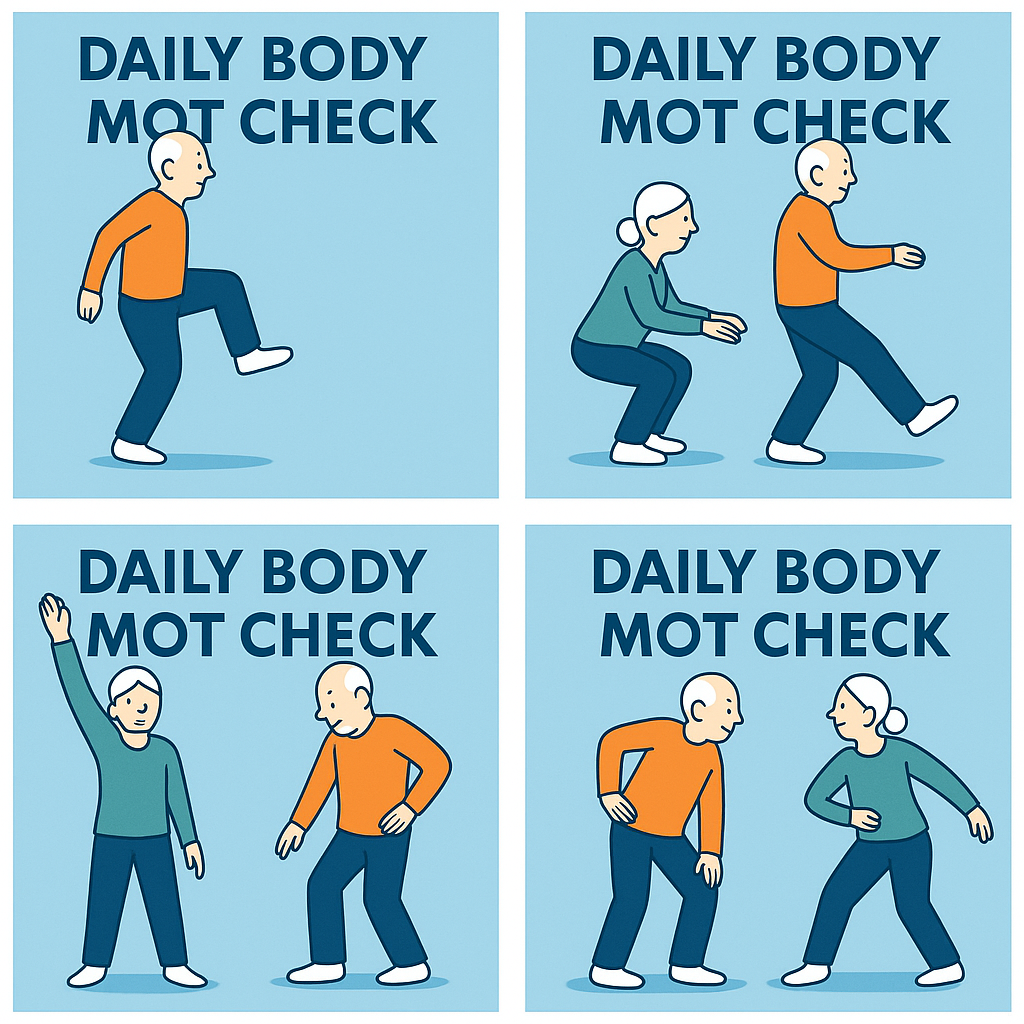 When something hurts, naturally, that is where our attention goes.
It is perfectly reasonable. Pain has a remarkable ability to dominate the conversation. A stiff hip does not politely wait in the background while you make tea. A painful heel announces itself the moment it touches the bedroom floor.
The danger is assuming that the loudest part of the body must also be the guilty part.
Dennis puts it more simply. The painful area may be the victim rather than the villain.
Imagine a roof beginning to sag because one supporting wall has shifted. You could keep patching the crack in the ceiling, but until you examine the support underneath, the crack may continue to return.
The body often behaves in a similar way.
If one area loses comfortable movement, another area adapts. It may take additional weight, rotate differently or tighten to create stability. That compensation can be useful for a while because it allows us to continue walking, working and carrying on with ordinary life.
Eventually, however, the part doing the extra work may begin to complain.
This is why Restore Natural Body Alignment begins with a wider question.
Not merely, “Where does it hurt?”
But, “What is making this area work so hard?”
Restore Natural Body Alignment By Reading The Foot
The foot is a sensible place to begin because it is where the body meets the ground.
It receives your weight, responds to the surface beneath you and helps send information upwards every time you stand or take a step. It is not simply a solid block at the bottom of the leg. It is a responsive structure designed to adapt.
Dennis describes what may happen when the inside arch begins to drop excessively.
As the foot rolls inwards, the shin bone may begin to rotate inwards with it. The knee then has to respond. The hip may alter its position, and the pelvis and lower back may make further adjustments to keep the body upright.
That does not mean every dropped arch creates pain. Nor does it mean every knee, hip or back problem comes from the foot.
Human bodies are not that simple.
It does mean that the position and movement of the foot can influence pressures elsewhere. A person may spend months concentrating on the knee without realising that the knee is repeatedly adapting to what is happening below it.
Here’s the point.
The foot may not hurt at all.
It may continue doing its job quietly while the knee, hip or back carries the consequences. By the time discomfort appears, the original compensation may have become so familiar that it feels normal.
This is where experienced observation matters. The aim is not to frighten people into believing they are badly misaligned. It is to notice whether the body has found a less efficient way of standing and moving.
Through Natural Body Alignment Through The Body’s Compass
Dennis often compares parts of the body to guidance instruments.
The feet tell the nervous system what is happening beneath us. The joints provide information about position and movement. The eyes and inner ears help us understand where we are in space.
Together, these signals allow the brain to make thousands of tiny adjustments without conscious thought.
You do not need to calculate how far to lean when you step off a kerb. You do not issue written instructions to your ankle when the garden path is uneven. Your nervous system gathers information and responds before you have time to think about it.
However, when the information coming from one part of the body changes, the rest of the system must adapt.
If the pelvis tilts, the spine may alter its curves. If the head shifts, the body may redistribute weight through the feet. If one ankle becomes restricted, the opposite hip may work harder during walking.
Dennis described this as having several gyroscopic compasses within the body, each helping to tell the brain where we are.
When one compass is slightly tilted, the body does not collapse. It adjusts.
That is both its brilliance and its weakness.
Compensation keeps us moving, but it may also conceal the original problem until another part begins to ache.
Try Natural Body Alignment Routine Before Blaming Your Age
There is a sentence many older people hear far too often.
“Well, you are getting on a bit.”
Age does bring change. Recovery may take longer, tissues may become less forgiving and old injuries can make themselves known. Yet age alone does not explain every ache, limp or restriction.
Sometimes the body has simply been repeating the same compensation for years.
A retired tradesman may still carry the effects of climbing ladders, lifting boilers or working beneath sinks in awkward positions. A keen gardener may always kneel on the same side. A driver may spend hours with one leg working the pedals while the pelvis remains slightly twisted.
The occupation may have ended, but the movement habits can remain.
This is why Restore Natural Body Alignment is not about trying to make an older body behave like a twenty-year-old one.
It is about helping the body find a more comfortable version of itself.
The aim is not perfection. Nobody stands with textbook symmetry throughout the day. The aim is to reduce unnecessary strain and give the body more movement choices.
That is a far more respectful way to work with someone who has lived, laboured and adapted for decades.
Restore Natural Body Alignment Without Forcing A Correction
Many people have been taught that discomfort must be fought.
If a muscle feels tight, stretch it harder. If the sole of the foot is tender, press more firmly. If a joint feels stiff, push until it moves.
That approach can occasionally leave the body feeling threatened rather than helped.
A guarded body rarely relaxes because it has been bullied.
Dennis’s developing self-maintenance system takes a calmer route. It uses particular positions, movements and pressure points to encourage the body to reorganise without forcing it.
This matters because the nervous system is always involved in movement.
If a technique feels threatening, the body may tighten in defence. If it feels controlled and manageable, the nervous system may become more willing to release unnecessary tension.
The difference can be surprisingly small.
A gentler pressure.
A shorter movement.
A slower breath.
A position that allows the body to feel supported rather than stretched to its limit.
None of this means serious or persistent symptoms should be self-diagnosed. New weakness, unexplained numbness, severe pain or rapidly worsening symptoms deserve proper medical assessment.
For everyday stiffness and recurring mechanical discomfort, however, self-maintenance may help people become active participants rather than passive recipients.
Createing Natural Body Alignment And Making The Correction Last
A practitioner may help place the body in a better position, but what happens afterwards is equally important.
The moment you return to your usual chair, car, workshop, garden or golf course, the old demands begin again. Unless the body is given a way to maintain the change, familiar habits may gradually return.
This is why Dennis no longer sees alignment as something that should only be done to a person.
It should also be understood by the person.
A trained practitioner may identify the areas needing attention and help the body begin from a better starting position. The individual can then learn simple ways to support those improvements at home.
That is the real promise behind Restore Natural Body Alignment: learn how your own body responds, where it compensates and what gentle actions may help it recover more comfortably.
Not a miracle cure.
Not a claim that every pain can be eliminated.
It is the chance to learn how your own body responds, where it compensates and what gentle actions may help it recover more comfortably.
The next stage takes us deeper into the foot itself: the fascia that holds and connects us, the nerve travelling behind the inner ankle and the reason Dennis believes some stubborn foot problems cannot be solved by stretching the sore spot alone.
Restore Natural Body Alignment By Helping Nerves Move
The video turns to a structure few consider: the posterior tibial nerve.
This nerve travels down the lower leg, passes behind the inner ankle and continues into the foot. It must move comfortably beside muscles, fascia and other tissues as the ankle and toes bend.
Dennis’s point is straightforward. If surrounding tissues become tight or irritated, the nerve may not move freely. The answer is not to drag or aggressively stretch it. Nerves respond better to calm movement than force.
Active Balance self-maintenance is not a hard exercise routine. It uses gentle pressure and small movements to encourage easier movement through the tissues.
The aim is comfort, not punishment.
Balance Body Alignment Through Fascia And Footwork
Fascia is the connective tissue that helps support and link the body. Under the foot, it contributes to the arch and helps deal with loads created by standing and walking.
When the sole of the foot feels tender, many people attack it with a hard ball or prolonged stretching. A small massage ball can help, but more pressure is not always better.
Used slowly, ball work may help someone notice stiff or sensitive areas. It may also encourage the tissues of the sole to move with less guarding.
The important word is gently.
Roll across the foot rather than grinding into one painful point. Keep breathing normally. Stop if the movement produces sharp pain, numbness or strong tingling.
Dennis also draws upon pressure-point work. He sees these areas not as magical buttons, but as practical places where gentle stimulation may influence tension, circulation and body awareness.
The foot becomes a doorway into the larger system.
Restore Natural Body Alignment And Put Recovery In Your Hands
The wider Active Balance plan is not simply to train practitioners who perform corrections and send people home.
It is to teach those practitioners how to pass on suitable self-maintenance.
A person may first receive an assessment and alignment session. They can then learn the points and movements most relevant to their body, occupation, hobby or sport.
That matters because the demands placed on a retired plumber are different from those placed on a golfer, gardener or office worker. A useful recovery plan should reflect real life rather than demand that someone abandons everything they enjoy.
It is informed support followed by greater independence.
You learn what tends to tighten, where your body compensates and what you can do before a small warning becomes a larger setback.
Persistent heel pain, weakness, loss of sensation or worsening symptoms still require qualified assessment. Self-help should support good healthcare, not replace it.
Yet there is something quietly powerful in understanding that the body is not merely wearing out.
It is communicating.
When you learn to listen, align and move with less force, recovery stops feeling like a mystery performed by somebody else.
It becomes a skill you can begin practising for yourself.