Nervous System Shapes Effort
Nervous System Shapes Effort Before Movement Even Begins
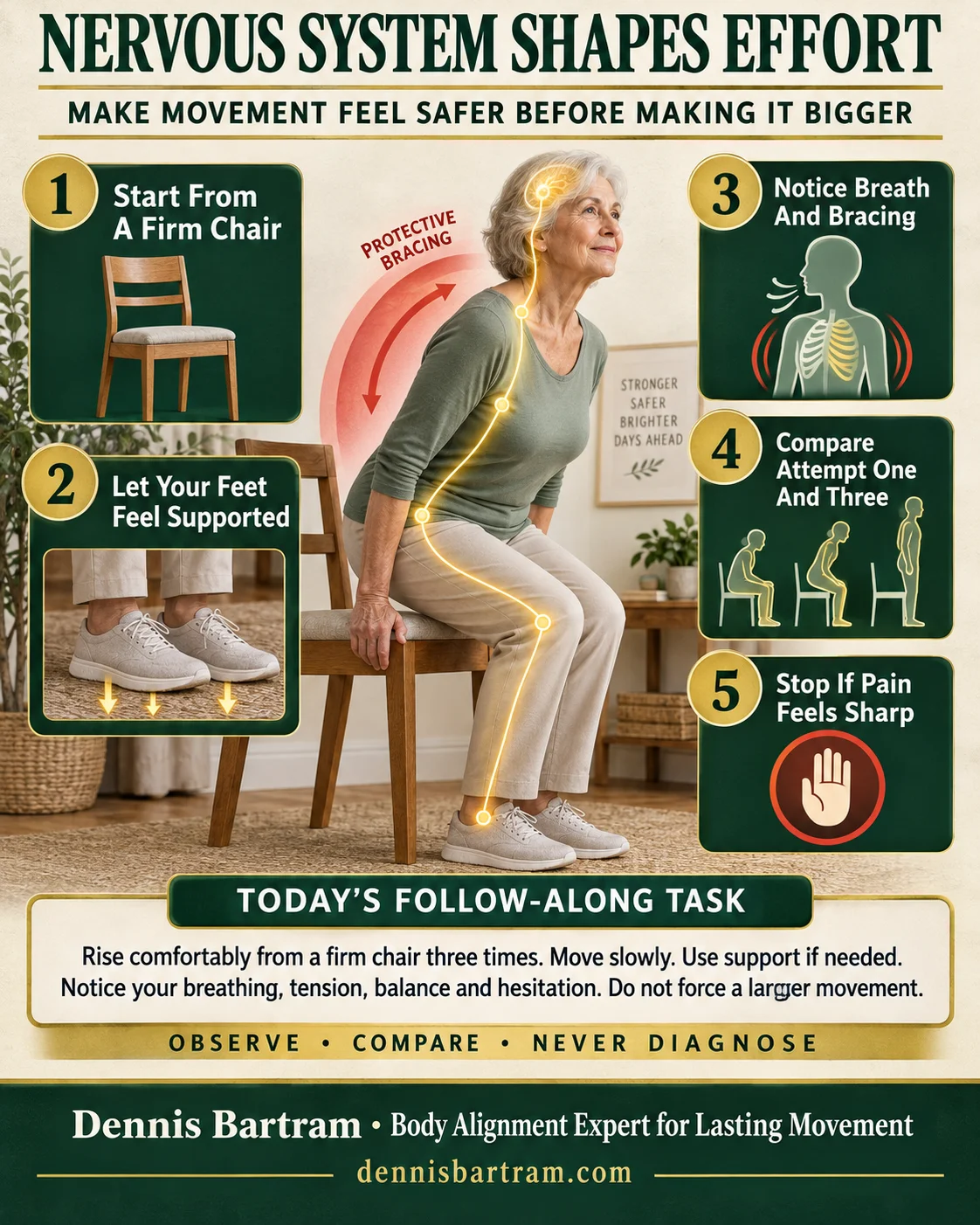
The body may apply its protective brakes before you leave the chair.
Could Nervous System Shapes Effort Explain Your Hesitation?
An ordinary movement can feel demanding even when strength remains available.
Dennis Bartram Reveals How Nervous System Shapes Effort
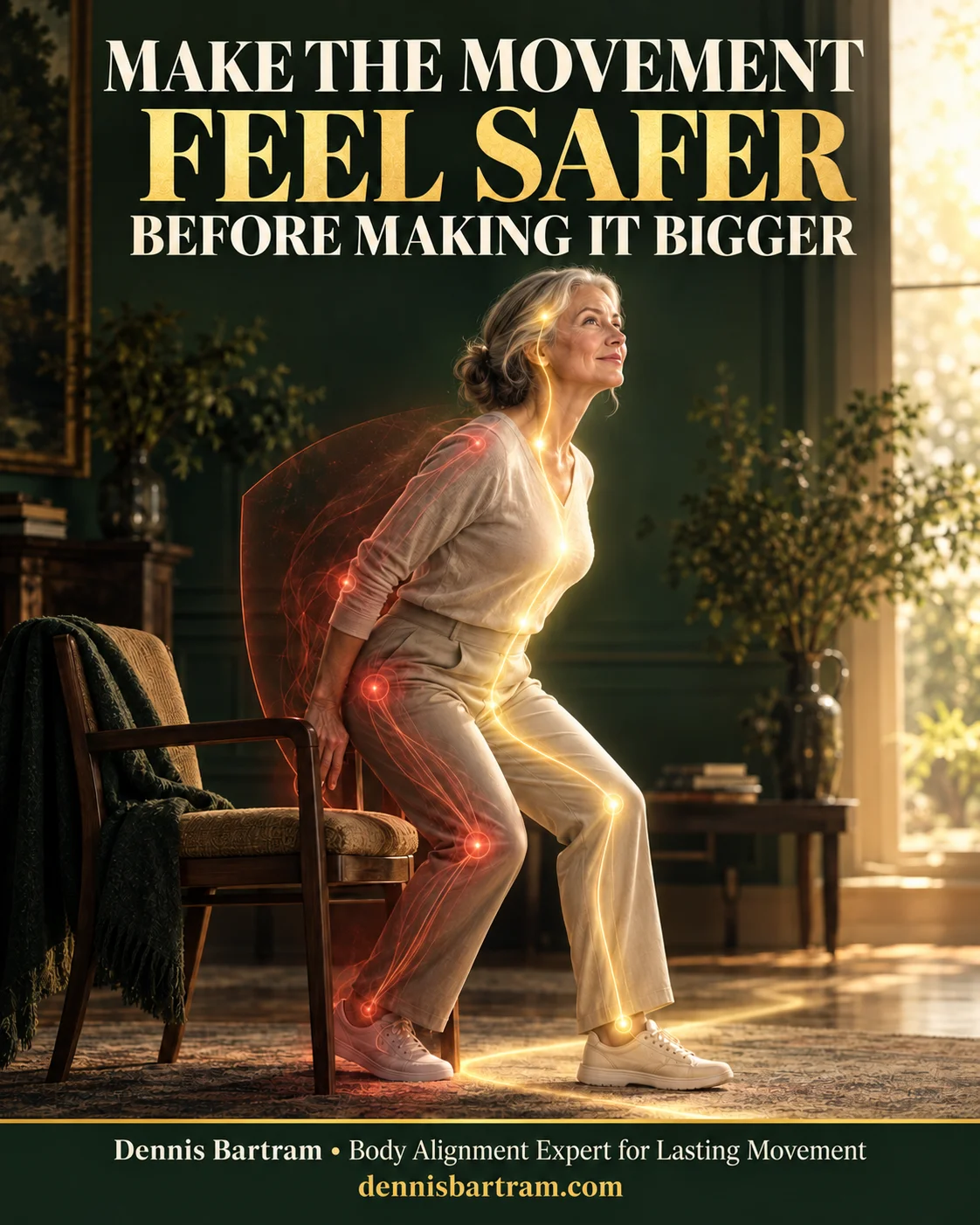
Make the movement feel safer before asking the body for more.
Nervous System Shapes Effort Before Movement Even Begins. The body may apply its protective brakes before you leave the chair. Could the Nervous System Shape Effort and Explain Your Hesitation? An ordinary movement can feel demanding even when strength remains available.
Dennis Bartram Reveals How the Nervous System Shapes Effort
Move feel safer before asking the body for more.
The chair had not changed overnight. It still had four legs, two wooden arms and the same faithful cushion that had survived years of newspapers, television dinners and visiting grandchildren. Yet this morning, standing up from it seemed like a major engineering project. The feet shuffled backwards. One hand held the armrest. The breath stopped, the shoulders tightened, and the body paused before moving. Most people witnessing this little performance would reach an immediate verdict: the legs are getting weaker. However, Nervous System Shapes Effort offers another possibility. Sometimes the body isn’t short on power. It is simply reluctant to release it.
That distinction matters because effort and strength are not the same thing. A person may possess enough muscular strength to stand, turn or take a step, while the movement still feels unusually demanding. Balance, coordination, confidence, breathing and the expectation of discomfort may all influence how much effort the task appears to require. The nervous system continually receives information from the body and surroundings before organising a response. It does not wait politely until movement has begun. It prepares, adjusts and sometimes protects. So when somebody grips the chair as though it is about to leave without them, the hand may reveal more than weak legs.
Dennis Bartram has spent more than fifty years watching what people do before listening only to what they say. Someone may report that standing feels difficult, yet the revealing moment occurs a second earlier. The chin lifts. The breath is held. The feet lose their firm contact with the floor. One shoulder rises while the person prepares for an expected struggle. None of these clues provides a medical diagnosis, nor should they be treated as proof that the nervous system is causing every difficulty. Nevertheless, they show why observation matters. The movement story begins before the bottom leaves the chair.
 This is where the phrase Nervous System Shapes Effort earns its place in Dennis’s whole-body approach. Muscles produce force, joints allow movement and fascia helps connect the working structure. However, these parts do not organise themselves. The nervous system receives sensory information and helps coordinate the response. It also influences involuntary processes such as breathing and heart rate.
When a person is uncertain, uncomfortable or poorly balanced, the resulting movement may include extra tension and hesitation. The body is not necessarily misbehaving. Right now, choosing caution feels like the safer option.
When Nervous System Shapes Effort, The Body May Apply Its Brakes
Imagine driving towards a narrow country bridge after dark. The car hasn’t lost horsepower, but your foot eases off the accelerator. You sit forward, grip the wheel and reduce speed because the road ahead looks uncertain. Something similar can happen during movement. The legs may be capable, yet the body approaches the task cautiously. This does not mean fear is imaginary or that discomfort should be ignored. It means the nervous system can change the way available strength is used. The engine may still be running perfectly well while the driver has wisely decided not to put their foot down.
The first attempt often tells the best story. Watch somebody rise from a chair for the first time that morning, and you may notice a collection of protective preparations. They push heavily through one arm. They rock backwards before moving forwards. Their face tightens, and their breath disappears until the job is finished. If they repeat the same movement comfortably, the second or third attempt may look different. The feet settle, the breath continues, and the body travels forwards with less ceremony. This does not prove that a neurological brake has been released. It does reveal that effort can change before measurable strength has had time to change.
That observation gives us a useful rule: never judge a movement by distance alone. Two people may rise from identical chairs and finish at the same height, yet complete entirely different journeys. One breathes steadily, transfers weight through both feet and arrives upright without drama. The other holds their breath, twists to one side and needs several seconds to recover. Both technically completed the movement, but their nervous systems organised the task differently. Nervous System Shapes Effort encourages us to notice the quality, preparation and aftermath of movement rather than awarding a simple pass because somebody reached the finishing line.
The same principle appears while walking. A person may take perfectly respectable steps across their own living room but become smaller, stiffer and more cautious on an unfamiliar path. The muscles have not weakened between the carpet and the garden gate. The information has changed. The surface looks different, the surroundings feel less predictable, and balance demands greater attention. That extra caution may be entirely sensible. However, if it starts shrinking everyday life, the answer isn’t always to shout “try harder.” A better starting point may be to discover what would make movement feel more secure.
Making Movement Feel Safer Can Change How Effort Appears
This is not an invitation to talk the body out of genuine pain or ignore an underlying condition. New, severe, worsening or unexplained symptoms deserve appropriate professional assessment. Instead, it is a practical sign that more force isn’t the only tool available. A firm chair may feel safer than a deep sofa. Stable footwear may feel more reliable than loose slippers. A clear floor, good lighting and a nearby support can reduce uncertainty. When Nervous System Shapes Effort, changing the starting conditions may reveal abilities masked beneath unnecessary struggle.
Dennis’s approach starts with making the movement understandable. Both feet are allowed to find the floor. The body is given time to lean forwards rather than being ordered upwards immediately. Breathing remains part of the movement instead of being suspended until the danger has passed. The task is performed slowly enough for the person to notice what is happening. None of this guarantees that standing will suddenly become effortless. However, it replaces a confused demand with a clearer job. The nervous system receives a more organised starting position, while the person gains information instead of simply surviving another difficult attempt.
Support also differs greatly from surrender. Using the arms of a chair while learning how the movement feels does not automatically mean somebody has failed. Support may provide enough security for the feet, knees, hips and trunk to coordinate more calmly. Once the movement feels dependable, support can be reviewed with appropriate professional guidance. Removing assistance too early may turn a useful observation into a test of courage. Nervous System Shapes Effort reminds us that confidence is not decorative. It can influence how freely somebody is prepared to move.
Breathing offers another visible clue. People frequently hold their breath when lifting something heavy, expecting pain or preparing for uncertainty. During an ordinary chair rise, this may increase the sense that a tremendous effort is underway. The answer is not to force an exaggerated breathing routine while attempting to stand. Instead, notice whether breathing disappears at the most demanding moment. If it does, that observation belongs beside foot pressure, hand support and balance. Dennis does not need one clue to explain everything. He follows several clues until the wider movement pattern begins to make practical sense.
Nervous System Shapes Effort Without Telling The Whole Story
Be careful, because fashionable explanations can quickly become universal answers. Not every difficult movement is a nervous-system protection pattern. Reduced strength, joint problems, drug effects, illness, injury, fatigue and many other factors may affect mobility. Persistent difficulty deserves a proper assessment, not a confident guess made beside the dining table. Nervous System Shapes Effort is not meant to replace medical reasoning. Its value is that it prevents strength from automatically taking the blame when the person’s breathing, balance, confidence and preparation may also deserve attention.
The practical question therefore changes. Instead of asking, “How can I force this movement to become bigger?” we ask, “What would help this movement feel clearer and safer?” That may mean choosing a firmer chair, slowing the first attempt, placing both feet comfortably or allowing a stable hand support. It may mean stopping because the movement produces sharp pain, dizziness, sudden weakness or another concerning symptom. Safety is not softness. It is the condition that lets you explore useful movement without turning an everyday task into an unnecessary battle.
Tomorrow morning, the chair will still have four legs, two wooden arms and that veteran cushion. Yet the person rising from it may look at the task differently. They need not accuse their legs before gathering the evidence. One can notice the feet, breath, hands, balance, and hesitant pause. They can compare the first comfortable attempt with the third without forcing either one. That is the practical lesson behind Nervous System Shapes Effort: movement may become easier to understand when we observe how the body prepares, not simply whether it reaches the finish.
Section Two will turn those observations into a calm five-part movement check. We will examine the starting position, foot support, breathing, protective bracing and the difference between the first and third comfortable attempts. The purpose will not be to diagnose the nervous system or promise a cure. It will help readers recognise how effort is organised and prepare a clearer account for an appropriate healthcare professional when needed. Before asking the body for more movement, we will first discover what might help it feel safe enough to begin.
Research grounding: the autonomic nervous system helps regulate involuntary processes including respiration and cardiovascular activity, while pain is recognised as both a sensory and emotional experience. These principles support careful observation but do not diagnose the cause of an individual movement problem. NCBI Bookshelf, National Institute of Neurological Disorders and Stroke.
The chair now stands in the middle of the room like a witness waiting to give evidence. Nothing dramatic is required. There will be no stopwatch, no scorecard and certainly no retired drill sergeant shouting from the mantelpiece. The purpose is to observe how the body organises one familiar movement. When Nervous System Shapes Effort, the clues often appear before the person is fully upright. Feet reposition, fingers tighten, breath pauses, and the eyes search for security. Dennis Bartram’s five-part check gives those small details a useful place to go, without pretending they provide an instant diagnosis.
The chair now stands in the middle of the room like a witness waiting to give evidence. Nothing dramatic is required. There will be no stopwatch, no scorecard and certainly no retired drill sergeant shouting from the mantelpiece. The purpose is to observe how the body organises one familiar movement. When Nervous System Shapes Effort, the clues often appear before the person is fully upright. Feet reposition, fingers tighten, breath pauses, and the eyes search for security. Dennis Bartram’s five-part check gives those small details a useful place to go, without pretending they provide an instant diagnosis.
Begin by choosing a firm chair that does not slide, swivel or disappear beneath you like an enthusiastic sofa. Place it on a stable surface with enough clear space in front. If you normally use a walking aid or dependable support, keep it within safe reach. This is not the moment to remove assistance merely to prove a point. The object is to observe a comfortable everyday movement under sensible conditions. If standing causes sharp pain, dizziness, sudden weakness, chest discomfort or a feeling that you may fall, stop and seek appropriate professional advice in place of continuing the experiment.
Nervous System Shapes Effort From The Starting Position
The first clue appears before anything moves: where are the feet? Some people place one foot well behind the other without realising it. Others keep both feet too far forwards, leaving the body with a difficult journey before its weight can travel over them. Neither arrangement is automatically wrong. Bodies develop individual solutions for individual reasons. However, the starting position influences how the work is shared. Place both feet where they feel comfortably supported, then notice whether one heel lifts, one foot turns out, or one side appears ready to escape before the movement begins.
Next, notice what happens through the hands. Do they rest lightly, press firmly or grip the chair before the body moves? Hand support is not cheating. It may provide stability, confidence and useful assistance. The key question is whether the pressure fits the task. A person may push fiercely through one arm even though both legs are contributing. That extra effort could reflect habit, pain, uncertainty, weakness or numerous factors working together. Nervous System Shapes Effort does not tell us which explanation is correct. It tells us that the hand pressure is worth recording rather than dismissing.
Now look at the direction of travel. Standing is not simply an upward movement. The body usually needs to move forwards before it can rise. Somebody expecting difficulty may rock backwards, stiffen the trunk or attempt to lift vertically before their weight has travelled over their feet. The result can seem like attempting to launch a wardrobe through a ceiling. Dennis watches the sequence rather than blaming the person. Does the chest move forwards calmly? Does the head shoot upwards first? The body twists toward the stronger-looking side. These observations show how the task is being organised.
Breathing Reveals When Nervous System Shapes Effort
The second major clue is breathing. Take one ordinary breath before beginning, then rise at a comfortable pace. Do not manufacture a theatrical inhale or blow hard enough to disturb the curtains. Notice whether breathing continues or disappears during the most demanding moment. Many people hold their breath when expecting effort, uncertainty or discomfort. That does not prove something is wrong with the nervous system. It does, however, reveal that the body is preparing for a greater challenge than the chair may appear to present.
Protective bracing may arrive with the held breath. The jaw tightens, shoulders climb, and fingers curl around the armrest. The stomach stiffens as if somebody has announced an unexpected photograph. Some tension is useful because movement requires stability. The question is whether the whole body has joined the emergency committee for a job that might need only a few members. When Nervous System Shapes Effort, unnecessary tension can make a manageable movement feel heavier, slower and more exhausting than the muscles alone would suggest.
After standing, remain still for a moment if it is safe to do so. Notice whether you feel balanced or immediately need to take a corrective step. Does one leg accept more weight? Do you lean towards a table, wall or familiar support? Does the breath return with a large sigh, as though the body has completed a dangerous border crossing? The aftermath belongs to the movement story. Reaching the upright position does not tell us how confidently the body arrived or how much recovery it required.
Compare Comfortable Attempts Instead Of Chasing A Record
Once you are safely seated again, pause briefly before repeating the movement. Aim to compare the first and third comfortable attempts, not to complete a fitness challenge. Use the same chair, foot position and available support. Move at roughly the same pace. If the third attempt feels calmer, notice what changed. Perhaps your hands pressed less, your breathing stayed steady, or your forward movement began more smoothly. Muscles do not transform within three repetitions, but familiarity, timing and confidence can change surprisingly quickly.
The comparison may also reveal no improvement at all. That is still useful information. If every attempt produces the same sharp pain, strong imbalance or considerable difficulty, repetition should not become punishment. Stop and record what happened. Nervous System Shapes Effort is not a command to keep trying until the body gives in. It is a framework for noticing how the movement is prepared, performed and recovered from. Good observation respects the answer even when the answer is “not today.”
A simple two-column record can prevent observation from turning into guesswork. In the first column, write only what happened: “I pushed hard through my right hand,” “I held my breath,” or “my left foot stepped forwards immediately.” In the second column, record possible questions: “Was I avoiding weight on one side?” or “Did the support help me feel steadier?” Keep those questions labelled as possibilities. The first column contains evidence. The second contains interpretations that may need professional assessment. Dennis’s method starts with careful observation, not assigning every clue its own medical condition.
Nervous System Shapes Effort But Observation Must Stay Honest
This separation between fact and inference matters especially when discussing the nervous system. It is tempting to turn a useful principle into an answer for everything. A silent breath does not prove fear. A hand on the chair does not prove weakness. A guarded first attempt does not prove that the body is unnecessarily protecting itself. These signs may arise for several reasons. Therefore, the honest conclusion is modest: the movement contained extra preparation or assistance, and that pattern may deserve closer investigation.
Professional assessment can then begin with better information. Instead of saying, “My legs are useless,” somebody can report, “I rise more easily from a firm chair, but I hold my breath, push mainly through my right hand and step forwards immediately with my left foot.” That description gives a physiotherapist, doctor or other appropriate healthcare professional something specific to examine. Nervous System Shapes Effort helps the reader replace a gloomy verdict with a clearer account of what the body actually did.
Use AI To Organise Movement Clues Without Creating A Diagnosis
A general-purpose AI assistant can help organise those observations, provided it is given strict boundaries. It should not diagnose the cause, prescribe treatment or declare that a nervous-system problem exists. Its useful job is smaller and safer: separate direct observations from possible interpretations, identify repeated patterns and prepare a concise note for a medical practitioner. Paste the following prompt only after recording what genuinely happened during your comfortable chair-rise attempts.
Act as a careful movement-observation assistant and help me craft one everyday movement to feel safer before increasing its size, speed, or strength. Use only the details I provide, such as my self-observations. Separate direct observations from reasonable inferences and label every inference clearly. Identify the three strongest clues that may raise perceived effort and keep the focus on practical, safe monitoring. Then give one calm observation test that uses a stable starting position, a comfortable pace, and optional support. Explain precisely what to notice during the first and third comfortable attempts, including breathing, muscle tension, balance, hesitation, and recovery. Do not diagnose a condition, promise improvement, or tell me to push through pain. Finish with a concise note for a healthcare professional and any symptoms that would justify stopping.
The AI response is not the final authority. Its value lies in organisation.
Check that it has not invented symptoms, exaggerated conclusions or presented an inference as fact. Remove anything you did not observe. The finished note should sound like a careful witness statement rather than an episode of a television hospital drama. Used this way, technology supports Dennis’s human-led approach: the person supplies the real experience, AI arranges it clearly, and an appropriate professional makes clinical decisions.
Open to See This Video, And This Is What’s Already Built,
Trained & Waiting For Your First Command.
Make Movement Feel Safer Before Asking For More
The bigger lesson isn’t limited to chairs. The same principle applies when approaching stairs, turning to look behind, reaching into a cupboard or taking the first steps outdoors. Begin with a stable setting. Notice the preparation, breathing and balance. Compare comfortable attempts without forcing a larger range. Then decide whether the movement became calmer, stayed unchanged or prompted you to stop. When Nervous System Shapes Effort, more determination is not always the missing ingredient. Sometimes the body needs clearer information and an increased sense of security.
Dennis Bartram’s approach therefore returns movement to the person rather than reducing them to one troublesome joint or supposedly weak muscle. Strength matters, but so do timing, confidence, balance and coordination. The nervous system does not work separately from the rest of the body. It helps organise the entire event. By noticing how effort is created, a person may replace frustration with interest and bring more useful evidence to anyone helping them move more comfortably.
Nervous System Shapes Effort Apprentice Task
Choose one firm, stable chair and keep your usual safe support nearby. Rise comfortably three times, resting between attempts. During the first and third attempts, notice five things: foot position, hand pressure, breathing, body tension and balance after standing. Write only what occurred without naming a condition or trying to explain the cause. Finally, circle the one observation that repeated most clearly. That single repeated clue is today’s result. Do not force another attempt if you experience sharp pain, dizziness, sudden weakness, chest discomfort, or feel unsafe. The task is to observe the movement, not conquer it.