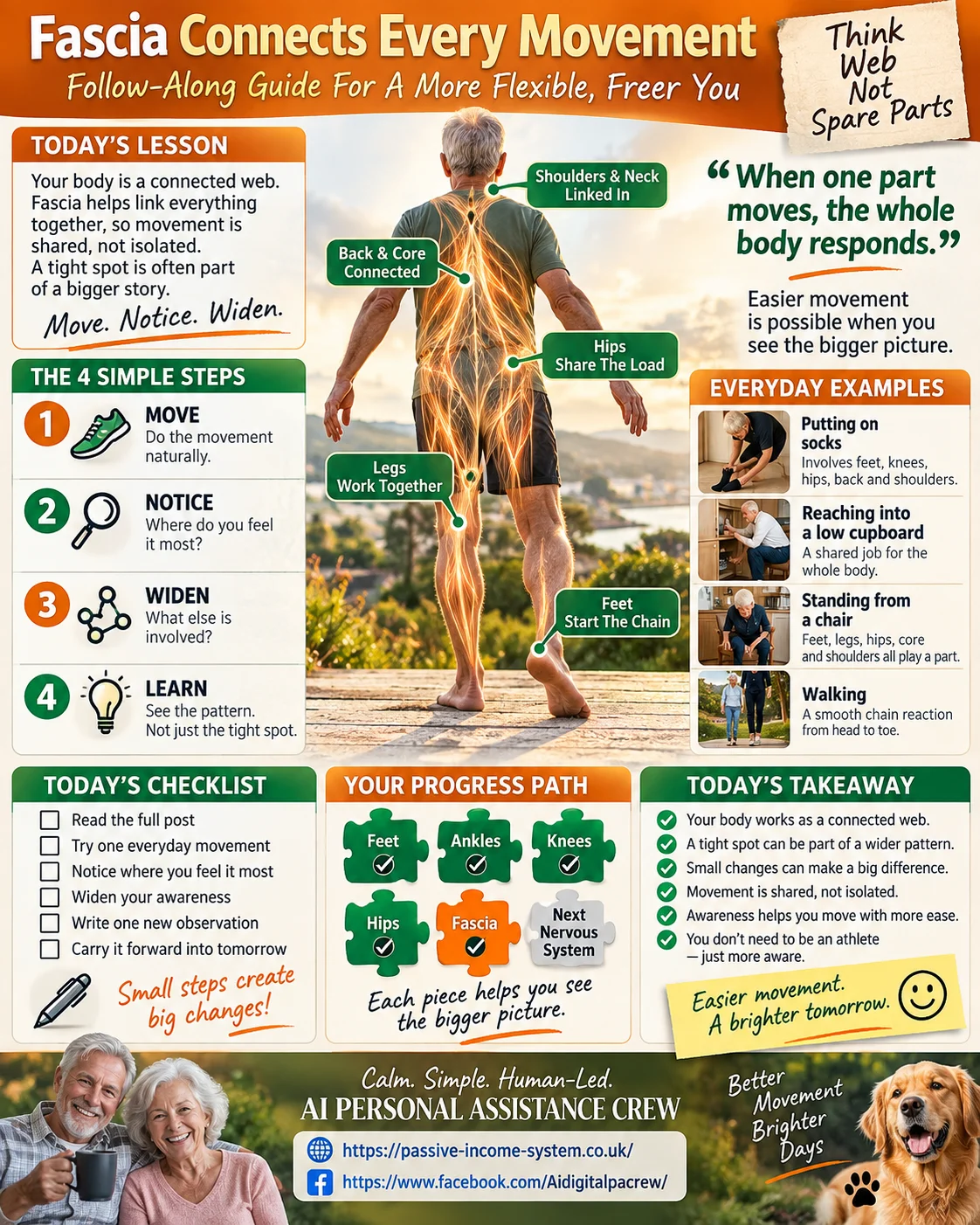
Fascia Connects Every Movement Beyond The Tight Spot
The place that complains loudest is not always the only place involved in the movement.
The Tight Spot May Only Be Where You Notice The Story
A stiff calf, hip, or shoulder can grab your attention while the rest of the body quietly changes how the job gets done.
Fascia Connects Every Movement Through A Wider Body Network
The place that complains loudest is not always the only place involved in the movement.
Fascia Connects Every Movement Through A Wider Body Network
The useful question isn’t simply where you feel tightness, but how the whole movement is shared.
A familiar little scene unfolds in homes across Britain every day. A retired bloke bends to lift the washing basket, reaches for a dropped sock, or leans towards the bottom kitchen cupboard, and suddenly hesitates, as if an unexpected bill has arrived. One hand goes to the calf, hip, or lower back, and the investigation ends almost before it begins. Fascia connects every movement because connective tissue forms part of a body-wide system rather than stopping at the imaginary borders we draw around the feet, knees, hips, backs, and shoulders. That does not mean fascia explains every ache or that the tightest spot is unimportant. It means the sensation may be one part of a much greater movement story.
When you bend to lift a washing basket, the feet stay grounded while the ankles, knees, hips, trunk, shoulders, and arms move as one linked sequence. The head shifts to keep sight of the task. This is not a string of isolated actions, but a coordinated whole.
Fascia Connects Every Movement When The Body Shares The Job
By now, the logic of our 10-Pillar Body Ladder is becoming difficult to miss. By the feet, we observed what happened where the body touched the ground. At the ankles, we noticed movement beginning to travel upwards. At the knees, we followed the direction handed up from below. We watched how the body organized itself around gravity at the hips and pelvis. Up to this point we have deliberately climbed one rung at a time because it makes the story easier to see. But the body itself has not been waiting politely for us to finish one article before moving on to the next joint. Everything has been working together from the beginning. Fascia Connects Every Movement is the rung where we stop pretending the body is a stack of separate spare parts and start looking at the connective web that helps those parts work as one person.
That shift in viewpoint matters. It changes the question we ask when something feels tight. When you bend forward and the back of the left leg feels restricted, the immediate urge is to attack the leg. You might stretch harder, pull the toes back, or rub the calf. These actions may help, but pause first and watch the entire bend. If you change your foot position, does the movement become easier? None of those observations proves what causes the sensation. They show whether the tight area is part of a broader movement pattern, and that distinction is enormous. Instead of saying, ‘My calf is the problem,’ you can say, ‘My calf feels tight, and when I bend I also notice my hips shift right and my left knee stays straighter.’
The Loudest Body Part Can Steal The Whole Investigation
Any tradesman who has spent enough years fault-finding knows the danger of chasing the loudest symptom. A boiler makes a knocking noise, and the inexperienced response is to replace whatever component happens to be nearest the sound. Sometimes that works. Sometimes the noise is only where the underlying problem becomes audible. The sensible bloke stands there for a moment, listens, watches when it happens, and follows the system before reaching for the spanners. A body is considerably more complex than a central heating system, but the thinking habit transfers beautifully. Before you decide which place is the stiffest and needs fixing, watch the movement that produces the stiffness. Fascia Connects Every Movement reminds us that tissues throughout the body help transmit movement and load. So if the whole movement centers on one area, the broader pattern is worth noticing before the loudest spot gets all the blame.
Picture somebody reaching into a high kitchen cupboard. The shoulder feels tight, so it naturally attracts attention. Yet observe the reach closely. One foot may rise onto the toes, the pelvis may shift sideways, the ribs may turn, and the spine may extend slightly. The opposite arm moves away for balance. The tea caddy is retrieved, and nothing seems amiss. But the shoulder did not act alone; the whole body coordinates the movement. This is where Fascia Connects Every Movement becomes practical rather than merely an anatomical slogan. Swap the close-up shot for a wide-angle perspective. Where did the movement begin? Which areas moved easily? Which resisted? Where did another part take over? The sensation still matters, but it no longer dictates the entire report.
Think Web, Not Spare Parts
For much of our lives, we are encouraged to think of the body as a motor-factor catalog. Bad knee. Tight hamstring. Weak back. Frozen shoulder. Dodgy ankle. The language makes it sound as though each section arrived in its own cardboard box and can be discussed without reference to anything else. That is convenient, but movement rarely behaves so neatly. Take one ordinary step, and the foot, ankle, knee, hip, pelvis, trunk and shoulders all participate in different ways. Turn while walking, and the arrangement changes again. Reach for something while carrying a bag,g and the whole body negotiates a new problem. The fascia network helps physically connect tissues across those regions, but the important lesson for readers is broader: think web, not spare parts. When movement feels awkward, widen your attention before narrowing it again.
That does not mean every stiff shoulder requires an investigation of the toes. Nor does it mean every distant body sensation has some magical hidden fascial cause. Those are exactly the sort of grand claims we want to avoid. The value lies in the habit of observation. If a tight place changes when another part moves, that is worth noticing. If the sensation stays the same regardless of how the rest of the movement is organized, that is useful information too. Either way, the body has told you something more valuable than the original words, “It feels tight.” Dennis Bartram’s approach to self-maintenance works best when curiosity comes before correction. See the movement first. Then decide what deserves attention.
Fascia Connects Every Movement When You Widen The Camera
Try a simple experiment without turning the living room into a rehabilitation clinic. Choose one ordinary movement that currently feels slightly awkward or tight. Perhaps bending towards the floor, turning to look behind you, reaching into a cupboard, or taking the first step after sitting. Perform it once naturally and notice the loudest area. Then repeat the movement, but instead of staring mentally at that one spot, widen the camera. What happens at the feet? What do the knees do? Do the hips stay centered or shift? Does the trunk rotate? Do the shoulders join in differently? You are not looking for perfection. You are not trying to diagnose fascia. Asking one question: ‘How is the whole body sharing this movement?’ lies at the heart of Rung 6.
And once you begin asking it, the previous rungs suddenly look different. The stiff foot was never only a foot. The hesitant ankle was part of a step. The knee followed what happened below. The hips organized the body above the base. Now fascia gives us a reason to think in terms of continuity rather than borders. Fascia Connects Every Movement is not a slogan claiming one tissue controls everything, but a reminder that the body’s connective tissues participate in a movement system that works across regions rather than inside isolated boxes. That is why the tight spot deserves attention but not automatic authority. Before we stretch it, blame it, or declare it the culprit, we widen the camera and see what everybody else was doing when it spoke up.
That may be the simplest lesson on this rung, Partner: the loudest place is information, not necessarily the whole explanation. And once the reader begins thinking that way, the BodyLadder no longer looks like ten separate pieces. It begins to look like what it really is: one connected human being moving through everyday life.
Open to See This Video, And This Is What’s Already Built, Trained & Waiting For Your First Command.
#5 Unlocking Body Alignment Fascinating Insights from Active Balance
Fascia Connects Every Movement In The Ordinary Jobs We Never Notice
The fascinating thing is that you do not need an exercise mat, a treatment room, or a complicated movement routine to see this connected web at work. Everyday life provides better examples than most demonstrations. Reach down to put on a sock, and the movement travels through far more than the hand doing the pulling. One foot supports you, the other leg changes position, the pelvis shifts, the trunk bends and rotates, the shoulder reaches, and the head adjusts so you can still see what you are doing. If one part contributes differently that morning, the rest of the movement may quietly reorganise itself. Yet because the sock eventually reaches the foot, nobody gives the operation another thought. Fascia Connects Every Movement becomes easier to understand when we stop looking for spectacular demonstrations and start watching these ordinary jobs that happen hundreds of times without applause.
Take getting something from the bottom cupboard. One person bends mainly through the hips and knees. Another keeps the knees straighter, turns one foot out, and reaches farther with the shoulder. A third lowers themselves by holding the worktop first. All three may retrieve exactly the same saucepan. The destination is identical, but the routes are not. That is why observing movement is so much more useful than simply asking which body part feels tight. The body is solving a task, and the solution may involve tissues and movement across multiple regions simultaneously. Fascia Connects Every Movement gives us permission to watch the route rather than judge only the destination.
The Useful Question Is Not Which Part Worked Hardest
The better question is how the whole person shared the job. This is also why small changes can be surprisingly revealing. Move the feet slightly wider before bending, and the hips may behave differently. Turn towards the cupboard instead of reaching across the body, and the shoulder may feel different. Bring the object closer before lifting, and the whole movement can change again. None of those experiments proves that fascia caused the original tightness, and we should resist pretending it does. What they show is that a sensation can change when the movement around it changes. That is valuable information. It moves us away from the spare-parts mentality and towards the question Dennis keeps bringing us back to throughout this ladder: what is the whole body doing to complete the job?
Fascia Connects Every Movement Powerful Hidden Connections
The Tight Spot May Only Be Where You Notice The Story
A stiff calf, hip, or shoulder can draw your attention as the rest of your body quietly changes the way the job gets done.
Spread the love
Dennis Bartram
Dennis Bartram is the Director of the Active Balance Home or on the Go System Dennis’ journey began in 1969 when he qualified in Swedish remedial massage and in 1974, he began his practice in remedial sports massage and manipulative
Calm Your Nervous System Before Tension Becomes Your Normal The body responds to clear information better than stern instructions. Through Slow Rhythmic…
Realign Your Spine Exercises Matter After Fifty How Realign Your Spine Exercises Improve Balance Daily Habits That Support Realigning Your Spine Exercises…
Effortless Balance Movement Coach for Everyday Confidence How an Effortless Balance Movement Coach Restores Walking Ease Effortless Balance Movement Coach for Lifelong…


 By now, the logic of our 10-Pillar Body Ladder is becoming difficult to miss. By the feet, we observed what happened where the body touched the ground. At the ankles, we noticed movement beginning to travel upwards. At the knees, we followed the direction handed up from below. We watched how the body organized itself around gravity at the hips and pelvis. Up to this point we have deliberately climbed one rung at a time because it makes the story easier to see. But the body itself has not been waiting politely for us to finish one article before moving on to the next joint. Everything has been working together from the beginning. Fascia Connects Every Movement is the rung where we stop pretending the body is a stack of separate spare parts and start looking at the connective web that helps those parts work as one person.