Natural Stability Through Awareness: Discover What Your Body Knows Natural Stability Through Awareness
Natural Stability Through Awareness Begins Beneath Your Feet
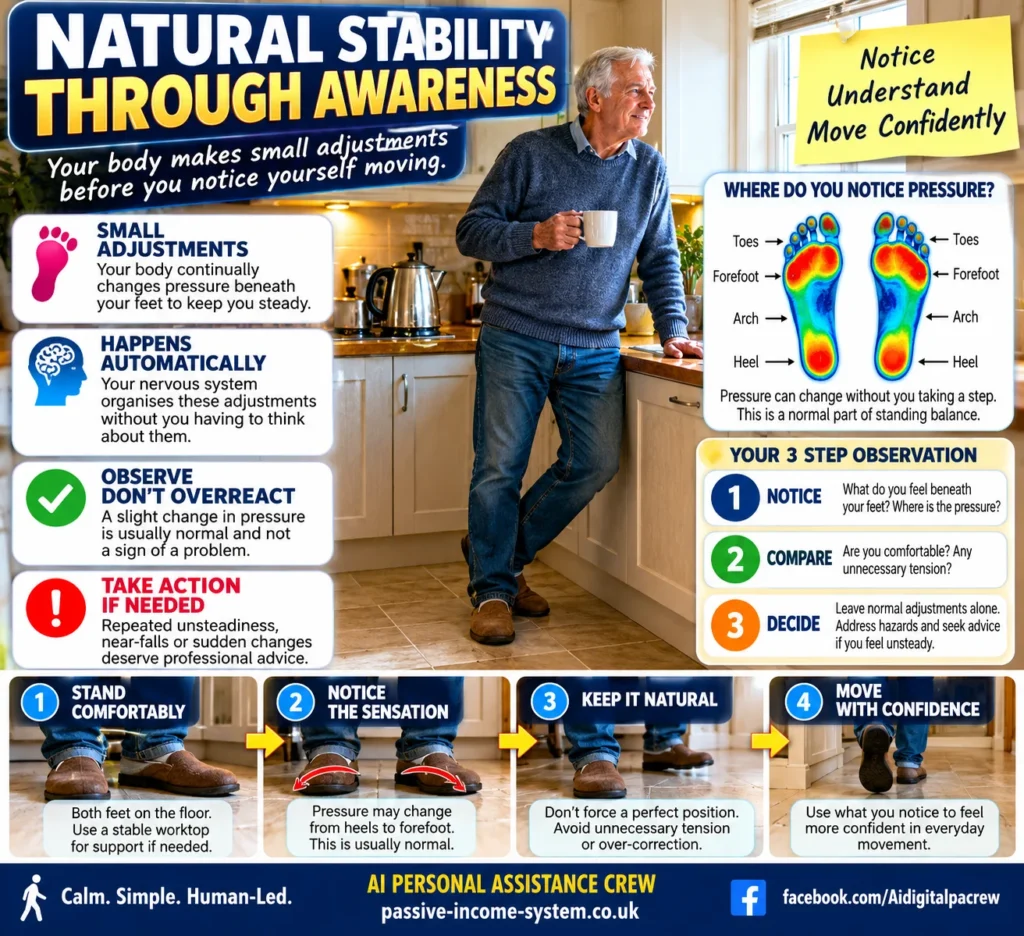
Your body makes small adjustments while you stand, often before you notice anything moving.
Standing Still Is Not Standing Motionless
Balance involves continuous coordination, even when both feet remain firmly on the floor.
Notice Before You Try To Correct
A small adjustment isn’t automatically a problem, and not every sensation requires a correction.
The Morning George Discovered He Wasn’t Standing Still
The kettle had just clicked off when George noticed something peculiar beneath his feet. After forty years working as a heating engineer, he’d spent countless mornings standing in kitchens, waiting for customers to find paperwork or explain an awkward radiator problem. He hadn’t expected to learn that in retirement. Yet there he was, beside his own kitchen worktop, wondering why the pressure beneath his feet seemed to change even though he hadn’t moved. For a moment, he felt more pressure towards his heels. Then the sensation shifted slightly forwards. His shoulders remained comfortable, his feet stayed on the floor, and nothing appeared unusual.
Nevertheless, something was happening. George had always associated good balance with keeping still. Now he was discovering that his body had been making small adjustments throughout his working life without demanding his attention.
Most people would have finished making their tea and forgotten the observation. George, however, had spent a lifetime investigating why things behaved as they did. He knew from experience that the first explanation wasn’t always the correct one. A heating system could make a familiar sound for several reasons, and a customer might describe a fault differently from the engineer examining it. So he resisted the temptation to draw an immediate conclusion. Had he become less steady? Was one foot carrying more weight than the other? Should he straighten his back or tighten his stomach? Those questions were tempting, but none could be answered reliably from a brief sensation beneath his shoes. He had noticed a change in pressure. Everything beyond that remained an interpretation. That distinction was useful, and it would change how he thought about everyday standing.
This is where Natural Stability Through Awareness becomes practical. The purpose isn’t to turn ordinary standing into a complicated exercise. Nor is it to persuade people that every movement reveals a hidden problem. Instead, it encourages us to recognise something easily overlooked: remaining upright is an active process. The nervous system continually receives information about body position and movement. Muscles respond to the demands of standing, and small adjustments help us remain supported. Most of this happens without deliberate concentration. That is useful because nobody wants to spend the day consciously controlling every movement of their ankles, knees and shoulders. George didn’t need to command his body to make each adjustment. His first useful achievement was recognising that standing comfortably didn’t require absolute stillness.
Your Body Doesn’t Work Like A Fixed Scaffold
Natural Stability Through Awareness Helps Explain Small Adjustments
A scaffold is designed to remain rigid once it has been properly assembled. George understood that principle from working around building sites. But a human body isn’t a scaffold. It contains joints that move, muscles that respond and a nervous system that continually interprets information from several sources. Even when standing still, the body’s position changes slightly. Researchers describe this as postural sway. The term can sound worrying, but some sway is a normal part of standing balance. Its presence alone doesn’t demonstrate weakness, poor posture or declining mobility. The body is continually managing the relationship between its centre of mass and the area of support beneath the feet. That work may involve subtle muscular responses that we hardly notice during familiar everyday activities.
The feet give us an accessible way to appreciate part of this process. They contact the ground, and the pressure beneath them shifts as our position changes. George may notice sensations beneath his heels, across his forefeet or around the areas supporting his weight. However, foot pressure isn’t a complete map of the body’s movements. A sensation beneath one foot cannot tell him precisely which muscle responded or whether his balance has improved. Shoes, flooring, stance and attention can all influence what he notices. Two observations made several hours apart may feel different without indicating any important physical change. This is why it helps to distinguish between an observation and a conclusion. “I noticed pressure beneath my heels” describes an experience. “My balance is deteriorating” is a much larger claim that the observation cannot establish.
George recognised the difference from his working life. If a homeowner reported that one radiator was cooler than another, he wouldn’t recommend replacing the entire heating system without investigating. He would consider the circumstances, ask questions and check the evidence. The same reasoning applies to awareness of movement. A small shift in pressure is information, not an instruction to correct something immediately. A tense shoulder may deserve attention, but it doesn’t prove that the body’s entire alignment is wrong. Equally, a person feeling genuinely unsteady shouldn’t dismiss that experience simply because minor postural adjustments are normal. Useful awareness depends on learning to tell these situations apart. The important question is not whether movement occurred, but what happened, how it felt and whether the person remained comfortably and safely supported.
The Difference Between Awareness And Interference
Observe The Adjustment Before Changing Your Position
Imagine George deciding that good posture demands equal pressure beneath both feet throughout the morning. Every time he notices a slight change, he tries to move his weight back to the centre. Soon he is paying more attention to correcting small sensations than to making his breakfast. He may tighten muscles unnecessarily or adopt an awkward position because he believes it looks more upright. Nothing in the original observation suggested these corrections were needed. The problem began when he treated every adjustment as evidence of faulty posture. Natural Stability Through Awareness takes a different approach. George can notice the sensation without immediately trying to eliminate it. If he feels comfortable and supported, he has no reason to manufacture a correction simply because something changed beneath his feet.
A second mistake is worth avoiding. Some movement advice suggests that relaxing is always preferable to using muscular effort. Yet standing requires muscles to work, and appropriate support matters. Telling someone to release every bit of tension would make little practical sense. The more useful question concerns effort that appears unnecessary for the task. George might notice himself gripping the kitchen worktop while standing comfortably, or holding his shoulders higher than usual while concentrating. Such observations can encourage curiosity about familiar habits. They do not establish a diagnosis, and they aren’t instructions to let go of support that helps him remain safe. The distinction is straightforward: necessary muscular activity helps us stand, while excessive deliberate correction may make an ordinary task feel more complicated than it needs to be.
A Safe Observation Beside The Kitchen Worktop
Explore Foot Pressure With Natural Stability Through Awareness
For someone who stands comfortably and safely, a familiar worktop offers a convenient setting for a brief observation. George chooses a clear, level floor, keeps his eyes open and stands in his usual comfortable position. Stable support remains within easy reach, and he can hold it whenever necessary. There is no need to close his eyes, lift one foot, balance on tiptoe or move towards the edge of his stability. This isn’t a balance challenge or a test of physical ability. He notices the contact between his feet and the floor while remaining comfortably supported. For people with existing balance difficulties, recent falls or uncertainty about standing safely, an unsupervised observation may be inappropriate. They should seek suitable professional guidance rather than attempt to test their balance at home.
George begins by asking himself a practical question: “Where do I notice the floor beneath my feet?” He doesn’t need to measure the answer. Perhaps his heels are particularly noticeable, or he notices pressure toward the front of his shoes. The sensation may change slightly while he remains standing. He then considers whether he feels secure and whether any unnecessary effort has attracted his attention. He doesn’t force his knees straight, pull his shoulders backwards or attempt to make both feet feel identical. The purpose is to describe an ordinary experience, not produce a preferred result. After a brief observation, he returns to making his tea. If anything feels uncomfortable, tiring or insecure, he stops and uses the support available. No achievement depends on continuing. Natural Stability Through Awareness gives him a reason to observe these sensations without trying to control every adjustment.
Later, George may remember the observation while standing at a different worktop. This time his footwear, position or level of tiredness could be different. He may notice sensations he hadn’t noticed earlier. That doesn’t establish improvement or deterioration. Comparisons become more useful when the circumstances are similar, and even then a person’s subjective impressions have limits. George understands that recording observations is not the same as conducting a clinical assessment. If he repeatedly feels unexpectedly unsteady, experiences falls or notices a change affecting everyday activities, he should discuss it with an appropriate healthcare professional. Sudden new balance difficulties accompanied by symptoms such as weakness, difficulty speaking or severe dizziness warrant urgent medical attention. Awareness should help people recognise when to seek support, not encourage them to explain away concerning symptoms.
What George’s Working Life Teaches About Balance
The Best First Question Is Often What Changed
George’s experience as a heating engineer provides a useful way to remember the lesson. Throughout his career, he learned to distinguish what a customer had observed from what might be causing it. That habit prevented unnecessary work and helped him choose the next sensible step. Movement awareness benefits from the same discipline. Noticing a small adjustment doesn’t mean the adjustment needs correcting. Feeling comfortably supported differs from feeling unstable, and neither experience can be fully understood from a single sensation beneath the feet. George can apply that reasoning without becoming preoccupied with his posture. He pays attention when something seems worth noticing, considers the circumstances and avoids concluding from the information available.
The practical lesson is modest, but it changes an important assumption. Good standing balance doesn’t mean the body has stopped moving. It means the body is coordinating the activity needed to remain upright. Natural Stability Through Awareness gives George a way to notice part of that activity without turning every sensation into a problem. The first step is to observe comfortably and safely. The second is to describe what happened. Only then should he consider whether the experience calls for action. Sometimes it won’t. Other times, especially when genuine unsteadiness is involved, a professional assessment may be appropriate. That is a more dependable approach than forcing the body into a supposedly perfect position whenever something feels different.
Riley’s Wisdom Drop
“Notice what your body is doing before deciding what your body needs correcting.”
Another question waits just beyond the kitchen worktop. George has discovered that balance involves small adjustments, even when both feet stay on the floor. But standing is only part of everyday movement. Eventually, he must turn away from the kettle and take a step. At that moment, the body faces a different task. Support shifts as weight transfers and one foot prepares to move. Understanding the difference between quiet standing and the first step opens another useful way to observe movement without trying to control every detail.
Natural Stability Through Awareness Changes How George Observes Movement
The Moment Before A Step Reveals Another Kind Of Balance
George finished his tea and prepared to leave the kitchen when an ordinary movement caught his attention. He turned towards the doorway, shifted his weight and stepped away from the worktop. Nothing dramatic happened. He had done the same thing thousands of times, usually without thinking. Yet his earlier discovery about standing had left him curious. If the body makes small adjustments while both feet stay on the ground, what happens when one foot prepares to leave? George knew the answer involved more than simply lifting a shoe. Something had to happen first. His body needed to organise support while transferring weight, allowing one leg to move without leaving him unexpectedly unstable. The familiar journey from kettle to doorway had become an opportunity to understand another everyday movement.
The first distinction concerns standing balance and preparing to walk. During quiet standing, the body maintains an upright position through small coordinated adjustments. Taking a step introduces a changing task. The nervous system must prepare for movement, organise muscle activity and manage transitions among various support areas. Some adjustments occur before the foot visibly leaves the floor. Researchers call these preparatory changes anticipatory postural adjustments. The terminology matters less than the principle. Movement preparation begins before we can easily see it. George doesn’t need to identify individual muscles or consciously control this process. His body already possesses systems for coordinating ordinary movement. Awareness can help him appreciate that stepping involves preparation rather than a sudden switch from standing still to walking.
For somebody interested in Natural Stability Through Awareness, this offers a useful change in perspective. The first step isn’t simply a test of whether the legs are strong enough to move. It involves coordination between support, weight transfer and forward movement. These parts work together, and their timing varies by person, task and surroundings. A narrow hallway, unfamiliar flooring or the need to carry an object can change the demands of an otherwise ordinary step. However, noticing hesitation doesn’t reveal its cause. Discomfort, cautious behaviour, unfamiliar conditions and balance difficulties may all influence movement. George’s task is not to diagnose himself through observation. It is to recognise the difference between what he feels, what he assumes and what he can reasonably conclude.
Why The First Step Deserves More Attention Than Perfect Posture
Standing Comfort And Moving Confidence Are Different Experiences
A person may feel perfectly comfortable standing beside a kitchen worktop yet feel less confident when turning or starting to walk. This isn’t contradictory. Standing in a familiar position and transferring support during movement place different demands on the body. The first relies on maintaining an upright position within a relatively steady base of support. The second includes preparing to change that base while keeping movement controlled. George remembers customers who could stand and talk comfortably but proceeded carefully when navigating awkward spaces. Their behaviour didn’t provide him with a medical explanation, nor should it have. It reminded him that balance shows up in activities, not simply in how a person stands.
That distinction matters for anyone tempted to judge movement by a photograph. A picture may show someone standing tall, shoulders level and feet neatly positioned. It cannot establish how confidently that person starts walking, turns around or responds to an unexpected obstacle. Nor can it reveal how much effort they’re using to maintain the pose. Even a carefully arranged standing position tells us little about movement under changing conditions. Natural Stability Through Awareness stimulates a broader question: can the person carry out their ordinary activity comfortably and safely? For George, this means paying attention to the demands of everyday tasks rather than trying to reproduce an ideal-looking posture. His goal is not to look perfectly aligned while standing beside the kettle. It is to move around his home without needless difficulty.
There is also a danger in treating every instant of hesitation as something to overcome through determination. Older adults may become cautious for understandable reasons, including unfamiliar surroundings or previous experiences of losing balance. A measured step isn’t automatically evidence of weakness, and forcing quicker movement isn’t an appropriate response. Repeated hesitation, near-falls or unexpected changes in steadiness also deserve attention rather than casual reassurance. The practical value lies in clearly describing the situation. Does the difficulty occur when rising from a chair, turning, starting to walk or moving onto an unfamiliar surface? Does it happen repeatedly? Is it accompanied by dizziness, pain or another symptom? Those observations can help a qualified professional understand the circumstances. They shouldn’t be used to invent a diagnosis or prescribe a personal treatment.
A Supported Observation Lacking Turning It Into A Balance Test
Use Familiar Movement And Keep Safety In Charge
George’s curiosity doesn’t require him to balance on one foot or deliberately challenge his stability. Someone who already moves comfortably and safely can sometimes learn by observing an ordinary action performed under familiar conditions. George starts beside a stable worktop on a clear, level floor, wearing secure footwear and keeping his eyes open. He makes certain that support is available and that he isn’t carrying anything which interferes with safe movement. He doesn’t close his eyes, deliberately exaggerate his weight shift or attempt a difficult stepping exercise. If he feels insecure or needs help walking safely, he avoids experimenting and seeks appropriate professional guidance. The purpose is awareness during normal activity, not an unsupervised balance assessment.
Before stepping away, George notices that he is supported by both feet. As he begins his usual movement, he may notice pressure changing beneath his feet. However, he doesn’t force that change or try to match it to a prescribed pattern. His attention stays on moving safely to his intended destination. Afterwards, he can briefly reflect on what he noticed. Did the movement feel familiar and comfortable? Was he hesitant because the floor was crowded or because he needed to turn awkwardly? Did anything feel unexpectedly difficult? These questions encourage practical observation absent asking him to intervene in processes that normally occur automatically. The exercise has achieved its purpose if George can describe his experience more clearly while remaining safe.
One caution deserves particular emphasis. Directing too much conscious attention towards the mechanics of walking can make a familiar movement feel less natural for some people. George doesn’t benefit from mentally instructing each ankle, knee and hip to perform a separate action. He has spent a lifetime moving around workshops, gardens and customers’ homes without issuing such commands. Awareness is most useful when it identifies a relevant experience, not when it turns every movement into a complicated technical procedure. He can observe briefly and then return his attention to the activity itself. If movement feels comfortable and secure, there may be nothing further to investigate. When unexpected insecurity, recurring difficulty or a fall becomes part of the picture, professional assessment matters more than additional home experiments.
The Difference Between A Sensation And A Movement Problem
Natural Stability Through Awareness: Notice Before You Correct
George’s work experience offers a memorable way to think about what he notices. First, describe the event without interpreting it. Second, consider the circumstances. Third, decide whether the experience requires any action. This isn’t a medical examination or a scoring system. It helps you avoid jumping from a passing sensation to an unsupported conclusion. If George feels pressure move beneath his feet while standing comfortably, he has noticed an ordinary possibility within postural control. If he repeatedly reaches for furniture because he fears he may fall, the concern is different. One observation may require no correction at all. The other deserves appropriate assessment. The distinction rests on the nature of the experience and its effect on safe everyday activity.
The surrounding conditions also deserve attention. Flooring, lighting, footwear and obstacles can affect the demands of movement. A well-lit kitchen with a clear floor differs from a dim hallway with loose rugs and clutter. George can improve his immediate environment without diagnosing a physical problem. Keeping walking routes clear, arranging adequate lighting and using suitable footwear are practical ways to reduce avoidable hazards. They don’t guarantee someone will never fall, but they address factors worth considering. If George feels less secure on an unfamiliar surface, that may reflect the setting’s different demands. It doesn’t automatically reveal a problem with one particular muscle or joint. Describing where and when the difficulty occurs gives the observation more meaning.
This is where the earlier lesson about standing becomes valuable. We learned that the body can make small adjustments while appearing still. Now we can recognise that moving from one position to another requires even more coordination. In neither case should we treat a single sensation as a complete explanation. Natural Stability Through Awareness asks us to remain curious without becoming alarmed by every ordinary variation. It also requires judgement. A comfortable adjustment can be observed and left alone. Repeated difficulty, unexpected loss of balance or a fall should not be dismissed. New or worsening movement problems warrant useful professional advice. Sudden severe balance disturbance, particularly with weakness, facial drooping, speech difficulties or other possible stroke symptoms, requires emergency assessment. In the UK, call 999 when stroke is suspected.
What Everyday Confidence Actually Depends Upon
Familiar Tasks Reveal More Than A Perfect Standing Position
George begins to recognise that confidence in movement isn’t simply about believing he has good posture. He feels confident when familiar activities stay manageable, and his surroundings let him move safely. That confidence can change according to the task. He may have no worries while preparing breakfast yet feel more cautious when walking onto a wet garden path. Rather than treating those experiences as proof that his body has suddenly changed, he can consider the different conditions involved. Wet surfaces may be slippery, outdoor ground may be uneven and poor lighting can make obstacles harder to see. Sensible awareness includes recognising the environment and noticing the body. Sometimes the most useful decision is to remove a hazard, use appropriate support or choose a safer route.
The same reasoning applies to daily routines. A person who rises from a familiar chair, walks into the kitchen and prepares a meal may take little notice of the coordination involved. Yet those ordinary tasks bring together sensory information, muscular responses and decisions about the surrounding environment. A movement problem may first become noticeable during one of these transitions rather than while standing still. That doesn’t mean readers should begin monitoring every step. Excessive attention can make ordinary life tiring and unnecessarily worrying. A better approach is to notice meaningful changes when they arise and describe them accurately. If the task is comfortable and secure, the body does its work without calling for constant interference from the conscious mind.
For older readers, the practical benefit is clearer guidance on what deserves attention. A brief shift in pressure under your feet isn’t the same as repeated instability. A careful response to a slippery surface isn’t automatically evidence of declining balance. Conversely, repeated near-falls or sudden difficulty moving shouldn’t be explained away as normal ageing. These differentiations protect against two opposite mistakes: correcting harmless adjustments unnecessarily and overlooking experiences that deserve proper investigation. Natural Stability Through Awareness doesn’t offer a shortcut to diagnosing balance problems. It gives a more thoughtful starting point for recognising the difference between ordinary coordination, environmental requirements and genuine concerns about safe movement.
Today’s Reader Activity: Notice, Describe And Decide
A Small Observation With A Clear Purpose
Today’s practical task is deliberately simple. Think of a common moment when you stand comfortably beside a secure worktop or prepare to move during your usual routine. You don’t need to create a new exercise or challenge yourself. If you’re unsure about standing or walking, avoid attempting an observation lacking appropriate support or professional guidance. Consider what you can describe about the situation without guessing at hidden causes. Perhaps you noticed pressure shifting beneath your feet as you stood. Perhaps an unfamiliar floor made you more cautious. Or perhaps everything felt comfortable, and nothing needed attention. Each response is a valid observation. The purpose isn’t to discover a problem. It is to practise separating an experience from the conclusions you might be tempted to draw.
Use these three questions:
1. What did I actually notice? Describe the sensation or movement in plain language.
2. What were the circumstances? Consider the surface, footwear, task and available support.
3. Does anything need attention? Leave comfortable ordinary adjustments alone, address obvious environmental hazards and seek professional advice for persistent or unexpected instability.
You can write your answers on a small piece of paper, or simply remember the distinction. There is no requirement to record every movement or repeat an activity to produce a different result. A useful observation should clarify everyday decisions, not turn ordinary life into a permanent examination.
Riley’s Wisdom Drop
“Good balance isn’t proved by standing perfectly still. It shows itself in how safely your body manages the movement life asks of it.”
Natural Stability Through Awareness Gives You A Better Starting Point
And This Is What’s Already Built, Trained & Waiting For Your First Command.
George’s discovery started beside a kettle, as pressure moved under his feet while he believed he was standing still. His curiosity then extended towards the first step and the changing demands of movement. Both observations showed something useful: stability involves coordination, and coordination doesn’t always look like complete stillness. He learned not to treat every sensation as evidence of a problem, but he also recognised the importance of taking genuine insecurity seriously. Such balance between inquisitiveness and sensible caution is awareness’s practical value. It helps people ask better questions about movement without promising that simple observation will correct a physical condition or establish a diagnosis.
The next time George waits for the kettle, he doesn’t need to arrange his feet into a perfect position or concentrate on eliminating every small adjustment. He can stand comfortably, use the support he requires, and let ordinary movement stay ordinary. If something appears different, he can describe it, consider the circumstances and decide whether any action is justified. That is a useful skill for someone who spent decades solving practical problems before reaching for a tool. The same discipline belongs in everyday movement: establish what is happening before deciding what needs changing. Small adjustments aren’t automatically faults, and thoughtful observation is not the same as correction. The important achievement is recognising the difference.
Natural Stability Through Awareness Discover Hidden Body Secrets
Spread the love
Dennis Bartram
Dennis Bartram is the Director of the Active Balance Home or on the Go System Dennis’ journey began in 1969 when he qualified in Swedish remedial massage and in 1974, he began his practice in remedial sports massage and manipulative
Upper Extremity Mobility Exercises for Retirees Master the Anatomy and Mechanics of Upper Extremities “For Peak Performance and Injury Prevention!” Introduction to…
Retiree Knee Balance Training Improves Step Transitions How Natural Knee Mechanics Support Retiree Knee Balance Training Why Knee Freedom Matters in Retiree…
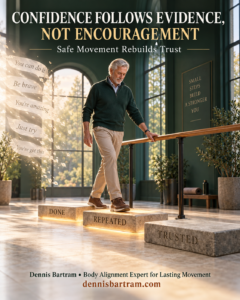
Safe Movement Rebuilds Trust Through Evidence, Not Encouragement The body may need a successful experience before it accepts reassuring words. Can One…


 A scaffold is designed to remain rigid once it has been properly assembled. George understood that principle from working around building sites. But a human body isn’t a scaffold. It contains joints that move, muscles that respond and a nervous system that continually interprets information from several sources. Even when standing still, the body’s position changes slightly. Researchers describe this as postural sway. The term can sound worrying, but some sway is a normal part of standing balance. Its presence alone doesn’t demonstrate weakness, poor posture or declining mobility. The body is continually managing the relationship between its centre of mass and the area of support beneath the feet. That work may involve subtle muscular responses that we hardly notice during familiar everyday activities.