Why The Knee Hurts May Involve More Than Your Knee
The painful joint may be delivering a message from a much wider movement pattern.
Could Your First Step Reveal Why The Knee Hurts?
Standing, rising and walking can expose work the knee quietly inherits.
Dennis Bartram Explains Why The Knee Hurts Differently
Follow the workload through the body instead of stopping at the sore spot.
Dennis Bartram Explains Why The Knee Hurts Differently.
Follow the workload through the body instead of stopping at the sore spot.
The knee had been blamed, sentenced and was halfway through serving its punishment before anybody thought to question the witnesses. It was rubbed, stretched, heated, needled and instructed to behave itself. For a while, the discomfort occasionally retreated. Then its owner rose from the armchair, took three guarded steps towards the kitchen, and the familiar complaint returned. This is where Dennis Bartram asks a different question. Instead of immediately adding another treatment to the painful joint, he watches how the person stands, where their weight travels and which side performs the hardest work. Understanding Why The Knee Hurts may begin with the knee, but the investigation should not necessarily end there.
That distinction matters because pain tells us where somebody feels a problem, not automatically where every contributing pressure began. The knee itself may be injured, irritated or affected by a condition requiring medical assessment. Nothing in a whole-body approach gives us permission to dismiss the joint or diagnose its cause from across the room. Dennis’s principle is more practical. A painful knee deserves attention, while the movement delivering work to that knee deserves attention as well. When exploring Why The Knee Hurts, the useful question becomes: is this joint performing only its own share of the task, or has it quietly inherited work from somewhere else?
The Painful Knee May Be Reporting A Wider Workload
Picture the knee as a worker stationed between the foot and the hip. Every time someone takes a step, the foot meets the ground, the ankle responds, the knee manages bending and loading, the hip contributes movement, and the pelvis and trunk organise the person above them. None of these departments clocks in alone. If one area contributes less, another may accept more responsibility so the journey can continue. That ability to compensate is not automatically a fault. It is one reason we can keep moving after stiffness, fear, or an old injury changes the original arrangement.
However, it can also help explain Why The Knee Hurts after months of apparently coping.
The body rarely sends a memorandum announcing that a compensation has begun. A sore left foot may quietly shorten one step. The right leg stays beneath the body longer, the pelvis alters its transfer, and the right knee takes on more repeated work. Eventually, the foot settles down and is forgotten, while the new walking pattern remains. When the right knee starts complaining, all attention turns towards the loudest reporter. Dennis does not automatically accuse the old foot injury, because observation cannot establish a diagnosis. He refuses to ignore the sequence. To investigate Why The Knee Hurts, we must notice what the whole person does before, during and after the painful moment.
Why The Knee Hurts Can Hide Inside An Ordinary Chair
An armchair can reveal more than a collection of impressive treatment equipment. Watch someone prepare to stand, and the body begins to give evidence. One foot may be positioned farther forward. One hand may press heavily into the armrest. The chest may swing towards one side before the hips leave the seat. By the time the person becomes upright, one leg has completed most of the lifting while the other has remained comparatively protected. None of this proves Why The Knee Hurts, but it reveals how the task is being shared. The painful knee may be struggling because it is guarded, overloaded, locally injured or involved in several of those circumstances together.
Consider Peter, a retired tradesman whose right knee protests whenever he gets out of a chair. He assumes age has finally presented the invoice and begins rubbing the joint each evening. Yet his chair movement tells a fuller story. His left foot remains several inches ahead, his right hand pushes hard, and his weight swings over the right leg before he stands. His first step with the left foot is short, leaving the right side to carry him longer. The observation does not tell us conclusively why the knee hurts. It does, however, reveal a repeated workload pattern worth discussing with an appropriate healthcare or movement professional.
The First-Step Test Adds A Missing Movement Clue
The first step is particularly revealing because standing balance must become forward movement. Before that step, the body must hold weight on one leg long enough to release the other foot. If somebody mistrusts one side, movement may begin with a sideways shift, a hurried step or a hand reaching for nearby furniture. Look at which foot moves first, how long the opposite leg remains loaded and whether one stride is noticeably shorter. These details are clues, not conclusions. Yet when asking Why The Knee Hurts, a repeated clue seen during standing, chair rising and walking is more useful than a single difference noticed once in a mirror.
This gives us a simple rule for the investigation: one difference is an observation; the same difference appearing across several actions becomes a question worth pursuing. If Peter favours the right side while standing, uses it to escape the chair and remains over it during his first steps, the pattern deserves attention. We still cannot declare that the left foot, hip or pelvis caused the pain. The right knee appears to be working inside an uneven arrangement. That is a more responsible way to explore Why The Knee Hurts because it expands the evidence without pretending that casual observation has become medical diagnosis.
Relief And Movement Change Answer Different Questions
Local treatment can still be valuable. Massage may ease surrounding tension. Carefully chosen exercise may support strength and movement. Other professionally delivered techniques may have an appropriate place depending upon the person and the assessment. Dennis’s objection is not that every local technique is useless. It is that collecting techniques can distract from integration. A treatment may change how the knee feels, but the body must eventually stand, transfer weight and walk again. When examining Why The Knee Hurts, we should therefore ask two separate questions: did the painful area feel better, and did the everyday movement become easier or more comfortably shared?
Those questions prevent temporary relief from being mistaken for the whole result. Suppose Peter’s knee feels calmer after treatment, yet he still throws his weight over the right leg and pushes hard through the chair. The relief is genuine and should not be dismissed. Nevertheless, the repeated movement strategy appears unchanged. Conversely, somebody may rise more evenly before pain has completely settled. That movement improvement also matters, but it does not mean you should ignore the remaining symptoms. Understanding Why The Knee Hurts requires tracking comfort and function separately, then considering how they change together over time.
Whole-Body Thinking Does Not Mean Ignoring The Knee
This is where responsible whole-body teaching draws a firm boundary. Severe pain, inability to bear weight, major swelling, a changed joint shape, painful locking or giving way, or a hot red knee accompanied by fever requires prompt medical advice. Persistent or worsening pain that interrupts sleep or ordinary activity should also be properly assessed. Dennis’s wider view is not a substitute for healthcare. It helps avoid tunnel vision once urgent and local concerns receive appropriate attention. The search for why the knee hurts should broaden the assessment, never excuse overlooking warning signs.
The knee may be the culprit. It may be the messenger. It may be both. The useful change is refusing to decide before watching the job it performs. Stand naturally. Rise once from a firm chair. Take the first few ordinary steps. Notice where the body sends its weight, which side works hardest and whether the same clue repeats. Section 2 will follow that workload more closely through the feet, hips, pelvis and walking pattern, before turning the observations into a practical whole-body clue test. For now, the investigation begins with one honest question: is the knee doing its own work, or reporting the work it has inherited?
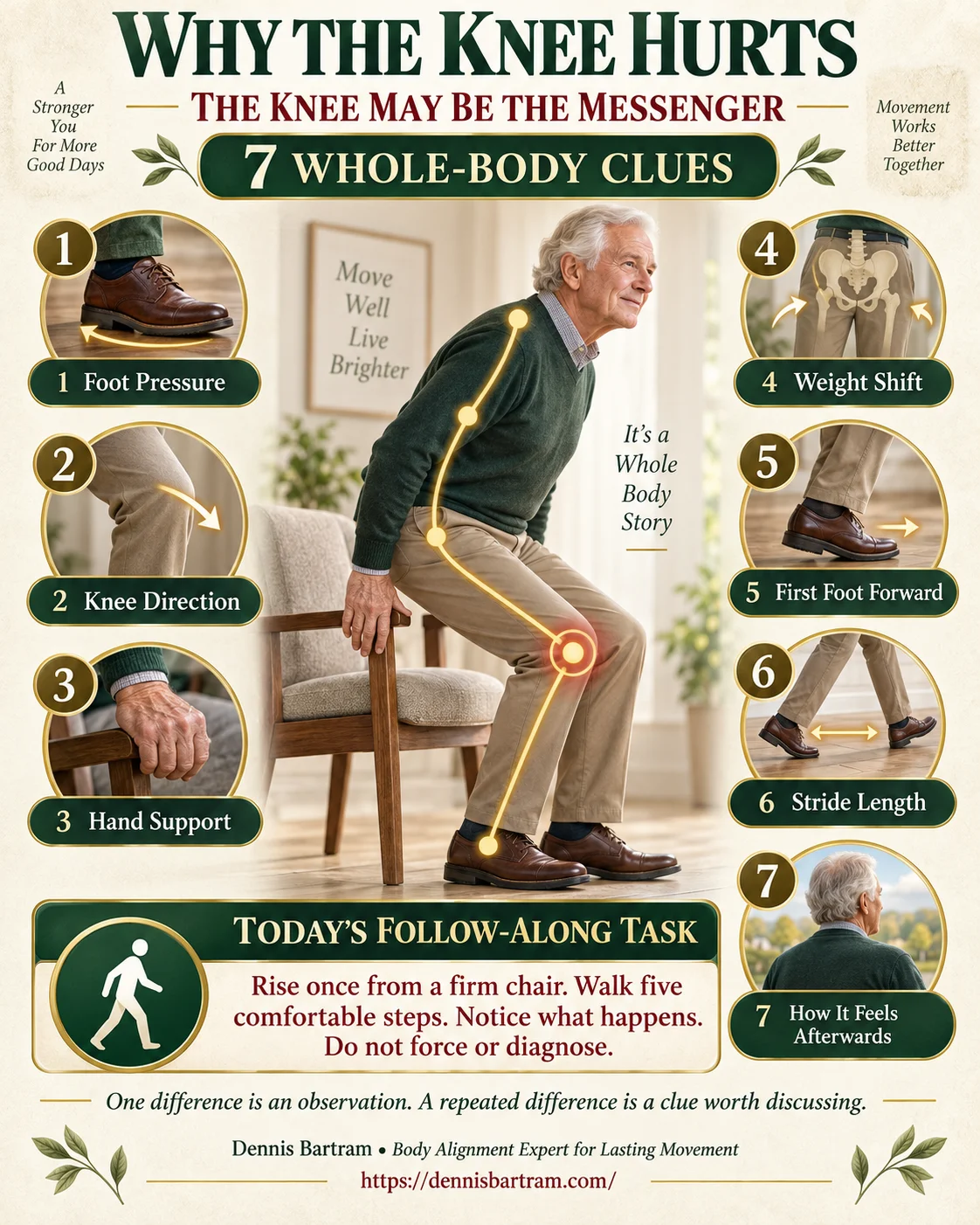
The wider investigation begins at the floor, not because the feet must be guilty, but because every upright movement has to negotiate with the ground. Stand naturally and notice where pressure appears beneath each foot. One heel may feel heavier. The toes on one side may grip while the opposite foot seems relaxed. The inside edge of one foot may accept more weight, or one foot may point farther outward. These differences cannot diagnose Why The Knee Hurts. They reveal how the body has arranged its foundation before the knee bends, straightens or receives the next step.
Dennis’s whole-body approach asks us to follow the work rather than chase the pain. If one foot accepts weight differently, the ankle, knee and hip above it must still organise movement. The body may handle that arrangement without difficulty, or it may gradually distribute the job less comfortably. The observation becomes more useful when it repeats. Does the same side feel heavier while standing, work harder when leaving the chair and remain loaded longer during the first step? If it does, we haven’t found a medical cause. We have found a recurring movement question that may help explain Why The Knee Hurts.
Follow Your Foot Pressure When Asking Why The Knee Hurts
Clue One is uneven foot pressure. Stand beside a solid worktop or another stable surface if balance is uncertain. Keep your eyes open, breathe normally and avoid correcting your posture. Notice the left heel, arch and toes, then repeat the observation on the right. Use neutral language such as “more pressure beneath my right heel” rather than deciding that one foot is damaged or misaligned. The purpose is to create a reliable description. When exploring Why The Knee Hurts, a clear observation is more valuable than a dramatic conclusion unsupported by proper assessment.
Clue Two is the position of the knees while standing. Does one knee appear locked while the other remains softer? Does either knee seem to turn inward or outward as weight settles? Again, visible difference does not automatically equal dysfunction. Human beings are not perfectly symmetrical statues, and forcing both knees into matching positions may replace one uncomfortable strategy with another. Notice the relationship instead. Does the knee position change when pressure moves beneath the foot? That relationship can help a professional investigate Why The Knee Hurts without treating a photograph as a diagnosis.
The Chair-Rise Clues Reveal Who Performs The Hardest Work
Clue Three is hand assistance. Sit in a firm chair with your feet in their usual position, then rise once at your normal speed if it is safe and comfortable. Notice whether one hand presses harder against the armrest, chair or thigh. A hand may help because of habit, reduced confidence, pain or several other influences. It isn’t proof of weakness. However, if the right hand pushes strongly while the body shifts over the right leg, the knee on that side may be getting extra help and extra workload at the same time. That contradiction can add valuable context to Why The Knee Hurts.
Clue Four is the direction of the weight shift. Does the chest travel straight forward before the hips leave the chair, or does the whole body swing sideways? A sideways route may be the body’s easiest available solution. It may help somebody avoid one foot, ankle, knee or hip, although observation alone cannot identify which structure influenced the decision. Watch the route rather than judging it. Dennis’s approach recognises that the way a person completes an ordinary task may reveal more about Why The Knee Hurts than examining the knee while the person remains still.
Your First Few Steps Can Expose A Guarded Movement Pattern
Clue Five: The foot that moves first. After rising, pause only if doing so feels natural and safe, then begin walking normally. Many people consistently release the same foot first because the opposite leg feels more secure. That preference may be harmless. It becomes more interesting when it matches the heavier standing side and the leg used most during the chair rise. The clue is not simply which foot moved. It is whether the same leg repeatedly becomes the body’s preferred support. That repeated responsibility may influence the investigation into Why The Knee Hurts.
Clue Six is stride length. Compare the first two or three steps without exaggerating them. Is one step shorter, quicker or more cautious? Does one foot slide forward while the other lifts cleanly? A guarded first step can keep body weight over the opposite leg for longer. Peter’s short left step, for example, left his painful right knee to support him while the rest of his body prepared to move. The observation doesn’t establish that his walking pattern caused the symptoms. It shows how the knee participates in a task that must be examined when deciding Why The Knee Hurts.
What Happens Afterwards May Clarify Why The Knee Hurts
Clue Seven is the after-effect. Notice what happens during the minute after standing and walking. Does discomfort appear immediately, build after several steps or settle as movement continues? Is the problem different when rising from a higher chair, wearing different footwear or walking after a long period of sitting? These comparisons can reveal conditions associated with the complaint without proving cause. Record what genuinely happened, not what you expected. Understanding Why The Knee Hurts improves when the description includes timing, task and response instead of relying only upon a number on a pain scale.
The seven clues create a practical movement record: foot pressure, knee position, hand assistance, weight-shift direction, first-step preference, stride length and the after-effect. None should be interpreted alone. Look for the pattern that survives several ordinary actions. One difference may be accidental. The same difference appearing during standing, chair rising and walking deserves a better question. This whole-body clue test does not tell somebody how to treat the problem. It helps them describe what the knee is experiencing while the rest of the body completes the job.
Separate Confirmed Observations From Possible Connections
Good observation means separating what happened from what might explain it. “I carried more weight on my right foot” is an observation. “My left hip caused my right knee pain” is an inference. The inference might eventually contribute to a professional assessment, but it should not be promoted to fact because it sounds convincing. This boundary protects readers from turning a useful whole-body idea into another simplistic answer. Dennis’s message about Why The Knee Hurts invites a wider investigation. It does not replace one automatic culprit with another.
A simple two-column page can keep that distinction clear. On the left, write only what you saw or felt. On the right, record questions you may wish to investigate. The left side might say, “My left foot stays forward when I stand.” The right side might ask, “Am I avoiding weight through the left leg?” The question remains open until suitable assessment provides better evidence. This method turns vague concern into a useful record and helps explain why the knee hurts without pretending self-observation is clinical diagnosis.
Use AI To Organise The Clues Without Diagnosing The Knee
An AI assistant can help organise these observations, but its job must remain tightly controlled. It should identify repeated workload clues, separate observations from inferences and prepare a concise summary for an appropriate professional. It should not name a condition, prescribe treatment or declare that the knee itself can be ignored. The reader supplies the real-world evidence. AI arranges that evidence into a clearer movement story. Used this way, it supports the investigation into Why The Knee Hurts without pretending to possess the examination, medical history or professional judgment required for diagnosis.
Try This With AI
Use the AI you already have, such as ChatGPT, Claude, Gemini, Grok, Meta AI or Copilot. Replace the example inside the brackets with your own observations, then copy and paste the complete prompt.
AI Prompt
Act as a careful movement-observation organiser, not a doctor or diagnostician. Analyse this account of how I stand, rise from a chair and take my first few steps: [Replace this example with your own observations: “My right knee hurts when I stand up. While standing, I place more weight on my right foot. To leave the chair, my left foot stays forward, and I push through my right hand. My first left step is short, so I remain over my right leg for longer.] Separate what I directly observed from anything that can only be inferred, identify the strongest repeated workload pattern across the three actions, and explain in plain language how the painful knee could be the complaint site while another part of the movement may be influencing the load it receives. Don’t diagnose a condition, declare a cause, prescribe treatment or suggest that the knee itself can be ignored. Give me one safe action to observe again without deliberately correcting or repeatedly provoking the movement, then produce a concise note I could show an appropriate healthcare or movement professional. Finish by clearly identifying any details in my account that suggest I should seek prompt medical advice, including severe pain, inability to bear weight, major swelling or changed shape, painful locking or giving way, heat and redness with fever, or symptoms that are worsening or disrupting normal activity.
Professional Assessment Still Decides Why The Knee Hurts
AI output is not a verdict. Treat every proposed connection as an inference and compare it with what you actually observed. If the response claims certainty, invents a condition or prescribes treatment, reject that part. The useful output is the organised record: what happened, which clue repeated and what question to take forward. A healthcare or suitably qualified movement professional can then consider the knee itself alongside the feet, hips, pelvis, spine, medical history and relevant testing. That is a responsible route to understanding why the knee hurts.
Seek prompt medical advice if the knee is severely painful, cannot bear weight, becomes badly swollen or changes shape, locks or gives way painfully, or becomes hot and red while the person feels feverish or unwell. Symptoms that persist, worsen or disrupt sleep and ordinary activity also deserve proper attention. Whole-body thinking should widen responsible assessment, never delay it. The knee may be carrying a message from the wider movement pattern, but that message still requires appropriate interpretation.
Open to See This Video, And This Is What’s Already Built, Trained & Waiting For Your First Command.
Why The Knee Hurts Apprentice Task
Complete one safe observation of three ordinary actions: standing naturally, rising once from a firm chair and taking your first few steps. Record the seven clues using neutral language: foot pressure, knee position, hand assistance, weight-shift direction, first foot moved, stride length and the after-effect. Circle only the clue that repeats across two or more actions. Do not correct the movement, provoke pain or decide what caused it. Finish this sentence: “The repeated workload clue I noticed was…” Keep the result as your evidence. Your task is not to diagnose Why The Knee Hurts. It is to provide a clearer account of the work your knee may be receiving.
Why The Knee Hurts 7 Powerful Clues Your Body Reveals
Spread the love
Dennis Bartram
Dennis Bartram is the Director of the Active Balance Home or on the Go System Dennis’ journey began in 1969 when he qualified in Swedish remedial massage and in 1974, he began his practice in remedial sports massage and manipulative
Simple Natural Body Alignment Therapy You Can Practice Daily Rediscovering Your Natural Alignment: How Active Balance Lets Your Body Heal Itself Natural…
Improve Balance While Ageing Without Strain or Over-Exercise Improve Balance While Ageing Through Calm Daily Routines Improve Balance While Ageing: Why Movement…

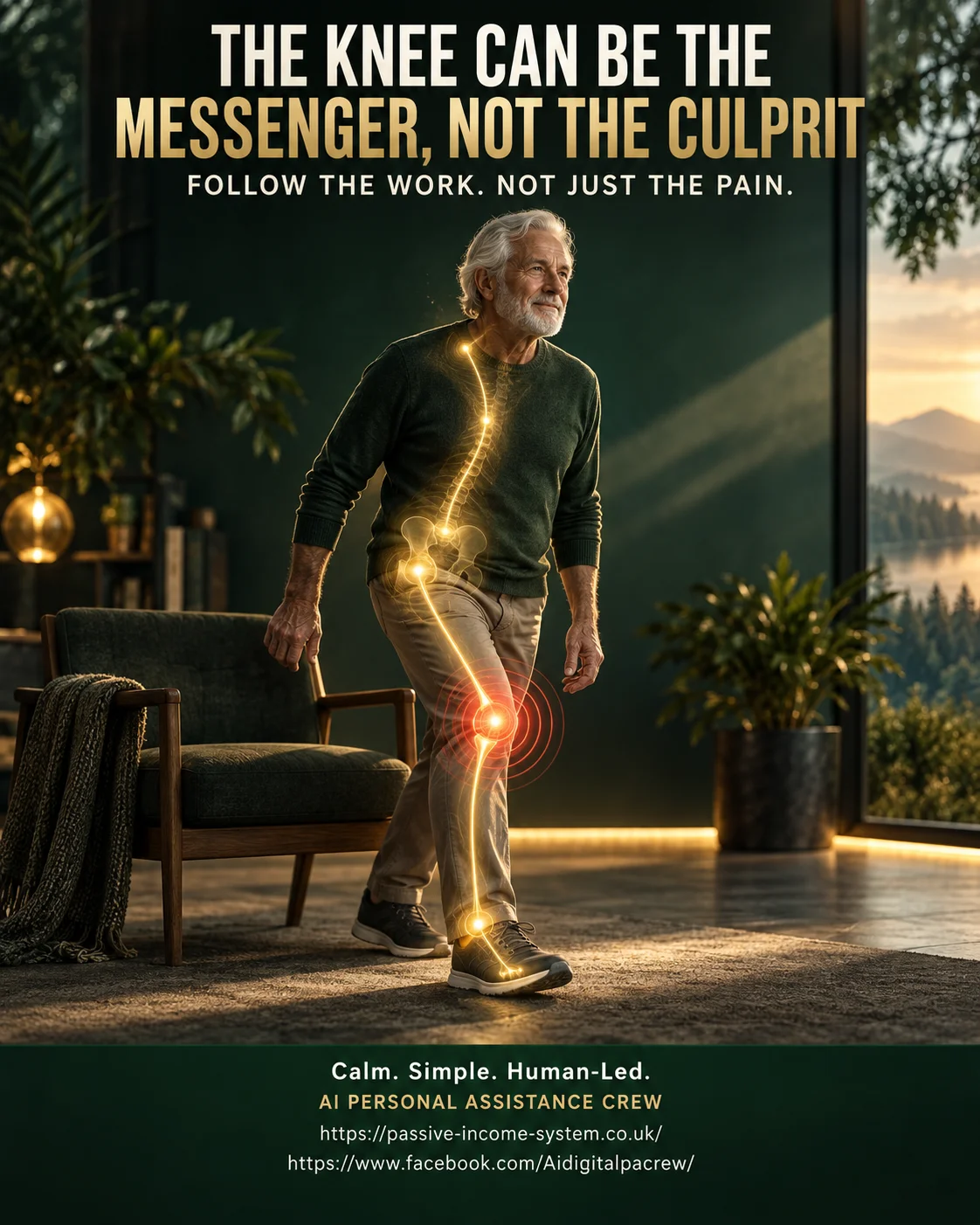
 Picture the knee as a worker stationed between the foot and the hip. Every time someone takes a step, the foot meets the ground, the ankle responds, the knee manages bending and loading, the hip contributes movement, and the pelvis and trunk organise the person above them. None of these departments clocks in alone. If one area contributes less, another may accept more responsibility so the journey can continue. That ability to compensate is not automatically a fault. It is one reason we can keep moving after stiffness, fear, or an old injury changes the original arrangement.