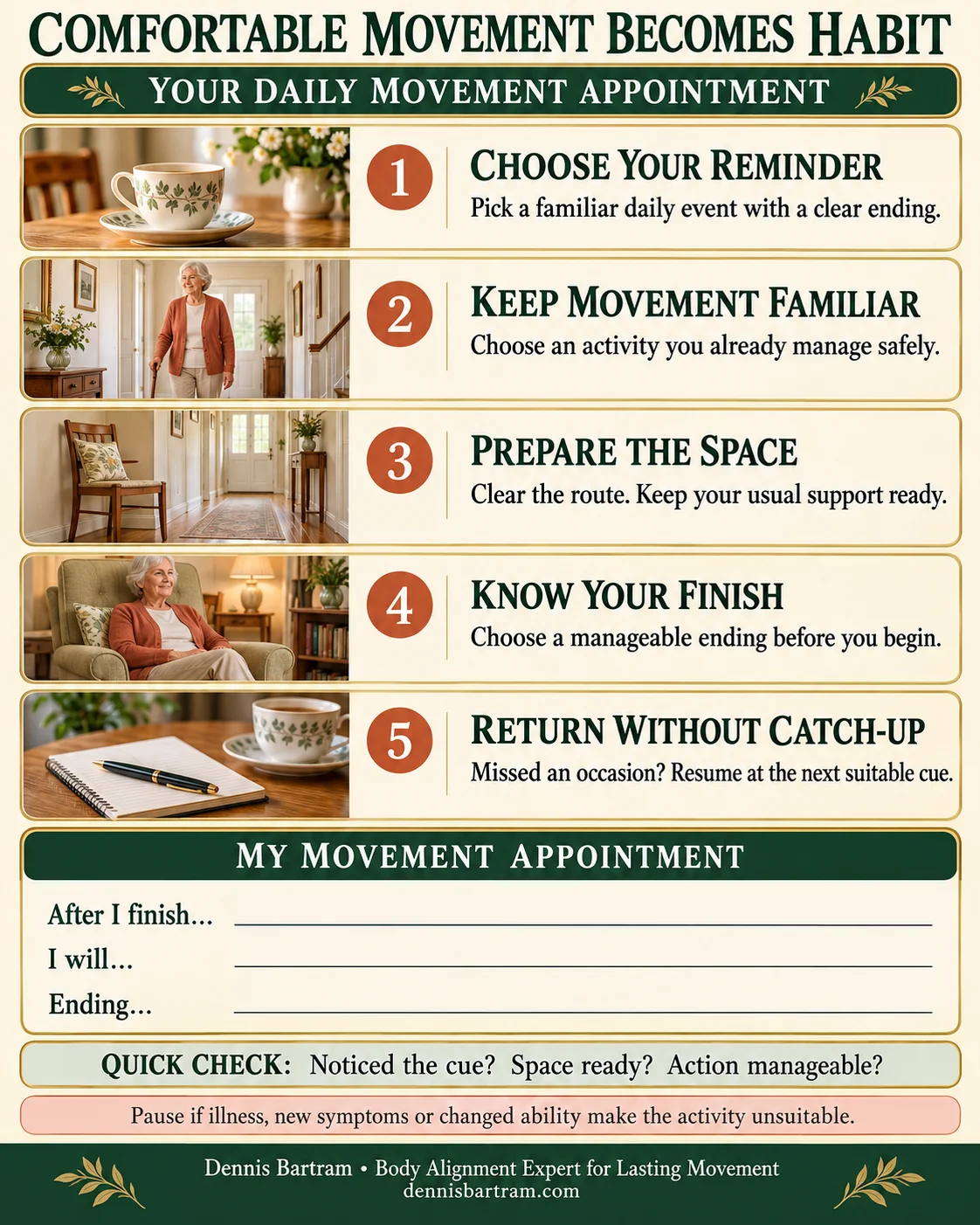
Comfortable Movement Becomes Habit
Give Movement An Appointment With Something You Already Do
A familiar daily moment can give you a clear starting point.
Comfortable Movement Becomes Habit Through A Dependable Reminder
Choose the occasion before the morning becomes busy.
Make Room For Comfortable Movement Within Your Existing Routine
Keep the action manageable and your usual support available.
The intention was there at breakfast, sitting quite comfortably between the toast and the marmalade. You would make time for that familiar movement routine today. Then the telephone rang, the post arrived, and the washing machine announced that somebody ought to attend to its contents. By lunchtime, the morning had vanished. The movement was still waiting for a convenient moment. This is where Comfortable Movement Becomes Habit begins with a practical question: did the activity have a definite appointment, or was it expected to introduce itself politely between everything else?
Before accusing yourself of having no discipline, inspect the arrangement. “I’ll do it later” leaves several decisions unfinished. Later might mean after breakfast, after the shopping or when the house becomes quiet. You must still choose the moment, prepare the setting and decide what counts as enough. A familiar action can become surprisingly easy to postpone when it carries that much unfinished business. Placing it beside something you already do clarifies the plan. It does not guarantee a habit, but it gives you an arrangement you can actually try and improve.
A Good Intention Needs A Recognisable Starting Point
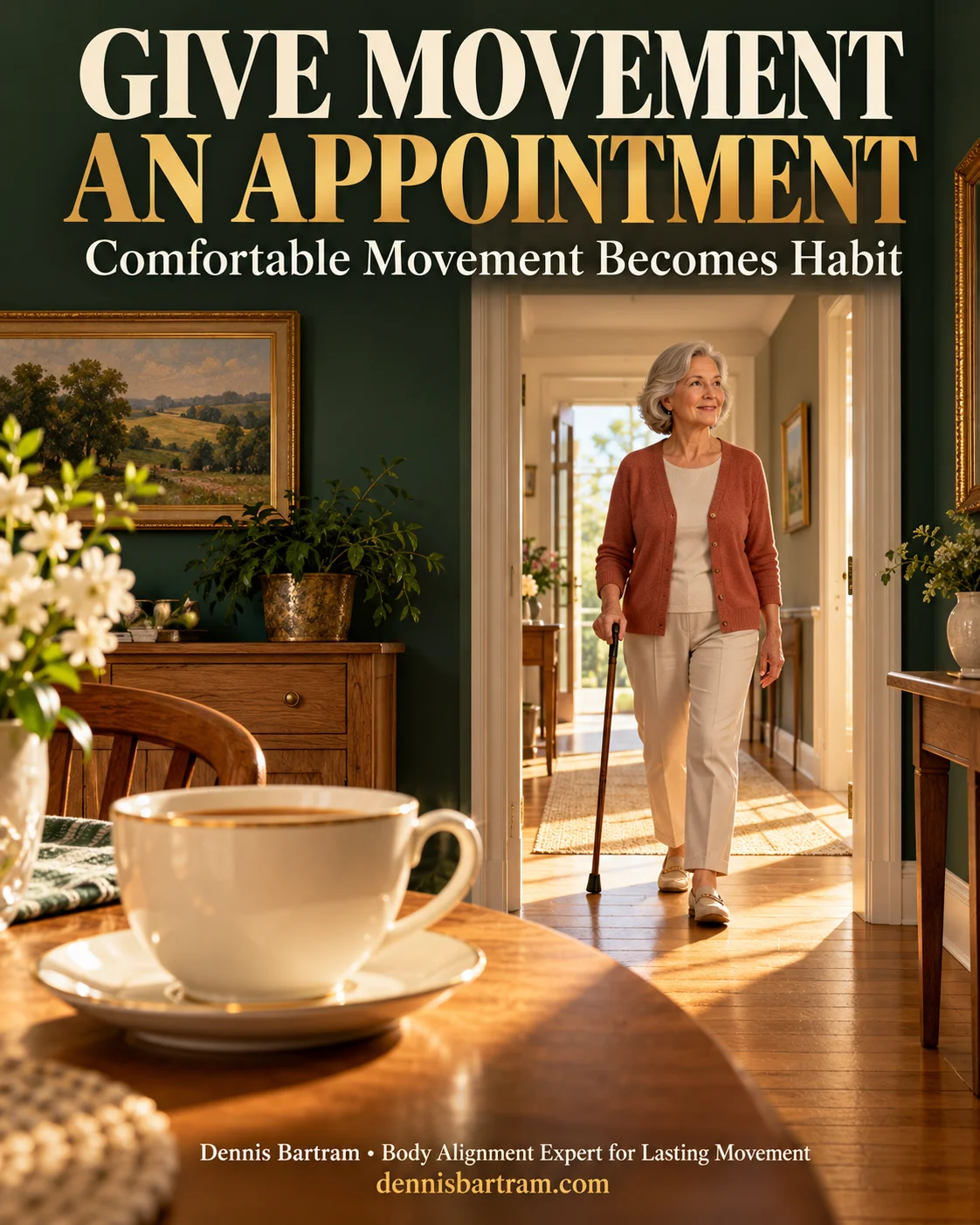 “During the morning” sounds specific until you look at what a morning contains. Meals, messages, visitors, household jobs, and the newspaper can occupy far more territory than the phrase suggests. A useful starting point is something you can recognise as it happens. Finishing breakfast, closing the newspaper or completing a familiar household task may provide that moment. Choose an event with an ending you can identify. Otherwise, the movement remains attached to a broad stretch of time through which several other activities are already wandering.
The reminder should belong to your existing day. If you must create an entirely new ritual to remind yourself about another new ritual, the arrangement has become unnecessarily complicated. Begin with something dependable. Ask whether it happens regularly, whether you notice its ending and whether that ending leaves you somewhere suitable to begin your chosen movement. Those three questions are more useful than selecting a cue because it sounds tidy on paper. The best place in the schedule is the one that fits the life you are actually living.
Comfortable Movement Becomes Habit When The Setting Fits
Location can decide whether a sensible intention gets anywhere. Suppose your reminder occurs upstairs, while your familiar movement belongs downstairs beside a particular support. Several steps now separate remembering from beginning. That may work for some people, but it is worth noticing if the plan repeatedly falls apart along the way. Wherever practical, connect the action with an event that ends close to where it can take place. You are reducing the number of arrangements needed at that moment, rather than asking yourself to organise a small expedition every morning.
The setting should also be ready for its intended use. A supportive chair is less available when it is wearing three coats and yesterday’s shopping bag. A familiar walking route needs to remain clear, with any usual aid accessible. These are ordinary household details, yet they can explain why a routine keeps being delayed. If the same obstacle keeps appearing, address it where you can. Another encouraging slogan will not move the laundry. A practical adjustment may give the intention somewhere useful to go.
Choose A Movement You Already Know
The action attached to the reminder should be familiar and already manageable for you. This approach builds on an existing activity; it does not determine what exercise suits an individual’s health or prescribe how much they should do. Keep your usual support and follow any personal guidance you have received. A short, comfortable indoor walk might suit one reader’s established routine, while another has a different familiar movement. The task here is to give that known activity a dependable place in the day, without changing its demands merely to make the plan sound impressive.
Define the action clearly enough that you can recognise when it’s done. “Do some movement” leaves the morning to decide what that means. A familiar route with a clear return point is more specific. So is an established routine whose beginning and ending you already know. Keep the commitment modest enough to remain believable. If every opportunity can expand into an open-ended session, starting becomes a larger decision. Knowing where you intend to finish gives the activity a boundary and helps it fit alongside the rest of your day.
Comfortable Movement Becomes Habit Through A Clear Connection
Consider Joan, a fictional reader who already manages a short hallway walk comfortably with her usual walking aid. She wants to make it a regular part of her morning. Her first plan is to walk “when there is time”. Unfortunately, something almost always comes up before that moment officially arrives. She changes the wording: “After breakfast is finished and my cup is safely down, I’ll take my usual hallway walk and return.” The physical task remains familiar. What changes is the connection between the task and an event she can recognise.
That sentence gives Joan something concrete to assess. Did finishing breakfast remind her? Was the route ready? Was the familiar walk manageable on that occasion? Those questions can reveal a practical difficulty without turning the whole experience into a judgement about determination. Perhaps she remembers perfectly but is immediately occupied with clearing the table. In that case, finishing the clearing up may be a better cue. Adjusting the appointment is a sensible response to what happened. There is no need to conclude that the entire idea has failed.
Finish One Activity Before Beginning The Next
Connecting two activities does not mean performing them together. Putting down a cup can remind you to move; carrying a hot drink need not become part of that movement. Choose a point where the first job is finished, your hands are free, and you can use your usual support. That clean transition keeps the arrangement straightforward. It also avoids turning a manageable action into a more complicated one by splitting your attention. The daily event supplies the reminder. It doesn’t require an object to carry, an extra task or a reason to hurry.
This is particularly useful when reviewing a morning that already feels crowded. You may discover that the proposed cue sits halfway through something else. The kettle clicks off, but you still need to make the drink. The telephone call ends, but it leaves you with an urgent job. Such events have clear endings, yet they may not leave a practical opening. Choose the moment by what follows it and what precedes it. An appointment works best when there is room to begin, rather than an immediate queue of unfinished business.
Separate Establishing The Routine From Making It Harder
Once a familiar action goes well, enthusiasm may lead you to add more. A comfortable walk could become longer, faster or more demanding before its place in the day has settled. There may be appropriate reasons to change an activity, particularly with individual guidance, but that is a separate decision. When considering how Comfortable Movement Becomes Habit, first notice whether the current arrangement works. Does the reminder arrive at a useful time? Is the setting ready? Can the familiar action fit without making the morning feel like an exercise programme with breakfast attached?
Keeping the activity manageable allows you to assess the appointment itself. If you change the cue, route, duration and support together, it becomes difficult to know which adjustment helped or caused trouble. Give the arrangement enough consistency to reveal where it works. You can then describe the problem precisely: “I remember, but the chair is unavailable,” or “The action fits, but that reminder is easy to miss.” Each description points towards a different practical response. Neither requires you to begin by criticising your character.
Give Tomorrow’s Movement Somewhere To Belong
You don’t need to rebuild your entire day around this idea. One dependable event and one familiar action are enough to establish a useful starting point. Complete the sentence: “After I finish this, I will do that, ending here.” Check that the location, support and timing make sense. Then let the next ordinary occasion show you whether the arrangement fits. You are trying a specific plan, with room to adjust it, rather than signing a lifetime contract over the breakfast table.
The practical meaning of Comfortable Movement Becomes Habit begins with making the start easier to recognise and the action easier to arrange. Some mornings will still be interrupted, and circumstances may require a pause. Those occasions do not make the planning pointless. They tell you how the routine fits into real life. For now, replace the promise to find time with an appointment you can recognise: which familiar daily event leaves a suitable opening for the comfortable movement you already know?
The First Week Shows You Where The Plan Catches
The first few mornings may reveal a detail that looked perfectly innocent on paper. Breakfast ends, the cup goes down, and your chosen movement comes to mind, exactly as intended. Then somebody knocks at the door. On another morning, the reminder arrives, but your usual chair has become temporary accommodation for the ironing. These interruptions provide useful information about the arrangement. Comfortable Movement Becomes Habit needs a practical place in daily life, and daily life rarely consults the schedule before making its entrance. The job is to notice where the plan catches and adjust as needed.
Three short questions can keep that review straightforward. Did I notice the reminder? Was the setting ready? Was the familiar action manageable? Each question concerns a different part of the arrangement. If you never noticed the cue, clearing the hallway will not solve the whole problem. If you remembered but could not access your usual support, a louder reminder misses the point. Locate the difficulty before changing the plan. That gives your next adjustment a clear purpose and prevents one inconvenient morning from prompting a complete overhaul.
Comfortable Movement Becomes Habit When You Fix The Right Obstacle
Suppose Joan, our fictional reader, discovers that finishing breakfast is an unreliable reminder because she often remains at the table reading. Breakfast has no obvious ending; it gradually turns into the rest of the morning. Closing the newspaper may provide a clearer moment. However, that only works if she reads it regularly and usually finishes somewhere suitable for her familiar activity. The aim is to find a cue she recognises in practice. Choosing something that sounds neat but seldom happens would give the original problem a new name.
Now imagine that Joan remembers readily but finds her walking aid has been moved while somebody tidied the room. The cue is doing its job. The difficulty is accessing her usual support. That calls for a practical household arrangement about where the aid belongs, rather than another promise to try harder. Keep the explanation close to what actually happened. “I remembered, but the setting wasn’t ready” is an observation you can act on. “I never stick to anything” turns one specific obstacle into a sweeping judgement that offers very little help.
Change One Part And See Whether It Fits
Once you identify a recurring obstacle, change the relevant part of the plan where possible. Choose a clearer daily event, prepare the space earlier or select a more suitable opening in the day. Leave the other parts familiar while you assess that adjustment. Otherwise, changing the reminder, location, and activity may leave you unsure which difference mattered. A simple plan is easier to understand when it succeeds and easier to troubleshoot when it does not. You are looking for an arrangement that works under ordinary conditions, rather than one that requires an unusually cooperative household.
Allow for occasional disruption before deciding that a cue is unsuitable. One visitor arriving early does not necessarily expose a flaw in the whole routine. Repeated difficulty under similar circumstances deserves more attention. A brief note can help: “Remembered, space ready, completed usual version,” or “Remembered, interrupted before starting.” You do not need a complicated diary. The purpose is to preserve enough detail to distinguish a recurring problem from an exceptional morning. That distinction keeps the adjustments proportionate and saves you from redesigning breakfast every time the doorbell rings.
Comfortable Movement Becomes Habit With A Manageable Commitment
An activity can be easy to remember yet difficult to fit because the commitment has quietly expanded. A short familiar walk becomes several circuits. A manageable routine acquires extra movements because the previous session felt comfortable. Soon the appointment asks for more time and attention than the original opening provides. The person begins postponing it and assumes motivation has disappeared. Before accepting that explanation, look at what the appointment now contains. You may be trying to fit a larger job into a space chosen for a smaller one.
Deciding whether to increase an activity’s demands is separate from establishing its place in the day. Keep any changes consistent with your individual needs and professional guidance. You don’t need to make the routine harder just because you remembered it. A dependable opportunity to complete an appropriate activity has value. When Comfortable Movement Becomes Habit, the practical aim is to keep the arrangement understandable and manageable. A plan that keeps changing its requirements is hard to rely on, like a tradesperson who adds another room every time you think the decorating is finished.
A Smaller Version Needs To Be Chosen Sensibly
Ordinary disruptions sometimes leave room for a shorter version of an established activity. If that is appropriate for you, decide what the alternative involves before the busy occasion arrives. It should remain familiar and within what you already manage, with your usual support. For example, someone with an established, comfortable indoor walk might choose a shorter, familiar route for a morning when visitors are expected. The shorter version needs a clear ending too. Otherwise, the decision you hoped to simplify returns at exactly the moment you have less time to make it.
This flexibility is for practical circumstances, not for explaining away a change in health. Illness, new symptoms or a change in what you can manage may require pausing and seeking appropriate advice. A reminder cannot determine whether an activity is suitable that day. Nor must every interruption be rescued with an alternative. Sometimes the sensible decision is to miss that occasion. The routine should support daily life, including necessary changes of plan. It should not become a rule that demands movement regardless of the situation.
Comfortable Movement Becomes Habit When Returning Is Straightforward
A missed morning can create an unhelpful calculation: yesterday’s activity was omitted, so today must include twice as much. That turns an interruption into a debt. It also changes the familiar activity you had planned to repeat. After an ordinary disruption, return at the next suitable cue with the established version, provided it remains appropriate. You don’t need to add compensatory effort to make the notebook look respectable. The useful action is resuming the arrangement. Yesterday’s unexpected family visit does not have to dictate today’s physical demands.
Make that return rule part of the original plan. “If an ordinary interruption prevents it, I’ll return at the next suitable familiar cue” leaves less room for bargaining afterwards. It also avoids treating one missed occasion as the end of the project. If the interruption involves illness or a change in ability, reassess suitability rather than automatically resuming. Clear rules can remain flexible enough to respect circumstances. The point is to know how you intend to return when it makes sense, without inventing punishment for having a life outside the routine.
Let The Reminder Become Part Of The Room
A small visible note may help while you are learning the arrangement. Place it somewhere you naturally look at the chosen moment, without obstructing anything or creating clutter. Its wording can be practical: “After clearing breakfast: usual hallway walk.” Covering the house with instructions that become part of the wallpaper adds little value. One relevant reminder close to the event may be easier to notice. If it stops attracting your attention, review whether the cue itself is clear rather than endlessly multiplying the signs.
Other people can also help with the setting, as long as their involvement suits you. A family member might keep the usual chair available or remember where an aid belongs. That support is different from supervising every attempt. You do not need someone announcing your movement appointment across the kitchen like a station departure. Agree on help that makes the activity easier to arrange and preserves your choice. The routine belongs to the person carrying it out. A useful household contribution removes an obstacle without turning a manageable habit into a public performance.
Judge The Arrangement Before Judging Yourself
After several ordinary opportunities, look at whether the plan is becoming easier to use. Do you recognise the cue? Is the setting generally ready? Does the familiar activity fit the opening you selected? You may find that one part needs adjustment while the rest works well. You don’t need to decide that you have either mastered habit formation or failed at it. Describe what you know. A clear account of how the arrangement works is more useful than a grand verdict about your willpower.
The phrase Comfortable Movement Becomes Habit gives the work a direction, not a deadline. There is no fixed number of mornings after which you must stop needing a reminder. Keep the practical arrangement that helps, revise what repeatedly obstructs it and recognise when circumstances call for a pause. The aim is a familiar activity with a workable place in your day. Success begins with a plan you can understand, use and return to, rather than a promise that depends on tomorrow being unusually quiet.
Open to See This Video, And This Is What’s Already Built,
Trained & Waiting For Your First Command.
Comfortable Movement Becomes Habit Apprentice Task
Choose one familiar movement or routine you already manage safely, keeping your usual support and individual guidance. Select one existing daily event with a clear ending that leaves you somewhere suitable to begin. Complete this sentence: “After I finish…, I will…, ending…” Be specific about the event, the familiar action and its finishing point. Then identify one practical preparation, such as keeping the necessary chair available or the usual route clear. You are arranging an existing activity, not adding a new exercise challenge.
When the next suitable occasion arrives, notice whether you recognised the cue, had the setting ready and found the action manageable. If the arrangement repeatedly catches in the same place, adjust that part. If an ordinary interruption prevents it, return at the next suitable cue without adding catch-up effort. Keep the appointment clear, the activity appropriate and the return straightforward. Give familiar movement a place in the day that you can recognise when you reach it.