Body Map Reveals Compensation
Ordinary Daily Tasks Show Where The Movement Workload Shifts
The place that feels busiest may not be the place telling the whole movement story.
Follow The Job Before The Body Map Reveals Compensation Feeling
Everyday movement becomes easier to understand when you watch how the whole task is being completed.
Busy Does Not Automatically Mean Guilty
An area working hard may simply be helping another part of the movement finish the job.
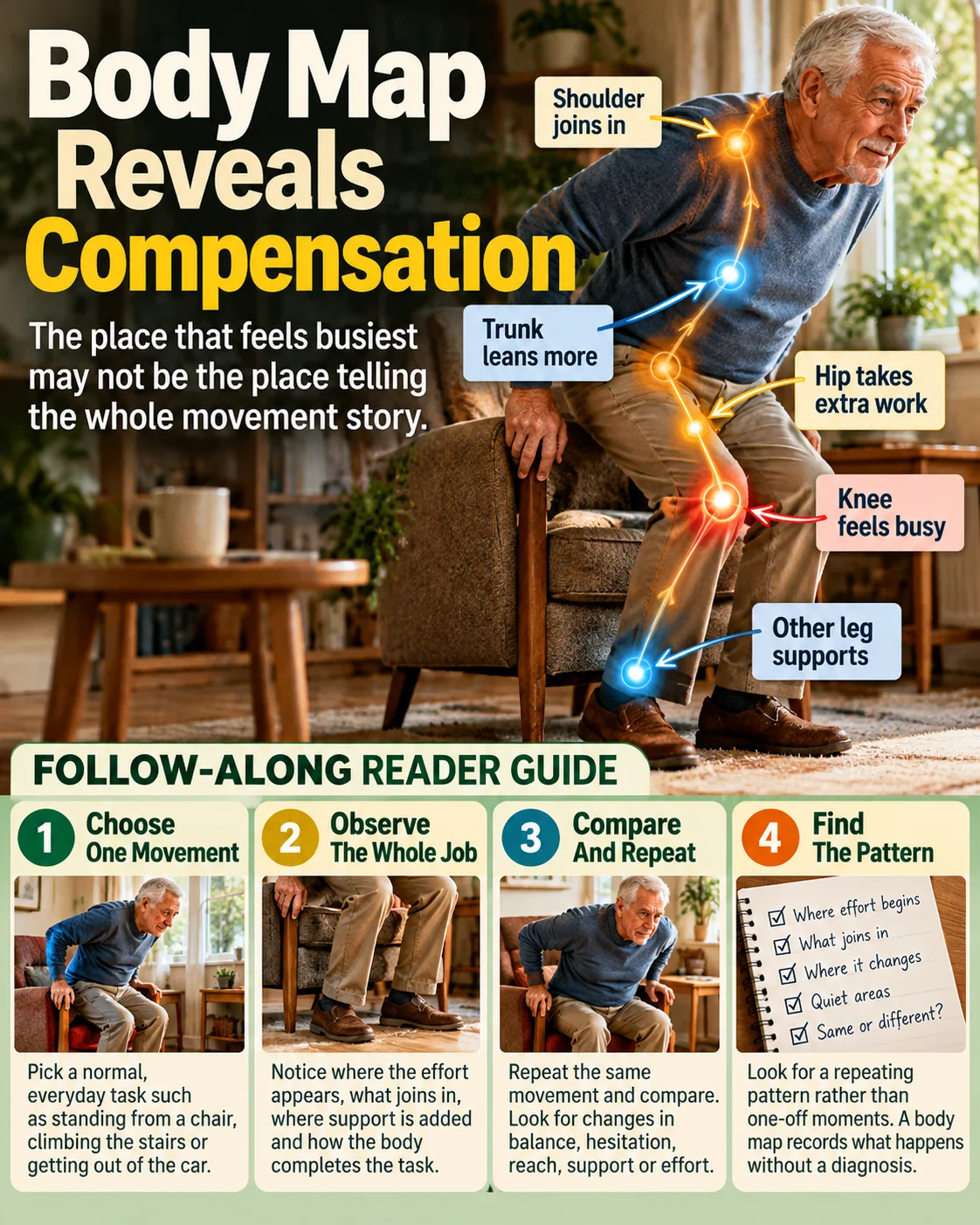
You know how it is with an old armchair. It starts life as an innocent piece of furniture and, after twenty years, becomes a family member with its own geography. There is the dip in the cushion, the polished patch on one arm and the precise spot where your backside has apparently taken out a long lease. Then one afternoon you stand up and notice your right knee working rather harder than you remember. Naturally, the knee gets the blame. It was the place that shouted, after all. Yet watch the whole manoeuvre and the story may be considerably more interesting than one noisy knee.
Perhaps you lean farther forward than you used to. Perhaps the left foot quietly slides backwards under the chair. One hand finds the armrest before you’ve consciously decided to use it, while the other leg appears to do more of the push. None of this proves why the knee feels different. It does reveal something useful, though. Standing up involves far more than the place where the effort is most obvious. Your body has still found a way to complete the task, and the strategy it uses may have changed without you noticing.
This is where Body Map Reveals Compensation becomes more than an interesting phrase. A useful body map isn’t simply a diagram of where something hurts, feels stiff or complains when you move. It is a record of participation. It asks where movement begins, what joins in, what holds back, where support is added and how the workload seems to travel through the task. Instead of staring at the noisiest body part like a detective who has arrested the first suspicious character, you widen the investigation and watch the whole job being done.
Comparison Helps You Follow The Body Map Reveals Compensation More Clearly

Imagine a small workshop where three people normally lift a heavy bench together. One morning, one of the three contributes less. He may have a perfectly good reason. The bench, however, remains every bit as heavy as it was yesterday. The other two workers have to change something if the job is still going to get done. They grip harder, shift position, or take more of the weight. If you walked through the door halfway through, you might notice the two busiest workers and assume they were the problem. You would be watching effort, not the job.
The same reasoning applies when observing ordinary movement. If one area contributes differently, another may appear busier because the task hasn’t disappeared. You still have to rise from the chair, climb the stairs, reach the kitchen cupboard, put on your socks or get out of the car. The body may alter the strategy rather than abandon the job. That doesn’t mean every change is compensation, and it certainly doesn’t diagnose a cause. It means the change is worth observing before someone rushes in and starts correcting whatever looks busiest.
A good working rule is remarkably simple: movement is the job; strategy is how the body currently solves it. Once you think that way, many familiar movements begin to look different. You stop seeing isolated elbows, knees, hips, and shoulders and start seeing a person completing a task. That shift matters because the obvious sensation may be only one part of the solution. The knee that feels busy may be working harder while the foot contributes differently. A tight shoulder may be accompanied by a larger trunk turn. The hands may be joining a job they once left to the legs.
The Loudest Spot Is Not Always Where The Body Map Reveals Compensation Movement Workload Leads
Those observations don’t tell you what is wrong. In fact, the quickest way to spoil a good body map is to become too certain too early. They show how the workload appears to be distributed during that task. That is enough to be useful. Dennis’s observe-first approach is important here because description comes before explanation. “I pull harder on the banister when the left foot is on the step” is an observation. “My left leg is weak” is already an interpretation. The first gives you something you can compare. The second may close the case before you’ve collected the evidence.
There is a lovely old tradesman’s lesson in that. No experienced plumber condemns the boiler because somebody says the bathroom radiator is cold. He looks at what the system is doing. Which pipes are hot? Which are not? What happens when another valve is opened? Has anything changed elsewhere? Otherwise, you could spend a cheerful afternoon replacing perfectly innocent parts while the real problem sits elsewhere, laughing at you. Movement deserves the same courtesy. Observe what the system is doing before attaching a confident explanation to the place making the most noise.
Map The Task Before The Body Map Reveals Compensation Part
This gives us another useful rule: map the task before you map the body part. Start with something ordinary enough that you aren’t performing it specially for the occasion. Standing from the kitchen chair is better than inventing an elaborate exercise. Getting out of the car is better than contorting yourself into something you last attempted during school games in 1958. Everyday tasks are useful precisely because the body already knows the job. You are watching the strategy it naturally chooses rather than asking it to put on a demonstration for the observer.
Getting out of a car is a particularly good example because it contains several small jobs disguised as one. Someone might say, “My hip feels stiff when I get out.” Fair enough. That is what they notice. But now watch what actually happens. Do both feet reach the pavement before they start standing? Does one hand stay on the steering wheel? Does the other push firmly on the seat? Does the trunk rotate gradually, or does the whole body seem to turn as one block? Is there a pause halfway through? The hip sensation remains part of the story, but it is no longer the entire book.
Then compare that with another familiar task. The same person may rise from a dining chair without using either hand. They may turn easily to reach something on the kitchen worktop. They may walk around the garden without the same hesitation. Suddenly you have comparison rather than assumption. The question is no longer, “What is wrong with my hip?” It becomes, “What changes when this particular job asks something different of me?” That is a far more productive question because it gives you something observable without pretending an everyday movement test can provide a medical diagnosis.
Open to See This Video, And This Is What’s Already Built,
Trained & Waiting For Your First Command.
Discover Your Unique Path to Well-Being with Movement Outlook Therapy

Staying Curious Helps You Follow The Body Map Reveals Compensation
The Three Body Map Reveals Compensation Questions That Change The View
A simple body-map observation can begin with three questions. First: What is the job? Name the actual task before thinking about individual body parts. Second: Where does the obvious effort appear? Notice the place that feels busy, stiff, hesitant or demanding. Third: Where else does the body change the job? Look for extra support, altered timing, a weight shift, an unusual turn, less movement somewhere else or another area apparently joining in more strongly. That third question often turns an ordinary observation into something genuinely useful.
Imagine putting on a sock while sitting on the edge of the bed. One side is straightforward. On the other side you find yourself leaning backwards, lifting the leg with both hands and holding your breath as though the sock has suddenly become a competitive sport. The temptation is to stare at whichever hip or knee feels most restricted. But the whole task contains more information. What changed in the trunk? Did the foot come towards you, or did you move towards the foot? Did one hand support you while the other did the work? Was the difficulty in reaching, balancing, lifting, turning or some combination?
The Body Map Reveals Compensation most clearly when you let these observations remain observations. You aren’t deciding that one body part caused another to behave differently. You notice how the workload appears to shift around the task. That distinction keeps the map useful. It also gives you something you can return to tomorrow, next week or after a change in routine. The same sock, the same chair and the same person can provide a surprisingly informative comparison when you stop treating each movement as an isolated event.
Hidden Progress Appears When You Follow The Body Map Reveals Compensation Workload
One of the easiest mistakes is seeing an area working hard and immediately deciding it needs to stop. Suppose somebody uses both hands on the armrests when standing. The instant instruction might be, “Don’t use your hands.” Yet the hands may currently be helping the movement succeed. Remove them before you understand why they joined the job, and you change the test. A better first observation is, “When you stand naturally from this chair, your hands join the movement.” That gives you a fact to compare, not a correction you imposed.
Now the useful questions begin. Do the hands join the job from every chair or only the low sofa? Does it happen first thing in the morning but not later in the day? Does one hand arrive before the other? Does the amount of help change after a walk around the garden? What happens from the firmer dining chair? None of those comparisons provides a diagnosis. They do something more modest and often more valuable. They reveal whether the strategy is fixed or changes with the task’s demands.
That’s where a body map becomes genuinely informative. The aim isn’t to catch the body doing something wrong. It is to understand how the body is currently organising ordinary life. Once you can see that, you are no longer trapped by the loudest sensation or the busiest body part. You can follow the workload, compare the strategy and notice whether the same pattern keeps appearing. Sometimes the most interesting part of the map isn’t the place demanding your attention. It is the quiet area that has stopped doing quite as much of the job.