Whole Body Movement Connections Start With Everyday Tasks. Discover what a familiar movement can help you notice about your body
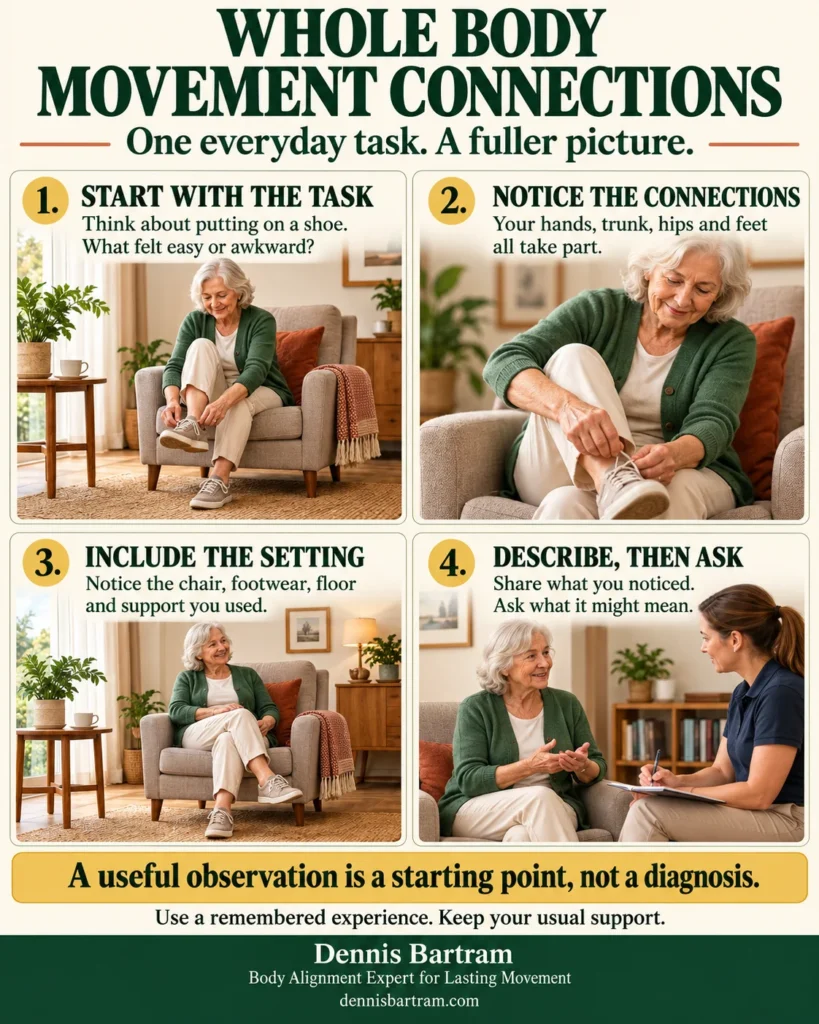
What Else Is Involved When One Movement Feels Difficult?
Look at your feet, your support and your surroundings to build a clearer picture.
Turn One Observation Into Useful Whole Body Movement Connections
Describe what you noticed so you can discuss it without guessing the cause.
Explore Connections Through Active Balance After Fifty
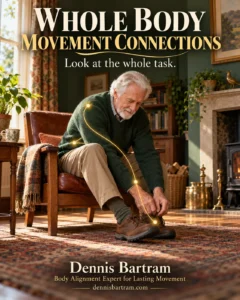
Whole-body movement connections become easier to understand when we look at an ordinary task, such as putting on a shoe, and notice everything involved. A knee may draw attention, while the person above it and the floor beneath it get very little. That is understandable. When something hurts, it tends to dominate the conversation. Yet an everyday action such as standing from a chair involves more than the place where discomfort is felt. The feet meet the floor, the body changes position, and the person organises the movement using whatever assistance is available. Exploring whole-body movement means considering the task more broadly. This doesn’t mean the knee is innocent or that the answer must lie elsewhere. Local symptoms still deserve appropriate assessment. The wider view adds context rather than replacing attention to the part that is troubling the person.
Imagine watching someone rise from a familiar armchair. Their feet are positioned under them, they use the armrests, and their trunk moves before they reach standing. Another person may complete the same job differently. A low seat, a soft cushion or different armrests can also change the situation. None of these observations provides a diagnosis, but they illustrate why the task cannot be understood from a single body part alone. The useful question is how the person completes the action in those circumstances. That invites attention to the whole movement while leaving room for individual differences. It also avoids treating every variation from somebody else’s technique as a fault that must be corrected.
The Feet Belong In The Whole Body Movement Connections
The body contains structures that connect and interact, but those connections don’t identify the source of an individual’s pain. This is where an appealing explanation can outrun the evidence. A foot position and a painful knee may be noticed at the same time. That observation alone doesn’t establish that one caused the other. A raised shoulder and an uncomfortable hip do not automatically reveal a chain that needs to be “released”. A professional assessment may consider several possibilities, including local problems and the demands of the activity. Readers can help by describing what they experience, but they shouldn’t have to become amateur diagnosticians to get useful help.
A whole-body approach broadens the questions and makes the conclusions more careful. What activity is difficult? How is the person completing it? What assistance, symptoms and circumstances are involved? What changes during assessment, and what remains uncertain? Those questions offer more than the claim that everything is connected. Connections are a starting point for investigation. They are not a finished explanation. When you explore whole-body movement, resist the temptation to replace one simple answer, “it must be the knee”, with another, “it must be the foot”. The purpose is to understand the person better, not move the certainty to a different postcode.
Whole Body Movement Connections Include Your Surroundings
Whether standing or walking, the contact between your feet, footwear and the surface is part of the task. A familiar indoor route and an uneven outdoor path present different circumstances. So do well-fitting shoes and footwear that slips or feels uncomfortable. The NHS includes suitable footwear and attention to household trip hazards among its practical advice for reducing falls risk. These reminders show that the setting deserves attention alongside the body. A problem isn’t always solved by asking someone to concentrate harder on posture. Sometimes an environmental issue needs addressing, and sometimes a health concern needs assessment. The feet belong in the conversation because they participate in the activity, not because they explain every difficulty above them. NHS
Alan has noticed something distinctive about his walking. He remembers the outside edges of his heels wearing down and now describes his feet travelling more nearly straight ahead, alongside a floating feeling. That is a memorable part of his account. It can prompt a useful discussion about footwear and movement, but shoe wear cannot independently prove that alignment has been corrected. Shoes differ in age, material and use, and the observation needs context. If you’re comparing two pairs, consider whether you’ve worn them for similar activities and for similar lengths of time. You can be interested in what you notice without letting it carry a conclusion it can’t support. A clue earns its value by leading to a sensible question.
Fascia Adds Context To Active Balance After Fifty
Fascia is connective tissue associated with structures throughout the body. It forms part of the anatomical picture that helps us understand how tissues are arranged and connected. That makes it relevant to discussions of movement, but it doesn’t justify attributing every feeling of stiffness or restriction to fascia. A sensation described as “tight” doesn’t identify a particular tissue by itself. Nor does an improvement after moving prove that a fascial restriction has been removed. The term can help explain anatomy when used carefully. It becomes less helpful when it is used as an answer before the person’s circumstances have been assessed. NIH
The familiar bedsheet comparison can illustrate connection: pulling one corner changes tension elsewhere. However, a living person is considerably more complicated than a bed awaiting inspection. Muscles, joints, nerves, circulation, health conditions and the demands of an activity all deserve consideration. A metaphor should make one idea easier to grasp without pretending to explain everything. If a demonstration uses fabric to illustrate a connection, remember what the demonstration can and cannot show. It may communicate continuity, but it cannot diagnose your shoulder or establish the treatment you need. To explore whole-body movement well, keep the useful picture while leaving its limits intact.
Posture Is Part Of An Activity
A photograph can capture a position, but it cannot show the full experience of moving into it, holding it and moving away again. This matters when readers judge themselves from a mirror or a still image. One shoulder may appear higher, or weight may seem uneven, but the image alone doesn’t explain why or show that the difference is harmful. It also doesn’t tell us whether the person is comfortable, what they are trying to do or how the position changes during movement. A useful assessment can consider these details together. Trying to manufacture a perfectly symmetrical photograph may distract from the ordinary activity the person wants to manage.
The phrase “gravity line” can describe position relative to gravity, but it shouldn’t become an invisible ruler readers feel obliged to obey at every moment. Standing, reaching and walking involve changing positions. The practical concern is how the person manages the task’s demands with their abilities and support needs. Instead of repeatedly commanding yourself to stand straighter, describe when standing feels tiring or uncertain and seek advice suited to that experience. There is a difference between learning something useful about your movement and spending the afternoon policing every shoulder position. The former should serve your day, not take it over.
Consider Your Surroundings With Active Balance After Fifty
Someone can feel uncertain about a movement without that feeling explaining every physical difficulty involved. Similarly, telling someone to be confident doesn’t mean the task is appropriate for them. Balance problems can have different causes, and the National Institute on Ageing identifies medical conditions and medicines among the possibilities. This is one reason broad claims about “switching off protective brakes” need care. They may sound vivid, but they can encourage readers to assume a cause that hasn’t been established. A person’s account of hesitation is useful information. It belongs alongside their symptoms, abilities and circumstances rather than replacing an assessment. National Institute on Ageing
In ordinary language, the distinction is straightforward. “I felt worried about turning” describes uncertainty. “I needed assistance while turning” describes the conditions of the movement. “My leg felt weak” describes a sensation that may need assessment. Those statements may belong in the same account, but they shouldn’t be treated as interchangeable. Keeping them separate helps a professional understand what the person means. It also makes progress easier to describe honestly. Suppose someone feels less worried but uses the same support, that can be a worthwhile change in experience without proving that their balance or strength has improved. Clear descriptions allow encouragement without asking it to do the work of a diagnosis.
Whole Body Movement Connections Include Your Surroundings
Consider a person who says that reaching for a cup is difficult. Focusing only on the shoulder misses the shelf height, the cup’s distance, the available standing space and whether the person is carrying something else. Those details don’t rule out a shoulder problem. They help explain the task being attempted. An appropriate change to the arrangement may improve access while a health concern is addressed separately. This is a practical advantage of exploring the whole situation: the person may have more than one useful option. It also prevents every difficulty from becoming a demand that the body must change before daily life can become easier.
The same principle applies to floor activity. A clear area, suitable arrangements and an agreed return plan are part of participation. A confident demonstration filmed in one setting doesn’t automatically transfer to a different home or a different person. Watch for what the demonstration assumes as well as what it shows. If the assistance, position or surroundings differ from yours, clarify that rather than improvise around it. You don’t need to copy every visible detail to prove that you have understood the lesson. Understanding may mean recognising where you need individual guidance before the movement becomes appropriate for you.########
And This Is What’s Already Built,
Trained & Waiting For Your First Command.
Take A Better Question Into Your Next Conversation
Choose one activity from ordinary life and describe the person, the task and the setting together. Include the part that concerns you, the support used and anything that seems relevant about footwear, furniture or space. Leave proposed causes out unless a qualified professional has already explained them to you. A note such as “turning towards the cupboard feels difficult when the kitchen is crowded” is useful without becoming an anatomical theory. It can help direct a conversation about assessment and practical arrangements. The aim is to explore whole-body movement with enough detail to avoid a narrow assumption, while keeping your conclusions no larger than the evidence. Exploring Whole Body Movement Connections starts with noticing an everyday task, the support you use and the surroundings in which it happens.
The wider view should leave you with more useful questions and fewer instant diagnoses. Your feet matter, connective tissues matter, and so do strength, coordination, confidence, health and surroundings. None needs to explain everything. Once your concerns and circumstances are clearer, the next step is to connect appropriate guidance with a routine that fits your life.
Whole Body Movement Connections Hidden Secrets For You
Spread the love
Dennis Bartram
Dennis Bartram is the Director of the Active Balance Home or on the Go System Dennis’ journey began in 1969 when he qualified in Swedish remedial massage and in 1974, he began his practice in remedial sports massage and manipulative
Active Balance Self-Maintenance For Lifelong Movement Picture yourself moving through each day with greater ease, Trust and Freedom. Why Active Balance Self-Maintenance Matters…
Improve Balance While Ageing Without Strain or Over-Exercise Improve Balance While Ageing Through Calm Daily Routines Improve Balance While Ageing: Why Movement…
Balanced Body Movement Coach Restores Confidence Naturally Balanced Body Movement Coach for Strength and Stability Pain Signals Explained by a Balanced Body…