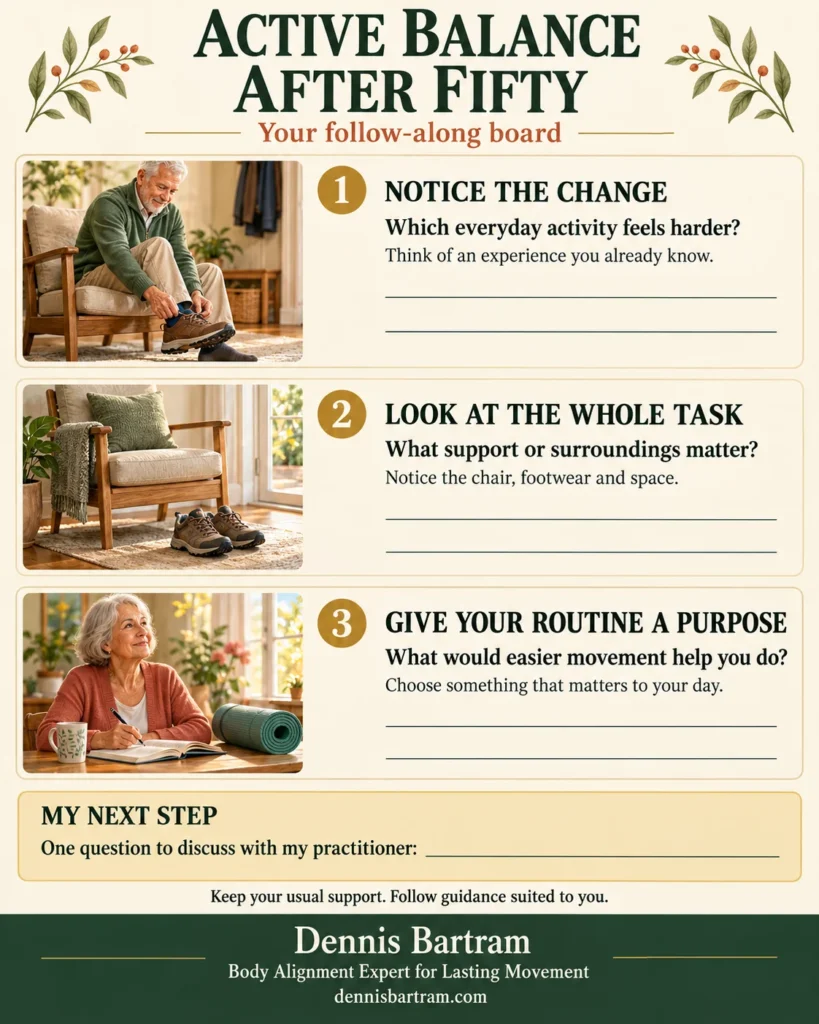
Active Balance After Fifty Starts With Everyday Freedom
Understand what feels harder and what you want to do more comfortably.
What Would Easier Movement Give Back To Your Day?
Getting dressed, joining a game or rising from the floor gives practice a purpose.
Give Your Morning Routine A Personal Reason
Follow appropriate guidance and notice what matters in your own life.
Part One: Understand Your Movement Changes. The Floor Hadn’t Moved, But The Journey Had Changed. The bedroom floor was exactly where it had always been. Nevertheless, in his early seventies, Alan discovered that getting down to it had become a job requiring something to hold on to. Getting back up was even harder. No sporting ambition drove his concern, no medal waited beside the wardrobe. He wanted to manage an ordinary movement without planning an expedition. That distinction matters because a useful conversation about movement begins with something a person wants to do. “I ought to get fitter” is a broad intention. “I struggle to get up from the floor” identifies a particular difficulty. To understand changes in your movement, start with the moment that has become awkward, tiring or uncertain. Place it in everyday life before deciding what it means.
Alan now describes a different experience. He follows a sequence of movements learned from Dennis Bartram for twenty minutes before leaving his bedroom each morning. He reports getting down and up without holding furniture, greater flexibility, no pain and a “float” in his walk. These are his personal observations, not a promise that another reader will achieve the same results. However, they explain why he keeps returning to his routine. He values how he feels throughout the day and afterwards. His story gives this subject a human purpose: the wish to feel more capable in ordinary life. It also raises a practical question for anyone who has noticed a change. Before choosing another exercise, can you explain what has become difficult and what you would like to do more comfortably?
Active Balance After Fifty Looks Beyond Your Birthday
“It’s my age” can end a conversation early. The phrase sounds reasonable, especially when friends share similar complaints, and the calendar provides undeniable evidence. However, it doesn’t tell us why a particular movement has changed or whether anything useful can be done. Two people of the same age may describe very different experiences. One struggles to rise from a low sofa but manages a firmer chair. Another walks comfortably indoors yet feels uncertain outdoors. A third has recently developed dizziness. Grouping those experiences under one heading loses important information. Growing older belongs in the picture, but a birthday isn’t an assessment. A clearer description leaves room to consider the task, the surroundings, the person’s health and the assistance they use.
Balance problems also deserve more than a single explanation about posture or muscle tension. The NHS lists several possible contributors to falls, including muscle weakness, conditions affecting movement, low blood pressure, medicines and problems with eyesight or hearing. We cannot assume that a movement routine addresses all those possibilities. Discuss new or worsening balance difficulties, repeated falls or dizziness with an appropriate healthcare professional. That isn’t an argument against being active. This helps ensure the activity fits the person and we do not overlook a relevant health issue. To understand changes in your movement, keep your curiosity broader than your favourite explanation. “What changed, and when?” is a more useful opening than announcing that your body is simply wearing out. nhs.uk
Give Difficulties An Address With Active Balance After Fifty
A complaint becomes easier to discuss when it includes a recognisable situation. “My legs feel useless” expresses frustration, but “getting out of the low sofa takes more effort than getting out of the dining chair” supplies a comparison. It identifies the task and the circumstances without diagnosing the cause. Similarly, “I feel unsteady” becomes more specific when someone explains whether it happens while turning, starting to walk, standing still or moving through a crowded room. These details can come from ordinary experience. There is no need to manufacture a test or repeat a difficult movement to gather them. If you don’t remember, say so. An honest gap is more useful than an answer produced by guesswork.
Imagine a retired neighbour called Jean. This is an illustrative example, not a report about a client. Jean says she has “lost confidence in walking”, but a fuller conversation reveals that she enjoys moving around her kitchen and sitting room. Her concern centres on the front doorstep, particularly when carrying something. That doesn’t establish the cause, yet it changes the question. A discussion about the doorstep, the load, available support and her health is more focused than a general lecture about confidence. It also preserves what remains manageable. Jean hasn’t said every step, everywhere, is difficult. If she describes walking as a whole failure, she may overlook both the specific concern and the activities she still enjoys.
Support Has A Place In Active Balance After Fifty
Support belongs in the account. If you use a walking aid, a rail or another person’s assistance, include that detail when describing what happened. “I managed” can otherwise mean something different to the person listening. Equally, needing help doesn’t cancel the value of participating. A grandfather who joins a suitable floor activity with agreed assistance still takes part. The assistance describes the circumstances; it doesn’t reduce the achievement. Alan’s report that he can now get up and down without holding furniture matters to him. It shouldn’t become a requirement for someone else’s practice. People have different needs, and changes in support should be considered with appropriate individual guidance rather than used as a competition.
One useful description contains three elements: the activity, the assistance and the experience. “I joined the game, used the help we had arranged and enjoyed sitting there, but getting up felt tiring” gives a fuller picture than either “success” or “failure”. It recognises the activity while preserving the difficulty. That balance matters because encouragement can mislead if it erases concerns, while criticism can mislead if it erases participation. You don’t have to choose between being pleased and being accurate. When you’re trying to understand changes in your movement, keep both parts visible. They provide a better starting point for a conversation about what to maintain, what to review and what needs assessment.
Active Balance After Fifty Includes Getting Back Up
Floor mobility illustrates why a complete task deserves more than one label. Getting down, settling into a position, moving while on the floor and returning to standing are different parts of the experience. Someone might manage the descent with assistance but find sitting uncomfortable. Another might enjoy sitting and playing with a grandchild but struggle to begin getting up. A third may find the change between two positions awkward. “I can’t manage the floor” could describe any of them. Separating the parts helps you explain where it becomes manageable and where it becomes difficult. These headings organise an account, not instructions for performing the movement. If you don’t already have a suitable plan for both directions, seek guidance before attempting floor practice.
Another distinction is hidden inside familiar activities: being in a position and changing position aren’t the same task. A person may be comfortable sitting and comfortable standing, yet find the transition between them difficult. If the conversation asks only whether they can sit or stand, the troublesome moment disappears. Describe that transition plainly. “I feel settled once seated, but I need help when I start to rise” tells a listener something useful. It doesn’t require a theory about which muscle, joint or tissue is responsible. The same approach works with getting into a car, turning in bed or reaching for clothing. Name the part that concerns you before trying to explain it.
Compare Like With Like In Active Balance After Fifty
A harder Wednesday doesn’t automatically overturn a manageable Monday. Were you using the same chair, footwear and assistance? Had the activity changed? Did you already feel tired, unwell or uncomfortable? These questions don’t establish a cause, but they prevent an unfair comparison. If Monday’s experience included assistance and Wednesday’s did not, the task was different. Similarly, an easier occasion doesn’t prove that a particular intervention produced the change. A useful account records what is known and leaves uncertainty visible. You don’t need a laboratory notebook beside the breakfast plate. A few specific details can protect you from dramatic conclusions based on occasions that weren’t comparable in the first place.
It can also help to distinguish what you felt from what you could do. Someone may complete a familiar activity while finding it unusually demanding. Another may feel more confident without doing more. Both observations are worth reporting, but they answer different questions. “I felt less worried” describes an experience. “I used less assistance” describes a change in the task’s conditions. Neither should automatically be translated into stronger muscles, corrected alignment or reduced risk. This careful wording doesn’t drain the encouragement from progress. It makes the encouragement more trustworthy. The aim is to understand your movement changes well enough to ask better questions, rather than turn every good day into a medical conclusion.
Your First Useful Step Is A Clear Account
Choose one ordinary activity that matters to you and recall a recent occasion when you did it. Write what you wanted to do, what assistance you used and where the activity became difficult or uncertain. Include anything that remained manageable. If you have noticed a recent change, record roughly when it began and whether there were other relevant changes in your circumstances. Don’t alter prescribed support or repeat a difficult task for the sake of the note. The purpose is to prepare a useful account that you can discuss with someone qualified to assess your needs. It is a small piece of work, but it replaces a vague verdict with a specific question.
Open To See This Video, And This Is What’s Already Built,
Trained & Waiting For Your First Command.
Alan’s starting point was concrete: he needed something to hold on to going down and struggled coming back up. Your own starting point deserves the same attention. Age belongs in your history, while the activity, circumstances and health concerns belong in the conversation about what happens next. Keep the help visible and give the awkward moment a name. Once you can describe the problem clearly, it becomes easier to consider the whole person involved in performing the task.
Active Balance After Fifty Powerful Ways To Feel Free
Spread the love
Dennis Bartram
Dennis Bartram is the Director of the Active Balance Home or on the Go System Dennis’ journey began in 1969 when he qualified in Swedish remedial massage and in 1974, he began his practice in remedial sports massage and manipulative
Improve Shoulder Muscle Function Starts With Coordination Why Does Improving Shoulder Muscle Function Matter Daily How to Improve Shoulder Muscle Function to…
Movement Coaching After Fifty restores your natural balance, relieves daily pain, and empowers you to move confidently and comfortably after fifty, supporting…


 “It’s my age” can end a conversation early. The phrase sounds reasonable, especially when friends share similar complaints, and the calendar provides undeniable evidence. However, it doesn’t tell us why a particular movement has changed or whether anything useful can be done. Two people of the same age may describe very different experiences. One struggles to rise from a low sofa but manages a firmer chair. Another walks comfortably indoors yet feels uncertain outdoors. A third has recently developed dizziness. Grouping those experiences under one heading loses important information. Growing older belongs in the picture, but a birthday isn’t an assessment. A clearer description leaves room to consider the task, the surroundings, the person’s health and the assistance they use.