When The Workload Moves, The Body Map Changes
The same task can recruit a different movement strategy at another time.
Compare Before You Correct
Repeated observation helps separate a one-off workaround from a recurring movement pattern.
When The Workload Moves, Do Not Rush To Correct
Notice which areas become busier when the body changes how it completes the task.
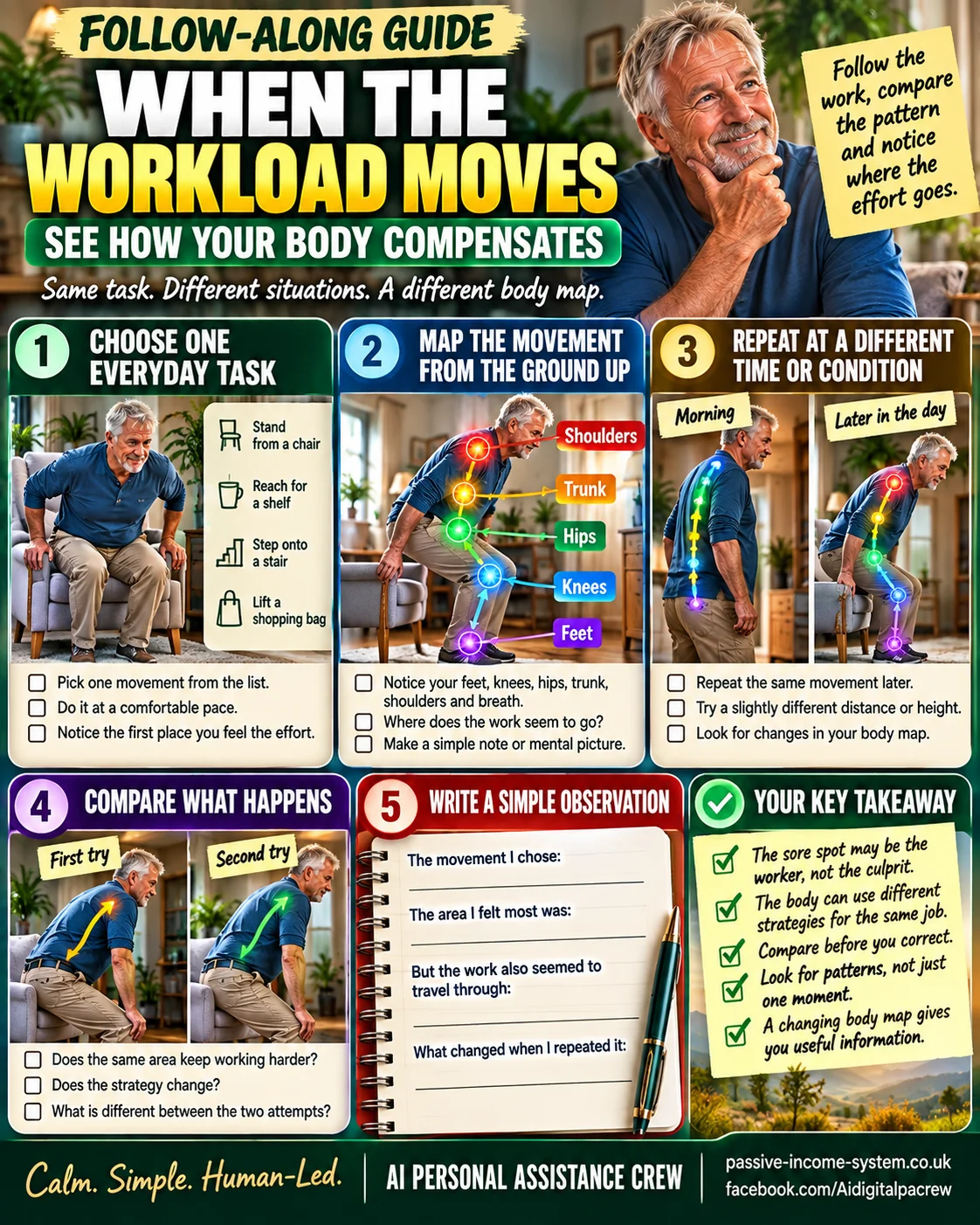
Body Map Reveals Compensation When The Workload Moves… Once you start following the work instead of staring only at the sore spot, another useful question appears: does the workload stay in the same place every time? That is where comparison begins to earn its keep. A movement that looks awkward once may reflect that moment. Repeat it later, and the body may organise the same task differently. One shoulder may rise less. One hand may need less support. The feet may settle more easily. The important point is not that the second attempt is automatically better. The body map has changed, and that change tells us the movement strategy is not carved in stone.
That is why one snapshot can be misleading. Take somebody standing from a low chair at the end of a long afternoon. Both hands push hard into the armrests, one foot sits farther back than the other, and the trunk leans well forward before the hips leave the seat. Watch the same person the next morning after walking around the kitchen, and the map may look different. The hands still help, but less. The feet organise more evenly. The rise looks quieter. Nothing magical has happened overnight. What has changed is how the job is shared, and that gives us more useful information than either movement viewed on its own.
Compare Before You Correct
This may be the most useful habit in the whole body-mapping process. Before trying to straighten, strengthen, stretch or fix anything, compare. Compare right with left. Compare morning with later in the day. Assess the same reach with the object at close range and then at a slightly farther distance. Compare standing from one chair with another. You are not looking for perfect symmetry. You are looking for repeatability. Does the same area consistently take over? Is the same support evident every time? Does the same side brace first? When a pattern repeats, it becomes more interesting; when it disappears under slightly different conditions, that tells you something too.
Old tradesmen do this without making a song and dance about it. When a boiler makes a strange noise once, you listen. If it makes the same noise every time the pump starts, you pay closer attention. If it only happens when another valve is closed, now the context matters. You do not condemn the first component that happens to be making the racket. You compare conditions. Movement deserves the same patience. Body Map Reveals Compensation best when we stop judging one isolated moment and begin looking for what changes, what repeats, and what only appears under particular circumstances.
When The Workload Moves The Body Can Change Strategy
That is not a flaw. It is one of the things movement does remarkably well. Reach for a cup from the middle shelf and the task may be shared easily between shoulder, trunk, and feet. Reach for the same cup from the back of a higher shelf and the whole strategy changes. The shoulder rises more. The trunk rotates farther.
One heel may lighten. Perhaps the free hand touches the worktop. The job has become different enough that the body recruits a different arrangement. If we label every change as compensation in the negative sense, we miss the fact that adaptation is often how the task gets completed.
The more useful distinction is between a strategy and a cost. A strategy is simply the route the body uses.
A cost appears when that route repeatedly seems to demand more work from one area, more bracing, more support or more effort than another route. That still does not prove harm, and it does not tell us why the strategy developed. But it gives us something observable. Compensation is worth watching when the same workaround keeps reappearing, and the workload repeatedly lands in the same place. That is a far calmer and more practical rule than declaring every asymmetry a problem.
Body Map Reveals Compensation In Everyday Jobs
Consider carrying the shopping from the car. One bag hangs from the right hand. The obvious worker is the arm holding it, but the map quickly becomes more interesting. Does the opposite shoulder lift? Does the trunk lean away from the bag? Do the steps shorten? Does one foot turn out? Does the free hand stiffen? The person still gets from car to kitchen, so the task succeeds. But the route reveals how the load is being managed. The body map doesn’t tell us what to correct. It shows where the job is being shared and where extra effort may be showing up.
The same thing happens when putting on a sock. One person crosses the ankle over the opposite knee and reaches down. Another lifts the foot onto a low stool. A third pulls the knee towards the chest with both hands. All three eventually get the sock on. If we only record success, the movements look equivalent. If we map the work, they differ completely. One strategy may ask more of the hip, another more of the trunk, another more of the arms. That is why the practical question is not simply, “Can you do it?” It is, “How are you currently doing it, and where does the workload appear to go?”
When The Workload Moves The Sore Spot Tells More
This shift in thinking matters because discomfort naturally dominates attention. If the right shoulder feels busy during a reach, it is hard not to make the whole investigation about the shoulder. But once the body map is widened, the sensation becomes one clue among several. Perhaps the trunk remains unusually still. Perhaps the left foot braces more strongly. The breath pauses at the same point. Those details do not replace the shoulder sensation. They place it in context. The shoulder may still deserve attention, but now we have resisted the temptation to let the loudest signal explain the entire movement.
That discipline is useful beyond movement, too. When one part of a system is under pressure, the pressure may be local, or it may reflect how the rest of the system is operating. The noisy radiator is not always the source of the heating problem. The apprentice running back and forth is not necessarily why the workshop is behind schedule. The busiest part is coping with what the rest of the system asks of it. Dennis’s movement philosophy repeatedly brings us back to this wider view: observe the pattern before deciding where the problem lives.
Do Not Chase Compensation Around The Body
A trap lies here, and it is worth avoiding. Once people discover the idea of compensation, they can start seeing it everywhere. The shoulder lifts, so the trunk must be stiff. The foot turns out, so the hip must be the problem. The head tilts, so something lower down must be causing it. Before long, the body has become a conspiracy theory. That is not what body mapping is for. The map helps us describe relationships. It doesn’t let us invent causes. A visible workaround can tell us how the task is being completed, but without proper assessment it cannot reliably tell us why that strategy exists.
So keep the language simple. Instead of saying, “My hip is compensating for my ankle,” say, “When I step up, I notice my foot turns out and my hip shifts to the side.” Instead of saying, “My shoulder is taking over because my ribs are locked,” say, “When I reach, my shoulder lifts while my trunk stays quite still.” The second version may sound less dramatic, but it is far more useful. It describes what you can actually observe. You can repeat, compare, and discuss that description without pretending we already know the explanation.
When The Workload Moves, Repetition Reveals The Pattern
One movement gives you a picture. Repetition gives you a pattern. That does not mean performing the same action fifty times until you are sick of it. Two or three calm observations can be enough to see whether the same workload keeps appearing. Try the same chair rise at two different times. Reach for the same shelf with each arm. Step onto the same stair leading with each leg. Notice whether the same area repeatedly becomes the busiest worker. If it does, the pattern becomes worth remembering. If it changes easily, that flexibility in strategy is useful information too.
This is where our earlier rung, Nervous System Shapes Effort, quietly connects with today’s lesson. Rung 5 asked how much effort the body spends before and during a task. Rung 4 asks where that effort goes. One tells us about the price of the movement. The other begins showing how that price is distributed. Together, they help us move away from crude labels such as weak, stiff or bad and toward something much more useful: a description of what the body is actually doing to get the job done. When The Workload Moves, comparison helps you notice whether the same area keeps taking extra work or whether the movement strategy changes with the task.
Open to See This Video, And This Is What’s Already Built, Trained & Waiting For Your First Command.
Follow The Work, Then Widen The Map
So when one region feels sore, tight, or unusually busy, start there because that is where your attention has already been drawn. Then widen the camera. Watch the feet, knees, hips, trunk, shoulders, and breath. Notice which areas join easily and which appear quieter. Repeat the movement under slightly different but safe conditions. Compare rather than correct. The goal is not to force the body into a textbook picture of perfect movement. The goal is to understand the strategy well enough to describe it clearly.
That gives us the working rule for this rung: follow the work before you chase the stiffness, and compare before you correct. Those two habits keep the investigation grounded. They keep the sore spot important without automatically turning it into the culprit. They also prevent us from treating every workaround as failure. Sometimes the body is simply solving the job with the options available at that moment. The interesting question is whether the same solution keeps appearing and whether another part of the body repeatedly seems to be carrying more of the load.
That naturally leads us to the next rung. Once the body map shows how effort is distributed, we begin to notice how the trunk, ribs, and breath shape the room available for movement. That is where Gentle Practice Builds Confidence will take the ladder next. For today, though, the lesson is simpler: the place you feel may be working hardest, but the wider map tells you whether that worker is doing its own job or quietly covering somebody else’s shift.
Apprentice Task: Choose one safe everyday movement such as standing from a chair, reaching into a cupboard, or stepping onto the first stair. Perform it normally once and notice where the effort feels strongest. Then repeat the same movement and map it from the ground upwards: feet, knees, hips, trunk, shoulders, and breath. Do not try to correct anything. Later in the day, repeat the same movement and compare the two maps. Write one sentence beginning: “The area I felt most was…, but the work also seemed to travel through…” Your job is not to diagnose the pattern. Your job is to discover whether the sore or busy spot is the whole story, or just one worker within a larger movement strategy.
When The Workload Moves How To See Hidden Compensation
Spread the love
Dennis Bartram
Dennis Bartram is the Director of the Active Balance Home or on the Go System Dennis’ journey began in 1969 when he qualified in Swedish remedial massage and in 1974, he began his practice in remedial sports massage and manipulative
Balanced Body Movement Coach Restores Confidence Naturally Balanced Body Movement Coach for Strength and Stability Pain Signals Explained by a Balanced Body…
Dennis Bartram Active Balance Grandfather Legacy Description Dennis Bartram, Active Balance Grandfather. Small daily self-care can help the body remain naturally functional…
Safe Movement Rebuilds Trust Through Evidence, Not Encouragement The body may need a successful experience before it accepts reassuring words. Can One…


 This may be the most useful habit in the whole body-mapping process. Before trying to straighten, strengthen, stretch or fix anything, compare. Compare right with left. Compare morning with later in the day. Assess the same reach with the object at close range and then at a slightly farther distance. Compare standing from one chair with another. You are not looking for perfect symmetry. You are looking for repeatability. Does the same area consistently take over? Is the same support evident every time? Does the same side brace first? When a pattern repeats, it becomes more interesting; when it disappears under slightly different conditions, that tells you something too.