Active Balance Movement System – Consistency Matters More Than Intensity
What Is the Active Balance Movement System?
Who Benefits From Floor Mobility Training?
How the Active Balance Movement System Restores Natural Mobility

What This Post Is All About…
The ability to move to the floor and back up is a clear sign of natural mobility.
The ability to move to the floor and back up is a clear sign of natural mobility.
Many people lose this confidence over time.
Not because the body is failing.
Subtle movement patterns shift gradually.
Subtle movement patterns shift gradually.
This page explains how the Active Balance Movement System supports natural walking, controlled floor movement, and smooth rising without strain, leading to increased confidence, reduced effort, and greater independence.
It is not about forcing flexibility.
It is not about extreme strength.
It is not about extreme strength.
Instead, it is about restoring coordination, alignment, and breathing rhythm.
Why Moving to the Floor Matters
Floor mobility is more than physical ability.
It reflects how well the body integrates:
- Hips
- Knees
- Ankles
- Spine
- Rib cage
- Breath
When these systems work together, movement feels fluid.
If one element stiffens, the body compensates.
For example, restricted hips may cause the lower back to work harder.
Limited ankle motion may cause weight to shift forward.
Shallow breathing may increase tension.
Limited ankle motion may cause weight to shift forward.
Shallow breathing may increase tension.
Over time, these adjustments become habits.
And habits influence posture.
Therefore, difficulty getting to the floor is rarely due to a single weak muscle.
It is usually about sequencing.
It is usually about sequencing.
What Changes As We Age
Age does not automatically reduce mobility.
Patterns change with age.
Many adults begin to:
- Sit more
- Rotate less
- Breathe shallowly
- Guard movement
As a result, the joint range gradually decreases.
However, this decrease is often subtle.
Gradual change leads to quiet adaptation.
Eventually, the floor feels further away.
Rising feels heavier with time.
And confidence reduces.
Restoring natural sequencing is essential.
The Active Balance Movement System: Importance of Controlled Descent
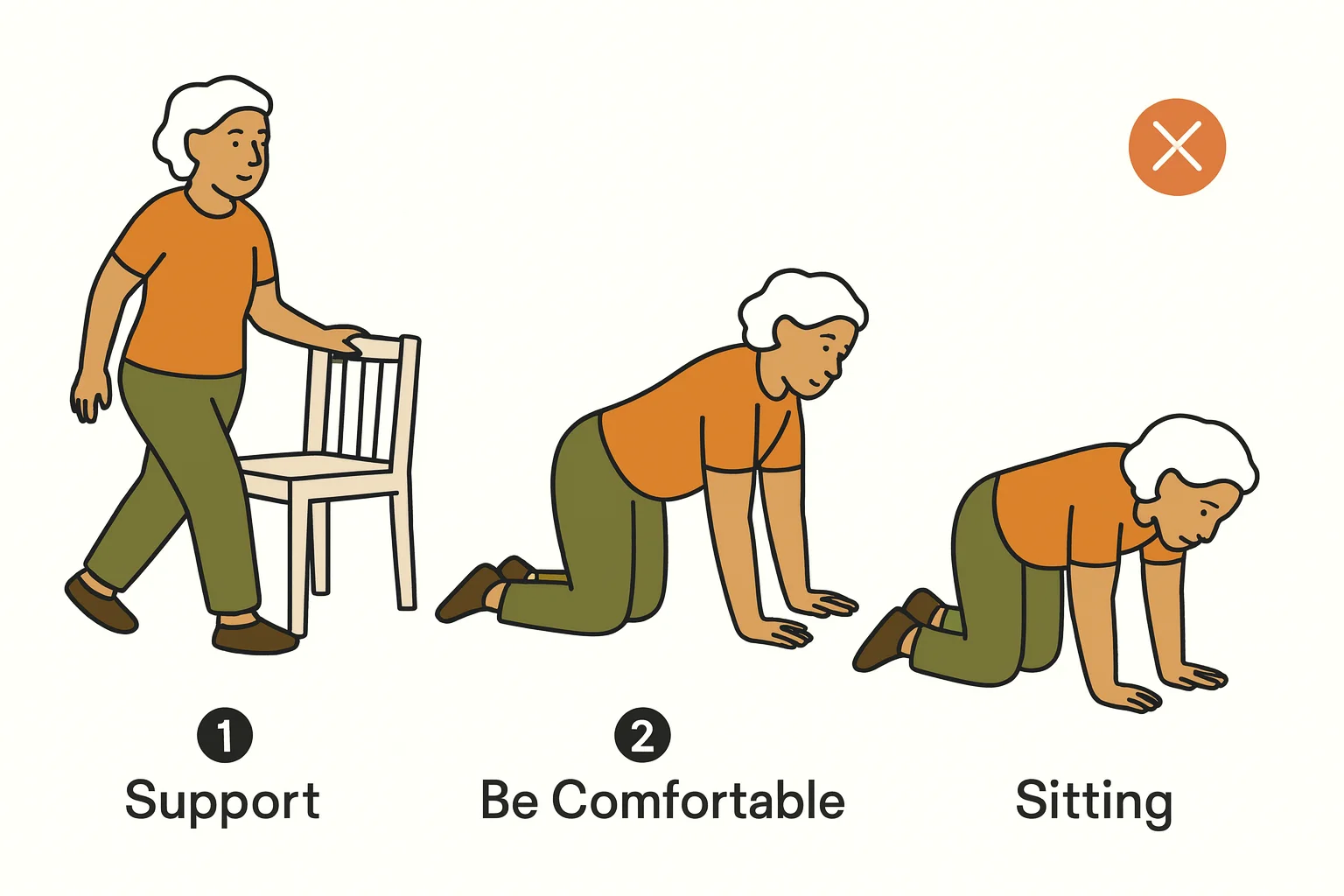
Going down to the floor should be a coordinated process.
First, the hips fold.
Then, the knees bend.
Meanwhile, the spine adjusts gently.
At the same time, the breath supports the movement.
Then, the knees bend.
Meanwhile, the spine adjusts gently.
At the same time, the breath supports the movement.
When this happens naturally, descent feels calm.
However, when coordination is disrupted, the body stiffens.
Stiffness increases effort.
Effort increases fatigue.
Fatigue increases caution.
Restoring rhythm, not force, improves descent.
How the Active Balance Movement System Restores Sequencing
The Active Balance Movement System focuses on alignment first.
Alignment distributes weight evenly.
When weight is distributed evenly, muscles do not overwork.
This reduces tension naturally.
The system also restores:
- Rib mobility
- Pelvic timing
- Foot grounding
- Together, these elements rebuild trust in movement, reduce injury risk, and help you move with greater freedom in daily life.
Trust reduces hesitation.
Reduced hesitation improves fluidity.
Fluidity protects against sudden strain.
Rising From the Floor Without Pulling Muscles
Getting back up requires more than strength.
It requires timing.
The feet must ground firmly.
The hips must initiate upward motion.
The spine must support without collapsing.
Breathing must remain steady.
The hips must initiate upward motion.
The spine must support without collapsing.
Breathing must remain steady.
If breathing stops, tension rises.
If tension rises, the body compensates.
For instance, the lower back may overextend.
Or the shoulders may tighten.
However, when alignment and breath are integrated, rising feels controlled.
Therefore, the goal is not speed.
The goal is smooth coordination.
The Role of Breath in Floor Mobility
Breathing influences movement more than most people realise.
When the diaphragm moves freely, it naturally stabilises the torso.
However, when breathing becomes shallow, the rib cage stiffens.
A stiff rib cage restricts spinal rotation.
Restricted rotation affects walking and rising.
Therefore, restoring diaphragmatic breathing is foundational.
In Active Balance, breath is not an afterthought.
It is central.
Because when breath flows, movement follows.
Walking and Floor Mobility Are Connected
Walking and floor transitions rely on similar mechanics.
Both require:
- Pelvic rhythm
- Arm swing coordination
- Rib rotation
- Ankle roll-through
If walking becomes stiff, floor mobility often follows.
Therefore, improving walking rhythm often improves rising ability.
Active Balance addresses both simultaneously.
It does not isolate one task.
Instead, it restores the system.
Why Active Balance Movement System Alignment Comes Before Strength
Strength has value.
However, strength layered onto imbalance reinforces compensation.
For example:
If one hip rotates poorly, strengthening that side alone may increase asymmetry.
Instead, alignment ensures muscles activate evenly.
Even activation reduces strain.
Reduced strain builds confidence, supports natural movement, encourages continued activity, and promotes ongoing independence in daily life.
Therefore, alignment is the foundation.
Strength becomes supportive, not corrective.
Floor Confidence and Active Balance Movement System Independence
The ability to sit, kneel, and rise influences daily life.
It supports:
- Independence
- Social comfort
- Reduced fear of falling
- Calm self-trust
When fear reduces, tension reduces.
When tension reduces, movement improves.
Therefore, floor competence is both psychological and physical.
The Philosophy Behind the Active Balance Movement System Method
The body adapts continuously.
However, adaptation sometimes becomes a restriction.
Restriction becomes habit.
Habit influences posture.
Active Balance gently reverses this chain.
It restores awareness.
It restores timing.
It restores natural coordination.
Importantly, it does this without force.
Because force creates guarding.
Guarding creates tension.
Tension disrupts rhythm.
Instead, gentle correction invites cooperation.
And cooperation rebuilds fluidity.
How the Active Balance Movement System Re-Educates the Body
Many people believe mobility fades suddenly.
However, movement patterns usually change gradually.
Small compensations build quietly.
For instance, you may begin to shift weight to one side.
Or you may avoid full hip flexion when bending.
Meanwhile, breathing may become slightly restricted.
Or you may avoid full hip flexion when bending.
Meanwhile, breathing may become slightly restricted.
Over months and years, these adjustments become normal.
Because they feel familiar, they go unnoticed.
Active Balance works by increasing awareness of these patterns.
First, it slows movement.
Then, it restores sequencing.
Finally, it rebuilds trust in natural motion.
As awareness improves, coordination improves.
And when coordination improves, the body moves with less effort.
Reconnecting the Active Balance Movement System With Natural Walking
Walking is one of the most revealing movements.
When walking is fluid, the body is usually well coordinated.
However, when walking becomes stiff, other transitions often suffer.
For example, limited rib rotation restricts arm swing.
Restricted arm swing reduces spinal rotation.
Reduced spinal rotation influences hip rhythm.
Consequently, rising from the floor becomes harder.
Active Balance restores walking by encouraging:
- Gentle pelvic rhythm
- Rib mobility
- Even foot roll-through
- Relaxed shoulder motion
As walking becomes smoother, confidence in floor movement often returns.
Because both share similar mechanics.
The Nervous System and Active Balance Movement System Confidence
Mobility is not purely mechanical.
It is neurological.
When the nervous system senses instability, it tightens the body.
Tightness may feel protective.
However, it limits fluidity.
For instance, if you once felt unstable when rising from the floor, your body may brace the next time automatically.
That bracing increases tension.
Increased tension disrupts coordination.
Active Balance reduces this cycle through calm repetition.
As movement becomes predictable, the nervous system relaxes.
When relaxation returns, coordination improves.
Improved coordination lowers the risk of injury; therefore, movement becomes more reliable, everyday activities feel easier, and the risk of injury is lowered.
The Hidden Risk of Avoiding the Floor
Many adults gradually stop sitting on the floor.
At first, it feels harmless.
A chair is easier.
A sofa feels safer.
The floor seems unnecessary.
A sofa feels safer.
The floor seems unnecessary.
However, avoidance alters the body.
When you stop moving through full ranges, joints stiffen.
When joints stiffen, coordination narrows.
When coordination narrows, balance becomes cautious.
This does not happen overnight.
Rather, it happens quietly.
For example, if you never kneel, the knees lose familiarity with flexion.
If you never rotate while lowering, the spine becomes less adaptable.
If you never practise rising without pushing heavily through the arms, the hips lose strength and timing.
Over time, the floor begins to feel foreign.
And what feels unfamiliar often feels unsafe.
Therefore, the real issue is not ageing.
It is reduced exposure.
Floor Mobility as a Diagnostic Active Balance Movement System Tool
The ability to lower and rise from the floor tells you a great deal about your movement health.
It reveals:
• Hip symmetry
• Ankle stability
• Rib mobility
• Core timing
• Balance confidence
• Ankle stability
• Rib mobility
• Core timing
• Balance confidence
If one side feels different from the other, that information is useful.
If you hold your breath during the movement, that is also information.
Instead of judging the movement, observe it.
Active Balance uses this awareness constructively.
Because awareness precedes correction.
Strength Versus Active Balance Movement System Coordination
Many people assume they need stronger legs to rise easily.
Strength helps.
However, coordination matters more.
If muscles fire in the wrong sequence, strength is inefficient.
For example:
If the lower back activates before the hips, strain increases.
If the shoulders tense before the feet ground, the balance shifts forward.
However, when sequencing improves, effort decreases.
This is why some individuals can rise smoothly despite not appearing strong.
Their coordination is efficient.
Active Balance restores efficiency. Strength follows naturally, supporting stable, confident movement to make daily activities easier and safer.
Rebuilding Confidence After Hesitation
Sometimes, difficulty begins after one awkward movement.
Perhaps you felt unstable once.
Perhaps you experienced minor discomfort.
From that moment, the body remembers.
The nervous system becomes cautious.
Caution creates stiffness.
Stiffness reduces fluidity.
Therefore, rebuilding confidence must be gradual.
Begin with supported movements.
Use controlled breathing.
Move slowly enough to feel each stage.
As positive experiences accumulate, hesitation fades.
And with reduced hesitation, movement becomes lighter.
The Psychological Effect of Being Able to Rise Easily
There is a quiet reassurance in knowing you can rise from the floor.
It affects:
• Social confidence
• Outdoor activity comfort
• Willingness to move freely
• Reduced fear of falling
• Outdoor activity comfort
• Willingness to move freely
• Reduced fear of falling
When the mind trusts the body, tension decreases.
Reduced tension improves posture.
Improved posture supports walking.
Therefore, this single ability influences overall movement quality.
Watch the Active Balance Movement System in Action
A Simple Weekly Practice Model
To maintain floor competence:
- Sit on the floor for a short period each day.
- Practise controlled descent twice.
- Rise slowly with even breathing.
- Walk immediately afterwards and notice fluidity.
This small routine keeps joints familiar with the full range of motion.
It also maintains coordination awareness.
Consistency matters more than duration.
Five mindful minutes are more valuable than rare, intense effort.
The Importance of Practising Safely
While enthusiasm is helpful, caution is wise.
Begin slowly.
Use support if needed.
For example, a chair or low bench can assist during early attempts.
Over time, as coordination improves, reliance on support reduces.
However, progression should be gradual.
Because confidence grows through consistency.
Not intensity.
How the Active Balance Movement System Restores Natural Mobility
You do not need long sessions.
Instead, brief daily exposure is effective.
For example:
- Sit on the floor for a few minutes.
- Practise controlled descent.
- Focus on even breathing.
- Rise slowly with awareness.
Consistency builds familiarity.
Familiarity reduces hesitation.
Reduced hesitation improves rhythm.
As rhythm improves, effort decreases.
Why the Active Balance Movement System Supports Floor Mobility
Floor mobility supports more than flexibility.
It reinforces:
- Balance awareness
- Joint sequencing
- Confidence in unexpected situations
- Overall movement resilience
Moreover, being comfortable on the floor reduces fear.
Reduced fear lowers muscle guarding.
Lower guarding supports natural walking.
Therefore, floor competence influences everyday life.
Why This Is a Lifelong Skill
The ability to rise from the floor is not a youthful trick.
It is a functional benchmark.
However, it must be maintained.
Like walking, it responds to repetition.
The more often coordinated movement is practised, the more automatic it becomes.
Conversely, avoidance accelerates restriction.
Therefore, occasional floor movement preserves adaptability.
Adaptability protects independence.
Who Benefits From the Active Balance Movement System
The ability to move down to the floor and rise again reflects integrated mobility.
It is not about flexibility alone.
It is not about brute strength.
Instead, it is about timing, alignment, and breath.
When foundations improve, movement becomes smoother.
When movement becomes smoother, strain reduces naturally.
And when strain reduces, confidence increases.
Floor mobility, therefore, becomes more than a task.
It becomes a marker of coordinated, resilient movement.
When to Practise the Active Balance Movement System
Begin gently.
Move slowly.
Breathe consistently.
Focus on sequencing rather than speed.
Practise regularly.
Over time, small improvements accumulate.
And those small improvements support lasting independence.
#activebalancemovementsystem, #naturalfloormobilitypractice, #saferisingfromfloor, #effortlesswalkingcoordinationmethod, #alignmentbasedmovementsystem, #ageingmobilitysupportapproach, #controlleddescentmovementpattern, #naturalposturewalkingsystem, #breathintegratedmobilitymethod, #functionalfloormovementtraining, #coordinatedhipkneesequencing, #independentmovementconfidencepractice,