Fascial Restrictions Change Movement
The Reach Can Improve While The Restriction Stays
Where your hand finishes tells only part of the story.
Could Fascial Restrictions Change Movement During Everyday Tasks?
Notice what joins the movement before deciding what improved.
Explore How Fascial Restrictions Change Movement Without Guessing The Cause
A movement clue is a starting point, not a diagnosis.
The mug was on the second shelf, where it had lived for years without attracting much attention. This morning, however, collecting it required a small committee. The arm reached upwards, the chest lifted, the back arched, and the heels threatened to join proceedings. Eventually, the fingers found the handle. Job done, apparently. Yet that ordinary kitchen moment raises a useful question when we explore how Fascial Restrictions Change Movement: did the shoulder move farther, or did the rest of the body find another way to deliver the hand? The mug arriving safely on the worktop does not answer that question.
We tend to judge movement by its result. The hand reaches the shelf, the shoe goes on, the coat sleeve accepts the arm. Those outcomes matter, particularly when independence depends on completing ordinary jobs. However, reaching a destination and changing the movement available at one joint are different achievements. A person might become better at organising a workaround while a particular limitation remains. That can be a useful adaptation. The mistake comes when we describe the successful task as proof that the original restriction has disappeared, without looking at how the task was completed.
The Hand Arrives, But Who Did The Work?
 Reaching is a shared job. The elbow, shoulder and trunk coordinate to position the hand, and their contributions can change with the task. Research examining reaching in younger and older adults has measured this coordination directly. That matters because the hand’s final position cannot tell us how much movement came from each contributing part. Watching the endpoint alone is rather like judging a removal team by whether the wardrobe reached the landing, without noticing who carried which end. The job may be complete, but the division of labour may remain a mystery.
Nor should we expect the trunk to remain motionless whenever an arm moves. Normal activity involves cooperation, and a little body movement is not automatically a fault. Leaning towards a distant object can be entirely sensible.
The more useful question is whether the strategy has changed, whether it feels comfortable and whether it helps the person complete the task with control. A newly pronounced back arch during a previously easy reach deserves attention. It does not deserve an immediate verdict that the body is broken, badly aligned or full of stuck fascia. When Fascial Restrictions Change Movement, Observe Before Explaining
The phrase Fascial Restrictions Change Movement gives us a topic to investigate, but it cannot diagnose the person standing in the kitchen. A pulling sensation, raised shoulder or sideways lean does not identify the tissue responsible. Someone might describe their shoulder as tight, but that word describes their experience rather than providing an anatomical explanation. Observing movement can help us describe what happens. Establishing why it happens may require a professional assessment, especially where pain, weakness or a persistent loss of function is involved.
This distinction keeps observation useful. “My back arches when I reach above shoulder height” is a clear description. “My fascia is glued down” is a conclusion that the observation cannot establish. The first gives a practitioner something concrete to investigate. The second may send the person searching for increasingly forceful ways to release a problem they have not actually identified. Good questions begin close to the evidence: which task brings the difficulty on, where is it felt, when does another part join in, and what happens afterwards?
A Higher Reach Can Hide A Different Strategy
Imagine a retired reader, Joan, who wants to reach her everyday mug more comfortably. This is an illustrative example, not a reported patient case. On Monday, her fingers stop below the shelf. On Friday, they reach the handle, and she understandably feels pleased. But suppose she also stands closer, turns slightly and lifts her chest farther than before. Her task performance has improved. We still cannot say that her shoulder has gained movement, because several other things changed. Both statements can be true: Joan achieved something useful, and the source of the improvement remains uncertain.
Now imagine a different Friday. Joan stands in the same place and reaches towards the same shelf. She notices less effort, maintains her balance and lowers her arm comfortably afterwards. That description offers a fuller picture of improvement than “I reached higher”. It still does not prove that fascia changed, but it gives her a practical result worth recording. The important comparison includes the destination, the way she got there and how the movement felt. Leaving out any one of those can make progress look simpler than it really is.
Fascial Restrictions Change Movement: Watch The Journey
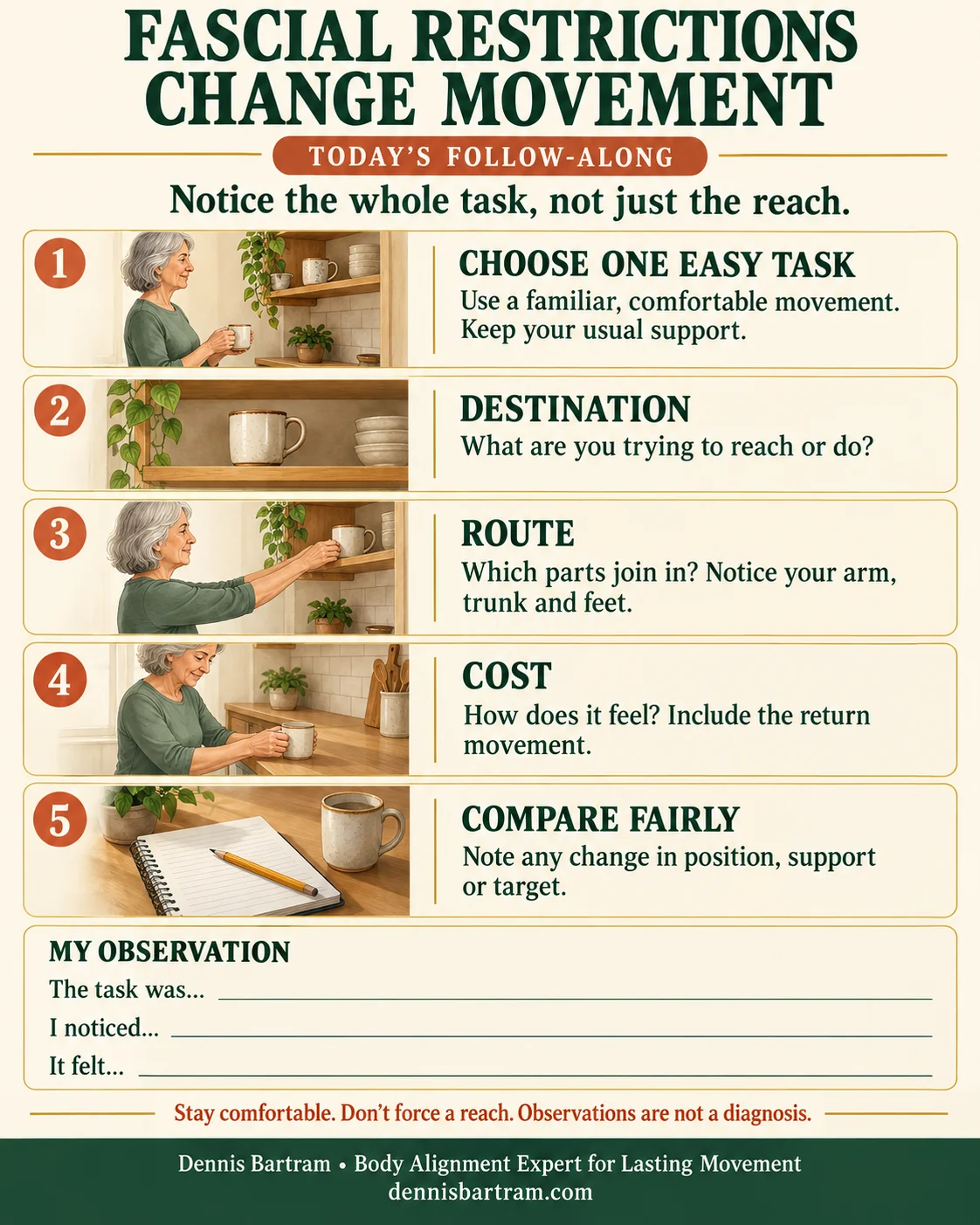
A useful way to organise these observations is to consider three things: destination, route and cost. The destination is the job itself, such as touching a shelf. The route is the combination of movements used to get there. The cost is the effort, discomfort or uncertainty the person experiences. These are everyday descriptions, not a medical scoring system. Together, however, they prevent one impressive result from taking over the whole story. An extra inch of reach means something different when it arrives with comfortable control than when it requires a sudden lunge.
The same thinking applies when the destination stays unchanged. Suppose somebody still reaches only the lower shelf, but does so without the previous pause, strain or uncomfortable return. That may be a meaningful improvement even though the hand finishes at the same height. Conversely, reaching a higher shelf with greater discomfort may be a poor trade for that person. The practical question becomes, “What improved, and what accompanied it?” That is a more informative question than asking whether the hand travelled farther and declaring the investigation complete.
Support Is Part Of The Picture
Support must also be included in an honest comparison. Resting a hand on a stable surface, sitting down to dress or bringing an object closer can change how manageable a task feels. Those adjustments do not make success less valuable. They make the conditions of success clearer. For an older reader, being able to put on a coat comfortably while seated may matter much more than reproducing somebody else’s standing demonstration. Independence includes arranging everyday jobs sensibly, rather than making each one an examination that must be passed without assistance.
It would therefore be a mistake to notice a workaround and immediately try to remove it. The person may depend on that strategy to remain comfortable or steady. Forcing the trunk still, pulling a shoulder down or taking away hand support can change the task substantially. Observation comes first. If a pattern is painful, newly difficult or limiting daily life, take that description to an appropriate healthcare professional. The purpose of noticing what joins the movement is to understand the task better, not to police every contribution the body makes.
Give Progress A More Honest Description
For anyone exploring how Fascial Restrictions Change Movement, careful wording protects against two opposite mistakes. One is celebrating every increase in distance as proof that a restriction has been released. The other is dismissing a useful adaptation because it does not look like an ideal demonstration. A better description is specific: “I can reach the shelf more comfortably when I stand closer,” or “My hand goes higher, but my lower back now feels strained.” Each statement preserves both the achievement and the condition attached to it.
That is the observation to carry forward: notice what joins the movement, not just where the hand finishes. The reaching hand deserves attention, but so do the feet, trunk, support and effort that helped it arrive. We do not need to turn breakfast into a clinical examination to recognise the difference. We need to resist letting the mug on the worktop tell the entire story. Once you consider the destination, route and cost together, the next question becomes much more useful: which part of this experience would actually make everyday life easier?
Research grounding: a study of arm–trunk coordination examined how elbow, shoulder and trunk movements contribute to reaching in younger and older adults. It supports looking beyond the hand’s endpoint; it does not establish fascial restriction as the cause of an individual’s difficulty.
:chatgpt-content-reference{index=”0″}
Change One Thing Before Drawing A Conclusion
The kitchen offers plenty of opportunities for misleading comparisons. Yesterday’s mug stood near the front of the shelf. Today’s has been pushed behind the sugar bowl. Yesterday, you wore slippers; today, shoes. Even your feet may have shifted while your attention was on the kettle. Before deciding that your movement has improved or deteriorated, check whether you are comparing the same job. When exploring how Fascial Restrictions Change Movement, the conditions deserve as much attention as the result. Otherwise, you may give the shoulder credit for an improvement achieved by moving six inches closer.
This does not require measuring tape and a clipboard at breakfast. Choose an ordinary, comfortable task and describe its starting point. Which shelf? Which hand? Were you seated or standing? What support did you use? Those details make a later observation more meaningful. If you change something, acknowledge it. “The reach felt easier after I moved closer” is useful information. It tells you how to make that particular task more manageable. It does not tell you which tissue changed, or whether any tissue changed at all.
Fascial Restrictions Change Movement: Keep The Question Specific
A vague question often produces an answer too broad to help. “Is my shoulder better?” could mean less discomfort, a higher reach, easier dressing or greater confidence carrying shopping. Those are different outcomes. Choose the one that matters to the job in front of you. If putting on a cardigan is the difficulty, reaching towards an empty shelf may not capture it. The relevant question might be whether the arm enters the sleeve with less pulling, whether the trunk twists less abruptly or whether the task requires fewer stops.
Imagine a reader called Peter preparing to leave the house. This is an illustrative situation, not a patient account. He can lift his arm higher than last week, yet getting into his coat remains awkward. The improved upward reach is encouraging, but it has not answered his practical problem. Watching the coat go on reveals a different demand: reaching backwards while holding the fabric and turning slightly. Peter now has a clearer description to discuss with his practitioner. He does not need to reject the improvement. He needs to distinguish the improvement he measured from the improvement he wants.
A Workaround Can Be Useful Without Proving Recovery
No one wins by making every household task unnecessarily difficult. Moving frequently used mugs to a lower shelf may be an excellent decision. Sitting comfortably to put on shoes can be equally sensible. Neither adjustment establishes that a restriction has resolved, but both may make daily life easier. That distinction permits people to solve the practical problem while a persistent movement difficulty is assessed. You can improve access to your kitchen today without making a grand claim about what’s happening inside your shoulder.
Equally, a workaround should not automatically become a fault to eliminate. Some adaptations are comfortable and dependable. Others feel increasingly strained or leave the person less steady. The useful distinction is between a strategy that serves the task and one whose disadvantages are becoming troublesome. Notice those disadvantages rather than declaring every lean or turn unacceptable. A person who reaches with a small, comfortable trunk movement does not need to freeze their body into a demonstration pose. The concern is what the movement costs them, not whether it matches a picture.
Fascial Restrictions Change Movement: Include The Return Journey
The fingers closing around the mug make an obvious finishing point, but the task is only halfway done. The arm must lower, the object must remain controlled, and the person must return comfortably to their starting position. A reach that looks successful on the way up may feel awkward on the way down. Therefore, include the whole action in your description. “I touched the shelf” and “I took down the mug comfortably” report different achievements. The second tells us more about whether the movement is useful in everyday life.
The same principle applies to getting into a car. Reaching the seat is one destination; settling the legs, turning comfortably, and later getting out complete the story. Nobody needs to repeat an action for an audience to show progress. One naturally occurring task can provide something worth noticing. Was the movement manageable throughout, or did one stage require a sudden pull or uncomfortable twist? If a stage remains difficult, record that stage. Specific observations are easier to act on than a general declaration that everything is either better or worse.
Do Not Let A Good Minute Describe The Whole Day
An easier movement immediately after practice or treatment can be welcome without settling every question. The next useful observation is whether that ease appears during the ordinary task later. If reaching feels comfortable in an appointment but remains difficult in the kitchen, describe both experiences. The difference might involve the height of the target, the object being held, the starting position or another factor that needs assessment. You do not need to invent an explanation. Keeping the circumstances visible gives a practitioner a better starting point for investigating the difference.
Record what happened afterwards as well, without becoming preoccupied with every sensation. For example: “The reach felt easier, but I noticed discomfort when lowering the mug,” or “Dressing was more comfortable this morning and remained so when I changed later.” These are observations, not guarantees about tomorrow. When discussing whether Fascial Restrictions Change Movement, such descriptions help keep attention on useful function. The aim is not to collect the most impressive moment. It is to understand which improvements are available when the person actually needs them.
Take A Description To The Appointment
A useful account of a problem need not sound medical. “When I reach into the upper cupboard with my right hand, I lean backwards and feel pulling at the front of my shoulder” is perfectly serviceable. Add when it began and how it affects your day. That tells a professional more than announcing that a fascial chain needs releasing. You can certainly ask whether fascia could be involved, but leave room for an assessment to identify other explanations. An accurate description remains useful even when your first theory turns out to be wrong.
Avoid trying to prove the theory by forcing the movement, removing necessary support or pressing harder into a tender area. This observation task requires no movement. If movement is painful, newly limited or increasingly difficult, seek appropriate professional advice rather than repeatedly testing it. The purpose here is modest: notice the task, the route and the experience clearly enough to explain them. You are gathering information about daily life, not performing a home examination designed to identify a particular tissue.
Open to See This Video, And This Is What’s Already Built,
Trained & Waiting For Your First Command.
Fascial Restrictions Change Movement Apprentice Task
Choose one familiar movement you already perform comfortably, such as reaching for a light object within easy reach or putting an arm into a loose sleeve. Keep your usual support, and don’t stretch farther than usual. During the ordinary action, notice three things: where you are trying to go, which parts of your body join in and how the whole task feels. Include the return to your starting position. If observing while moving distracts you or makes you less steady, leave the task and describe a recent experience instead.
Write three short sentences afterwards: “The task was…” “I noticed…” and “It felt…” Keep each sentence factual. An example might read: “The task was taking my mug from the lower shelf. I noticed a small turn through my body. It felt comfortable going up and coming down.” You don’t need to find a fault. A comfortable, useful movement is worth recognising without searching beneath it for something to correct.
If you later compare the task, note any change in the setup before judging the result. A higher reach, a more comfortable reach and an easier household job are all worth distinguishing. None, by itself, proves that fascia has changed. The rule to keep is simple: before calling it better movement, describe what became better and what helped it happen.