Small Wins Restore Confidence
Small Wins Restore Confidence When Reassurance Is Not Enough
The body trusts what it safely experiences.
Why Small Wins Restore Confidence Through Practical Evidence
One manageable movement can challenge an old expectation.
Dennis Bartram Shows How Small Wins Restore Confidence
Progress begins where calm, repeatable movement becomes possible.
Dennis Bartram Shows How Small Wins Restore Confidence…
Progress begins where calm, repeatable movement becomes possible.
The armchair hadn’t grown taller overnight. Its wooden arms were still in the same place, the cushion had not been secretly filled with concrete, and the journey from sitting to standing remained less than three feet. Yet the person preparing to rise behaved as though a small mountain had appeared beneath them. Their feet shuffled backwards. Both hands gripped the chair. The chin lifted, the breath stopped, and the shoulders joined a job that ought mainly to involve the legs. A cheerful voice saying, “You can do it,” might offer encouragement. However, the body was waiting for something more convincing than kind words.
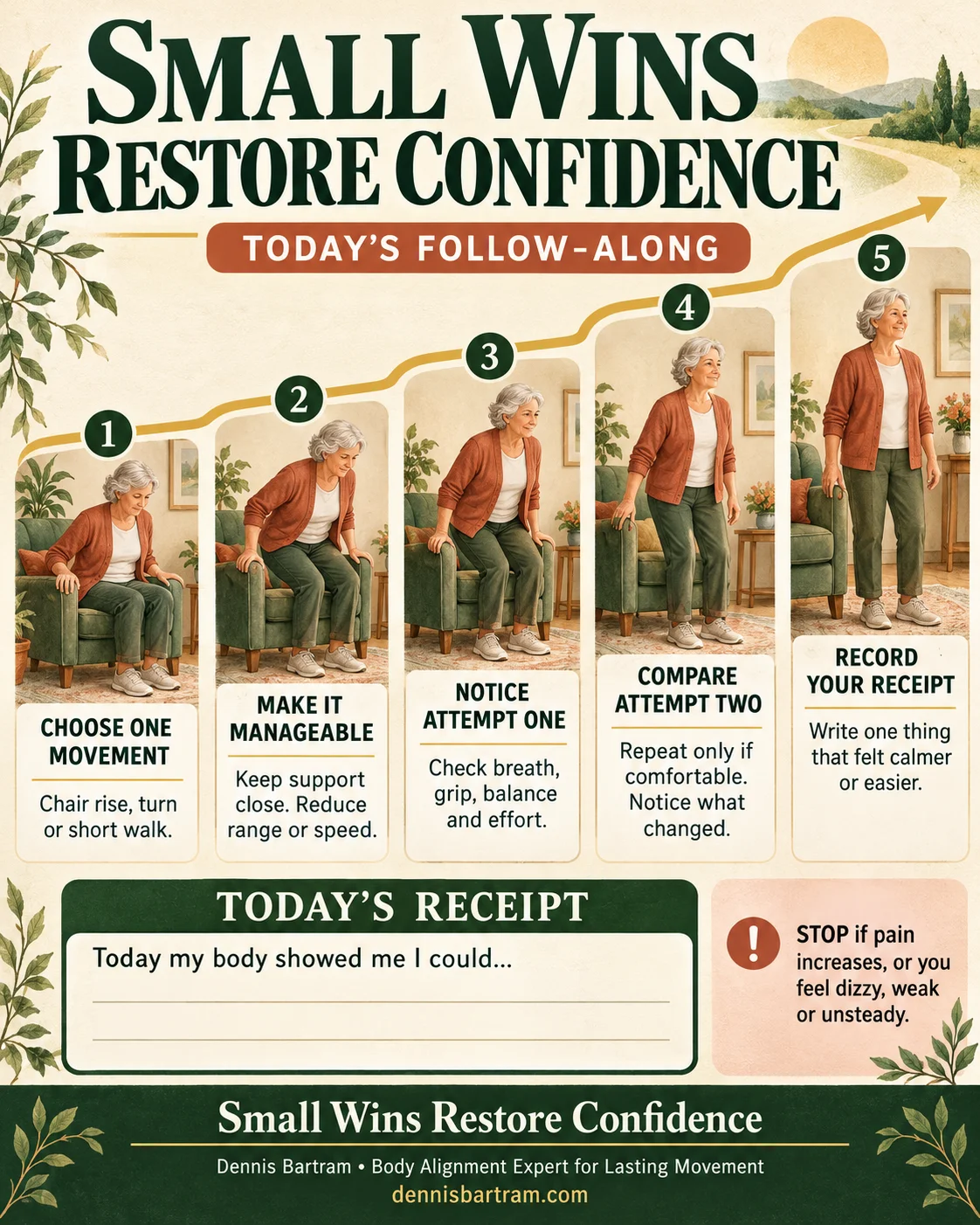
This is where Small Wins Restore Confidence becomes more than a pleasant slogan. Encouragement may help somebody attempt, but confidence grows more reliably when the body completes a manageable movement without the feared consequence arriving. The person stands safely. The knee does not suddenly collapse. The room does not begin spinning. They sit down again with control. That completed experience becomes a small piece of practical evidence. It doesn’t prove every future movement will be easy, and it certainly doesn’t erase genuine medical problems. It simply gives the nervous system a new receipt showing what happened this time.
Dennis Bartram has spent more than fifty years watching these moments closely. People often describe what they believe they cannot do, but their movements may tell a more detailed story. Somebody who says, “I can’t get out of that chair,” may actually mean, “I don’t trust what will happen when I try.” Another person may have enough strength to turn and reach, yet brace so heavily beforehand that the movement becomes awkward. The useful question is not whether their concern is real. It is. The useful question is whether the task can be adjusted until they can gather safer, calmer evidence.
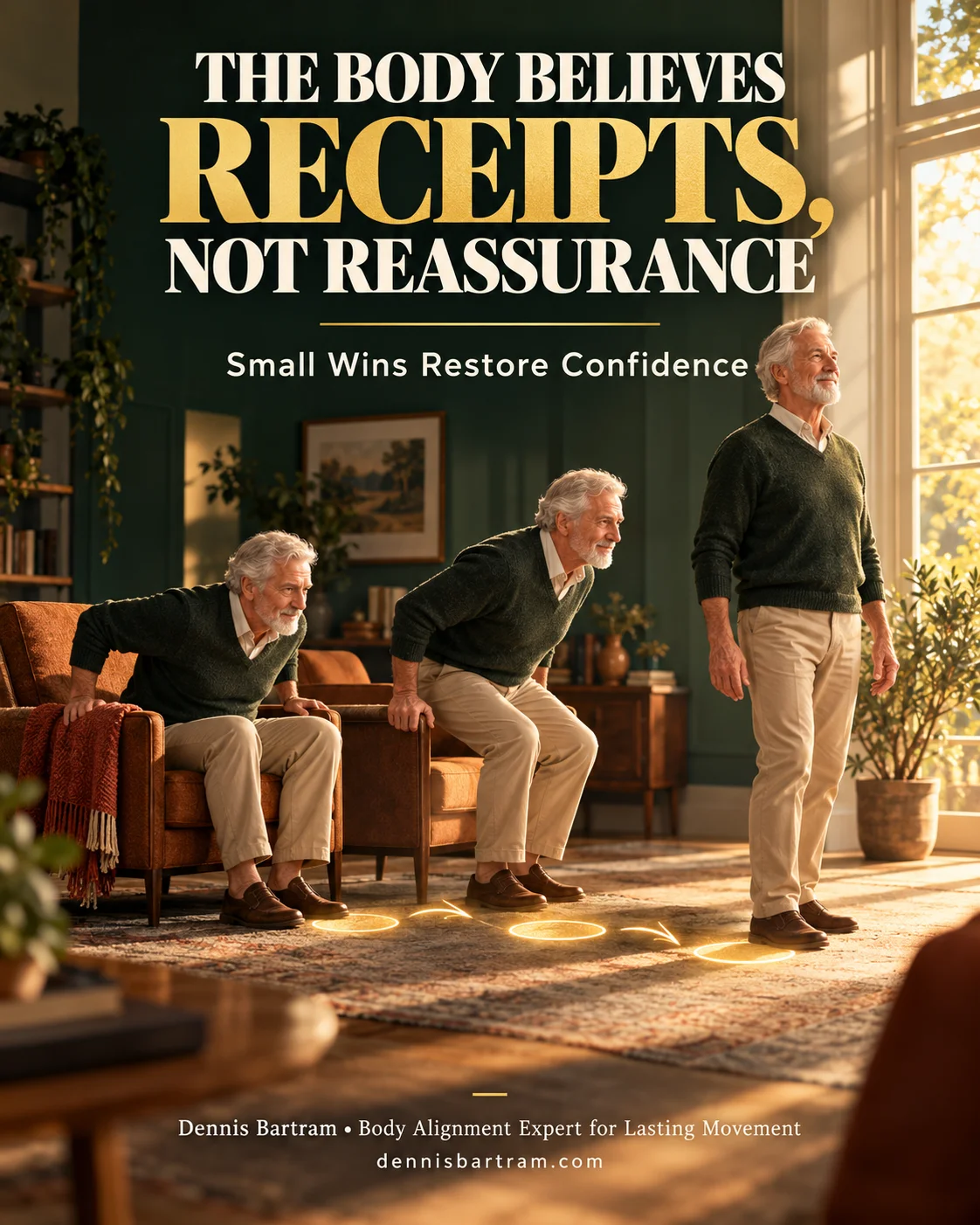
The Body Believes Receipts, Not Reassurance
 Imagine somebody telling you that a restaurant is excellent. They praise the service, promise the food is marvellous and assure you that everyone leaves happy. You may believe them, but your opinion changes after you have eaten there yourself. Personal experience carries a different weight. Movement confidence works in much the same way. Reassurance arrives from outside. Evidence is created through experience. That is why repeatedly telling somebody to be brave may achieve less than helping them complete one modest action safely. The body doesn’t need a speech. It needs a believable result it can recognise and remember.
This gives us a useful distinction: confidence is not always a feeling that must appear before movement begins. Sometimes confidence comes from completing movement at the right level. Waiting to feel completely confident before acting can therefore create a trap. The person avoids the movement because they feel uncertain, but avoidance prevents them from collecting evidence that might reduce that uncertainty. The answer is not to force the full movement. Instead, find a smaller version that feels manageable enough to attempt without panic, excessive bracing or reckless determination.
That smaller version might look unimpressive to an observer. A person may rise only halfway from a firm chair while keeping both hands on the arms. They may practise transferring weight towards their feet without standing at all. They might turn their head through a comfortable range rather than trying to look directly behind them. None of these actions deserves to be dismissed as too easy. If the movement can be done calmly and repeated without increasing symptoms, it provides useful evidence. Small Wins Restore Confidence because believable success gives the next attempt a firmer starting point.
Small Wins Restore Confidence With An Evidence Ladder
The practical method is an evidence ladder. The bottom rung is not the movement somebody wishes they could perform eventually. It is the safest useful version they can complete today with appropriate support. The next rung changes only one feature. They might move slightly farther, use a little less assistance, slow the action down or repeat it once more. Each rung must remain close enough to the previous one that the body recognises continuity. If the jump is too large, the movement can stop feeling like progress and start feeling like another test to survive.
Consider Margaret, who has begun hesitating before standing from her dining chair. Her family tells her she is stronger than she thinks, but their reassurance does not change how she grips the table. Her first rung is simply placing both feet comfortably beneath her, leaning forwards and feeling her weight arrive through them before returning upright. Once that becomes familiar, she repeats the preparation and lifts slightly from the chair while keeping her hands supported. Standing fully comes later. The ladder does not deny her destination. It gives her a route that produces evidence rather than another argument.
The important feature is repeatability. One dramatic effort may prove that a person can force their way through a task, but it may also leave them tired, sore or worried about doing it again. A useful win is one they can repeat. Dennis’s whole-body approach pays attention to what accompanies the movement: the breath, the feet, the grip, the face and the unnecessary help recruited from elsewhere. If standing once requires clenched teeth, raised shoulders and a breath held until the job is finished, the movement may be complete, but confidence has not necessarily been strengthened.
Repeatable Movement Matters More Than Heroic Effort
This leads to a rule worth remembering: do not spend tomorrow’s confidence on today’s heroics. Three comfortable chair rises may teach the body more than ten strained repetitions completed to satisfy a number. A short walk that finishes with steady breathing may be more valuable than pushing to the point where the return journey feels frightening. Stopping while the movement still feels organised is not laziness. It preserves the willingness to practise again. That willingness matters because confidence usually grows through accumulated evidence, not through one spectacular performance followed by several days of avoidance.
Small wins also need to be specific. “I moved better today” is encouraging, but it gives the mind very little to examine. “I stood without holding my breath,” “I used one hand instead of two,” or “I walked to the doorway without rushing” creates a clearer record. The improvement may involve less hesitation rather than greater distance. It may be a softer grip, steadier breathing or a smoother return to the chair. These details help distinguish genuine progress from wishful thinking. They also stop speed and range from becoming the only measures that count.
The second attempt can be especially revealing. The first may carry the memory of yesterday’s difficulty, uncertainty about what will happen and a collection of protective preparations. If the task is safe to repeat, the next attempt may look different. The feet settle more easily. The shoulders remain quieter. Breathing continues. This does not prove that every restriction was created by fear, nor does it provide a diagnosis. It shows that effort can change once the body receives new information. Comparing two comfortable attempts can therefore reveal progress that a stopwatch or repetition count would completely miss.
Small Wins Restore Confidence Before Progress Looks Impressive
People often overlook their earliest improvements because success quickly becomes ordinary. The first time somebody turns comfortably to see who has entered the room, it feels important. A week later, they do it without thinking and forget that it was once difficult. This is why a brief movement evidence record can be useful. It does not need charts, percentages or a new notebook with inspirational quotations on the cover. One daily sentence is enough: what required less support, less hesitation or less effort today? The purpose is not to manufacture progress. It is to notice evidence that memory might otherwise discard.
There must also be a sensible boundary around any self-observation. Sudden severe pain, unexplained weakness, numbness, dizziness, chest pain, breathing difficulty, a recent fall or a significant change in movement deserves appropriate professional attention. A small-win approach should never be used to explain away warning signs or persuade someone to keep going through worsening symptoms. Its purpose is to adjust ordinary movement practice to a manageable level, not to diagnose the cause of the difficulty. Safety is part of the evidence ladder. A rung that ignores the person’s condition, surroundings or available support does not belong on it.
The starting question is therefore refreshingly modest: what is the smallest useful version of this movement that I can complete calmly and safely today? That question replaces the argument between “I should be able to do this” and “I cannot do this anymore.” It looks for evidence instead. Once you collect the first believable receipt, the next decision becomes clearer. The body may still hesitate, but it no longer has only the old story to consult. It now has proof that one manageable action was completed, and that is where Small Wins Restore Confidence begins doing its quiet work.
Lower The Challenge Until Success Can Repeat
Human nature has a curious habit of treating difficulty as evidence of value. If an exercise feels demanding, it must be doing some good. If ten repetitions are suggested, completing three can feel like admitting defeat. Yet movement is not a school examination where marks are awarded for suffering. When the purpose is to rebuild confidence, the useful level is the one you can repeat successfully without panic, heavy bracing or forced effort. Small Wins Restore Confidence when the challenge matches what the person can organise today, not what they believe they ought to manage.
You can make a movement more manageable in several ways. You can shorten the distance, reduce the speed, change the position, or bring support closer. Someone who feels uncertain walking across the room might begin by standing beside a solid worktop and gently transferring weight from one foot to the other. A person who struggles to turn and look behind may practise a smaller turn while seated firmly. The movement has not been abandoned. Its complexity has been reduced until the body can experience the action without recruiting every available alarm bell.
This is not about remaining forever on the easiest rung. It is about earning the next rung instead of leaping towards it. Once a movement can be performed comfortably, with steady breathing and reasonable control, you can change one feature. The person might move slightly farther, use a little less hand support or add one more repetition. Changing everything at once makes it hard to know what helped or what made the task untidy. Progress is easier to judge when only one demand changes at a time.
Small Wins Restore Confidence Through The Second-Attempt Test
The first attempt of the day deserves special attention because it often contains more than the movement itself. It may carry the memory of yesterday’s stiffness, the expectation of discomfort and the private question, “Will I manage it this time?” Before the person has moved an inch, their toes may grip the floor, their shoulders may rise, and their breathing may pause. These actions are not foolish. They are preparations made by a body that expects a demanding job. However, they can make the job feel harder before it has properly begun.
If the first attempt is completed safely and symptoms do not worsen, a second comfortable attempt may provide useful information. Has the grip softened? Did the person breathe throughout the movement? Did the feet remain more settled? Was there less rocking, rushing or pulling through the arms? The distance travelled may be identical, yet the second attempt may require less protective preparation. That difference matters because progress can look like improved organisation before it looks like greater strength, speed or range.
Suppose Arthur usually pulls heavily on the kitchen table when rising from his chair. On his first attempt, he holds his breath, rocks twice and drags himself upright. Before trying again, he places both feet more evenly, lets his weight travel forward, and breathes out gently as he stands. The second rise is not perfect, and he still keeps one hand on the table. Nevertheless, the movement is quieter and more controlled. His useful win is not that he discarded support. It is that he completed the same task with less unnecessary effort.
The comparison must remain an observation rather than a diagnosis. A better second attempt does not prove why the first felt difficult, and a harder second attempt does not mean the person has failed. Tiredness, pain, medication, illness, poor sleep and many other factors can affect movement. The test asks whether the body behaves differently once it knows what to expect. Used sensibly, it helps people notice changes that disappear when success is measured only by how far, how fast or how many.
Do Not Spend Tomorrow’s Confidence On Today’s Heroics
The temptation to do more often arrives immediately after something goes well. A person completes three comfortable rises and decides that ten would be better. They walk confidently to the end of the street and add another circuit because they are enjoying the feeling. The desire is understandable, but a successful session can be spoiled by continuing until form, breathing, or confidence begins to deteriorate. The final repetition is not automatically the most valuable. Sometimes the wisest repetition is the one deliberately left undone.
Dennis Bartram’s approach asks what the movement is teaching. If the last few repetitions teach the body to strain, hold its breath and depend upon emergency effort, they may weaken the quality established at the beginning. The practical stopping rule is simple: finish while the movement remains recognisable, controlled and repeatable. That usually means stopping before support becomes frantic, balance becomes uncertain, or technique changes sharply. A person should finish believing that they could return to the movement tomorrow, not wondering what damage today’s enthusiasm may have caused.
This rule also protects consistency. A heroic Monday followed by an anxious Tuesday and complete avoidance on Wednesday is not necessarily progress. Three modest sessions that leave the person willing to continue may build more useful evidence. Small Wins Restore Confidence through accumulation. Each manageable experience joins the previous one until the movement no longer feels exceptional. It becomes part of ordinary life again, which is precisely why people often stop noticing how far they have come.
Pain and warning signs must never become targets to defeat. Sharp or increasing pain, sudden weakness, numbness, dizziness, chest discomfort, difficulty breathing, a recent injury or an unexplained change in balance call for appropriate professional advice. Even without those warning signs, a movement that repeatedly leaves someone worse afterwards deserves reconsideration. The evidence ladder is not a licence to push through symptoms. It helps you find an appropriate starting point while respecting what the body is communicating.
Record What Became Ordinary
Progress has a disappearing act worthy of a seaside magician. The movement that once required courage becomes routine, and routine stops feeling like progress. Someone who once used both hands to leave a chair may start using one without noticing. Another person may turn in bed without planning every stage. Because the improvement no longer demands attention, the memory of the earlier difficulty fades. The person concludes that nothing much has changed, even while quietly doing something they once avoided.
A short evidence record corrects this without turning daily life into a laboratory. After practising one chosen movement, write a single sentence describing what happened. Useful observations include: “I kept breathing,” “I needed one attempt instead of two,” “My hand rested on the chair rather than gripping it,” or “I reached the doorway without rushing.” These statements don’t exaggerate results or pretend every day will improve. They preserve specific evidence you can compare over time.
The record should include difficult days, too. “I felt less steady and kept both hands supported” is still useful information. Confidence does not require pretending that every attempt is better than the last. It grows from recognising conditions, making sensible adjustments and remaining within a manageable range. A difficult day may suggest returning to an earlier rung rather than abandoning the ladder. That is not moving backwards. It is using the method properly instead of treating the body like a machine with only one setting.
Small Wins Restore Confidence In Everyday Life
The strongest evidence often comes from ordinary actions rather than formal exercises. Getting out of the car without holding the door for quite as long, stepping into the garden with less hesitation or carrying a cup while walking steadily across the kitchen may matter more than adding another repetition to a routine. These moments show that improved confidence is beginning to travel beyond practice. The person isn’t merely getting better at an exercise. They are recovering a useful part of their day.
Family members can help by noticing these changes without turning every movement into a public performance. “You looked steadier when you stood” is more useful than shouting, “See, I told you that you could do it.” The first comment describes evidence. The second risks dismissing the person’s earlier concern. Support works best when it respects uncertainty while helping the individual notice what changed. The goal is not to argue somebody out of caution. It is to help them collect enough safe experience for caution to become more accurate.
Over time, the evidence ladder may reveal that the original goal also needs changing. A person may begin by wanting to stand without using their hands because they believe that represents independence. Yet they may discover that keeping one hand lightly supported allows them to stand smoothly, breathe normally and walk away with greater confidence. Independence does not always mean refusing assistance. Sometimes it means knowing exactly what support keeps a useful movement safe, controlled and available.
The lesson is wonderfully untheatrical. Confidence does not always arrive with a burst of courage. It may appear as a quieter grip, a continued breath or one less moment of hesitation. These small changes deserve attention because they provide the evidence from which larger movements can grow. Ask what became slightly easier, calmer or more controlled today. Record the answer. Then choose tomorrow’s rung from what actually happened, because Small Wins Restore Confidence when the body receives receipts it can believe.
Open to See This Video, And This Is What’s Already Built,
Trained & Waiting For Your First Command.
Small Wins Restore Confidence Apprentice Task
Choose one ordinary movement that you sometimes hesitate over, such as rising from a chair, turning to look behind, stepping through a doorway or walking across the room. Keep any support you normally need close by. Complete the smallest comfortable version once and notice your breathing, grip, balance and level of effort. If it feels safe and symptoms do not increase, pause and make a second comfortable attempt. Don’t force extra range or remove support to make the task look more impressive.
Write down one specific difference between the two attempts, even if the difference is simply that nothing became worse. Then create the first three rungs of your evidence ladder. Begin with what you completed today. Make the second rung only slightly more demanding, and keep the third rung for later. Finish by writing this sentence: “Today my body showed me that I could…” Your task is not to conquer the whole movement. It is to collect one honest receipt that gives tomorrow’s movement a more trustworthy place to begin.