Co-Contraction Creates Dynamic Lengthening Without Chasing The Stretch
Sometimes the useful part of a stretch begins when you stop trying to stretch.
The Muscle Can Work While It Lengthens
Dennis’s movement asks the body to stay engaged rather than simply hang at the end of a pull.
Co-Contraction Creates Dynamic Lengthening Through A Different Kind Of Effort
The important question is not how far you can reach, but what the body is actually doing while you create the length.
A familiar scene in bedrooms across Britain rarely gets discussed in movement books. One foot is on the floor, one sock is somewhere around the toes, and its owner is negotiating with a hamstring that appears to have introduced new working hours overnight. The traditional response is obvious. Reach farther. Pull a little more. Hold it. Perhaps add the expression of somebody attempting to retrieve a ten-pound note from beneath a wardrobe. We have been taught to recognise stretching largely by the sensation of pulling. If something feels tight, we pull on it. If it still feels tight, we pull a bit more. Dennis’s demonstration suggests there is another question worth asking before the tug-of-war begins: what if the body can create length while it is still actively working?
That sounds like a small distinction until you see it in motion. One leg travels backwards until the heel naturally comes away from the floor. Instead of rocking back and trying to force that heel down, the opposite knee moves forward, and the body travels downward. The heel approaches the floor as part of the whole-body movement. The back leg is not simply being dragged into length. There is effort present at the same time. Dennis describes this as bringing muscle groups into co-contraction and then loading and lengthening them together. The important practical point for the reader is not the terminology. It is the change in intention. You are no longer asking, “How hard can I pull on this?” You are asking, “Can the body stay organised while length is being created?”
The Direction Of The Movement Changes The Job The heel does not have to be bullied towards the carpet.
That is where Dennis’s phrase “down to lengthen” becomes surprisingly useful. Most of us would instinctively move backwards if we wanted more sensation down the rear leg. It feels logical. The heel is behind us, so surely we should shift backward towards it. Dennis goes the other way. The front knee travels forwards, the body lowers, and the back leg lengthens as the whole arrangement changes. It is a wonderfully simple reminder that the direction you think you need is not always the direction that creates the most useful movement. Sometimes the area you are trying to change does not need to be attacked locally at all. Change what the rest of the body is doing, and the experience in that area may change.
Anyone who spent years in a trade knows this principle without ever calling it biomechanics. A stubborn fitting does not always respond to more force. You adjust your stance at times. Sometimes you alter the angle of the spanner. Sometimes you support one side while moving the other. The inexperienced hand keeps pulling harder because the part in front of him is the part that will not move. The experienced hand starts looking at the whole arrangement.
Dennis is doing something similar with movement. The tight-feeling area may draw your attention, but the solution can involve changing the relationship between both legs, the pelvis, the trunk, and the direction of force. That is a much richer idea than “pull harder until it gives”.
Co-Contraction Creates Dynamic Lengthening Between Two Extremes
A useful middle ground exists between hanging loose and gripping for dear life. At one end, imagine a passive stretch. The body is largely allowing itself to be taken into a position. Perhaps you pull the foot towards you with a towel or lean into a wall and wait. At the other end is pure tightening. Everything contracts, the jaw joins in, the shoulders rise and very little actually changes except your facial expression. Dennis’s movement sits somewhere more interesting between those two. The body is working, yet the movement is also creating length. That gives us a simple way to think about the difference: passive stretching asks how far the body can be taken; active lengthening asks whether the body can work while creating space.
That distinction matters particularly after fifty because many people have spent decades judging flexibility by destinations. Can I touch my toes? Could I get my heel down? Can I reach over my head? Can I clasp my hands behind my back? Those measurements can tell us something about range, but they tell us very little about how the range was achieved. One person reaches the floor by allowing several areas to share the movement. Another keeps the knees locked, rounds the back, cranes the neck and achieves the same fingertip position through an entirely different route. The carpet does not care. It awards both competitors the same prize. But Dennis’s observational approach asks us to stop staring at the finish line and look at what happened along the way.
Distance Is A Poor Judge Of Useful Lengthening
How far the hand travels tells you where the hand finished, not how the rest of you got it there.
Try something as ordinary as reaching towards a high kitchen cupboard. You can raise the arm and gain another inch by lifting the shoulder towards the ear. The hand went higher, so if height is the only measurement, the movement improved. Now imagine reaching upward as though your whole body were helping push something toward the ceiling. The knees stay comfortable, the feet remain part of the task, the trunk lengthens, and the reach feels less like an isolated arm operation. The hand may finish in almost the same place. Yet the experience of the movement can be completely different. Dennis’s transcript makes this distinction directly when he describes reaching for the sky as more than simply raising the arm.
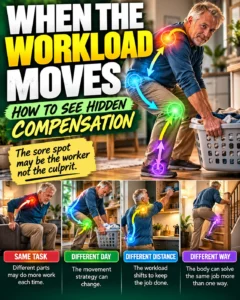
This gives us another useful rule for the ladder: judge lengthening by what joins in, not merely by how far the end point travels. That is easy to remember because it works far beyond stretching. A golfer can turn farther by forcing the shoulders while the hips stay frozen. A gardener can reach farther into a border by collapsing through the waist. A person putting on a shoe can get the foot closer by hauling the leg with both hands. In each case, the destination may improve while the strategy becomes more complicated. Dennis encourages us to ask whether the movement is being shared or whether one part has quietly been given everybody else’s workload.
The Body Should Feel Like A Working System, Not A Hanging Rope
That is why the bucket-of-ice image in Dennis’s demonstration is so revealing.
He asks the person to imagine pushing down onto ice floating on water. The hands are not simply pressing into space. The whole body creates the compression, as though real resistance lay beneath them. Only a small amount of movement is needed. The important thing is the sense that the task travels through the body rather than stopping at the wrists and shoulders. Again, the distinction is not theatrical. A press and a compression may look similar to somebody watching casually, yet they can feel like very different jobs to the person performing them. One is local. The other asks for a more connected response.
That same idea appears again when Dennis reverses the direction and asks the hands to reach upwards. He does not want the arms simply floating towards the ceiling. The intention is to lengthen through the body. Then one hand goes up while the other goes down, producing two opposing directions at once. Suddenly the body has something more interesting to organise. Length is created between two actively working points. It is not a contest to see which hand can travel farthest. The useful information lies in what happens between them. Does one direction feel easier? Does the trunk join in? Do the feet stay involved? Does one side appear to work harder? Those are observations. They do not diagnose anything, but they make the movement much more informative.
Co-Contraction Creates Dynamic Lengthening When Effort And Length Coexist
The simplest test is to stop asking only where you feel the stretch.
Instead, ask two questions: Where am I working? Where am I lengthening? If the answer to the first is nowhere because you are simply hanging at the end of the movement, that tells you something about the strategy. If the answer to the second is nowhere because everything is tightening and nothing appears to travel, that tells you something else. The interesting territory is where you can notice both. There is effort, but there is also a sense of length being created. There is organisation without simply locking everything solid. That is the practical meaning behind today’s four-word phrase.
And notice what this does to the old idea that more stretch must mean more benefit. Once you start looking for working and lengthening together, more sensation stops being the only target. A fierce pull is no longer automatically impressive. A deeper position is not automatically better. The body may be giving you more useful information in a smaller, better-organised movement than in a heroic attempt to reach another two inches. That fits perfectly with Dennis’s wider teaching style. Observe what the body is actually doing. Do not force a correction because somebody has decided what the perfect position should look like. Let the movement show you how the job is being solved.
That leaves us with a much better question than “How flexible am I?” The next time you create a comfortable lengthening movement, notice whether you are being pulled into it, simply tightening against it, or actively working while the body creates length. Then widen your attention. Notice whether the feet, legs, pelvis, trunk and arms are sharing the task or whether one small area appears to be carrying most of the load. We do not need to diagnose what that means. For now, it is enough to recognise that the destination is only half the story. The more interesting part may be discovering how the body creates the length while it is still very much at work.
“`html
The Same Stretch Can Become A Completely Different Movement
Once you notice the difference between simply pulling on a body part and actively creating length, ordinary stretching starts to look different. Two people can stand side by side, put one leg behind them and appear to be doing the same exercise. One rocks backwards, drives the heel towards the floor and waits for the familiar tug in the calf. The other allows the front knee to travel, lowers the body and lets the back leg lengthen as part of a larger movement. From across the room, the difference may be almost invisible. From inside the movement, however, the job has changed completely.
This is where Co-Contraction Creates Dynamic Lengthening becomes more than a clever phrase. The key change isn’t simply whether one muscle contracts while another lengthens. The useful observation is that the body is no longer being treated as a collection of bits that need pulling separately. The front leg is contributing. The back leg is contributing. The pelvis has somewhere to go. The trunk remains involved. The feet keep interacting with the floor. The movement becomes a conversation between several areas rather than one reluctant calf being interrogated beneath a bright light until it finally confesses.
Look For The Route Rather Than The Final Position
If you have followed Dennis’s teaching for any length of time, this idea should sound familiar. The destination is rarely the whole story. A heel touching the floor tells you the heel touched the floor. A hand reaching the ceiling tells you the hand reached the ceiling. Neither fact explains how the rest of the body contributed. That is why range alone can be misleading. Somebody may gain another inch by twisting, collapsing or moving elsewhere. Another person may travel a smaller distance while creating a much more connected action. The measuring tape sees only the finish line. Observation notices the route used to get there.
It is much the same in an old workshop. Two apprentices can remove the same stubborn fitting. One arrives at the answer after a wrestling match involving three spanners, a bruised knuckle and language that would upset the vicar. The other changes the angle, supports the pipe properly and completes the job with half the drama. Both can point to the fitting sitting triumphantly on the bench afterwards. Only one has shown you a more economical strategy. You can watch human movement the same way. Success is not merely arriving somewhere. It is worth noticing how much of the body had to reorganise itself to make the journey possible.
Co-Contraction Creates Dynamic Lengthening Without Maximum Effort
Another trap waits here, particularly for people who have spent years believing that effort proves usefulness. If working while lengthening is valuable, it is easy to assume that working harder must be even better. That is not what Dennis’s demonstration suggests. His instructions repeatedly stay within what feels comfortable. The leg travels back until the heel comes away naturally. The body lowers enough to create the action. The hands compress only a few inches into the imaginary bucket. This is not a strongman competition disguised as mobility work. More force can turn a coordinated movement into another contest against yourself.
The useful target is participation, not strain. Can the body produce enough effort to stay actively involved while still letting the movement travel? That is a subtler skill than either relaxing completely or tightening everything at once. Think of holding a garden hose. Grip it with every ounce of strength, and your hand soon becomes the most important thing in the entire operation. Hold it just firmly enough to direct the water and the task becomes simpler. Dynamic lengthening asks for something similar. There is enough activity to organise the movement, but not so much that effort itself becomes the obstruction.
The Bucket Of Ice Shows Whether The Whole Body Has Joined In
Dennis’s imaginary bucket is useful precisely because no real bucket exists. He asks you to picture ice floating on the surface of water and to push it down. The image gives the body something to work against without requiring gym equipment. More importantly, the instruction is not to press down with the hands alone. The whole body compresses. The knees remain comfortably bent, the trunk joins the action, and only a small distance is needed. The imaginary resistance changes the quality of the movement because the task suddenly has somewhere to go. The hands become the end of the action rather than its entire source. :chatgpt-content-reference{index=”0″}
You can see the same mistake in everyday life. Ask somebody to push a heavy door, and they may attack it entirely from the shoulders while the feet remain almost decorative. Ask them to move their whole body toward the door, and the job can look entirely different. The door has not become lighter. The person has changed how the task is shared. This is the distinction Dennis is inviting us to notice. A local press and a whole-body compression may finish with the hands in almost the same place, yet one recruits the body very differently from the other.
When Two Directions Appear, The Middle Has To Organise
The one-hand-up, one-hand-down movement makes this especially clear. One palm travels towards the floor while the other reaches towards the sky. Suddenly there are two destinations instead of one. The body must organise what happens between them. You may notice one side responding freely while the other feels less familiar. You may feel the trunk becoming more involved. The feet may suddenly seem more important because they provide the base from which both directions are created. None of these sensations tells you why one side behaves differently, and you should not treat them as a diagnosis. They are simply observations produced by a more interesting task.
This is one reason opposing directions can reveal so much. If both hands travel upwards together, the movement can hide behind symmetry. Put one hand down and the other up, and the body has to negotiate the difference. The task resembles wringing out a towel far more than hanging one over a line. There is organisation through the middle. You are no longer asking one limb to wander off on its own while the rest of the body waits patiently for its return. The movement becomes connected, and connection gives you more information about how the whole system is sharing the job.
Co-Contraction Creates Dynamic Lengthening Through Shared Work
That phrase, shared work, may be the simplest way to recognise what Dennis is demonstrating. If one area is doing everything while the rest of the body remains absent, you may be creating movement without much coordination. If every area is tightening simultaneously, the system may be working very hard without creating much length. Between those two extremes lies the more interesting possibility: different regions contribute enough effort to keep the movement going. The result may feel less dramatic than a powerful stretch, but drama is a poor measurement of useful movement. The question is whether the job is being shared.
After fifty, that can become a valuable way to look at many familiar tasks. Reaching for something on a high shelf is not merely an arm test. Putting on a shoe is not simply a hamstring test. Turning to reverse the car is not just a neck test. Each task involves several regions, and one area may end up doing more because another contributes less. We should be careful not to turn that observation into a claim about cause. But it gives us a better place to start. Instead of asking which body part is tight, ask how the movement is being shared.
Break Free from Debt Pain, Defeat Financial Fears, And Discover Your True Desires for a Better Life!
This may be the most useful change to carry away from the entire lesson. “How far?” is an easy question because it produces a visible answer. The heel touched the floor. The fingers reached the shelf. The hand moved another inch. “How?” requires more attention. Did the movement come from one area or several? Was there effort and length at the same time? Did the body remain organised, or did one part appear to take over? Did one direction feel different from the other? Those questions don’t give you a neat score, but they give you something more valuable: a clearer picture of the strategy you’re using.
And that brings us back to Dennis’s original instruction. Don’t rock backwards just because the heel is behind you. Move down and allow the relationship between both legs to create the length. Don’t simply press with your hands. Let the whole body compress. Don’t just lift the arms toward the ceiling. Lengthen upwards through the body. Then create opposing directions and notice what happens between them. The lesson is remarkably consistent once you see it. The body is not being asked to arrive at a position. It is being asked to organise itself while moving towards it.
That is why Co-Contraction Creates Dynamic Lengthening belongs so naturally within Dennis’s wider approach. It shifts the emphasis away from forcing range and back to observation, participation and movement quality. You do not need to declare the stretch good or bad. There is no need to decide that one side is faulty because it feels different. You notice whether you are hanging, gripping or working while creating length. From there, you can compare one side with the other, one day with another, and one movement strategy with another.
Apprentice Task: Choose one comfortable movement you already know, such as Dennis’s leg-back heel movement or a gentle upward reach. Perform it once as you normally would, and notice mainly where you feel the stretch. Then repeat it more slowly and ask two questions: “Where am I working?” and “Where am I lengthening?” Notice whether the movement remains local or whether more of the body begins to contribute. Don’t force extra range, and don’t try to correct anything. Your job today is to compare the two strategies and discover whether you are being stretched, merely tightening, or actively working while you lengthen.
Co Contraction Creates Dynamic Lengthening How To See Active Movement Clearly
Spread the love
Dennis Bartram
Dennis Bartram is the Director of the Active Balance Home or on the Go System Dennis’ journey began in 1969 when he qualified in Swedish remedial massage and in 1974, he began his practice in remedial sports massage and manipulative
Retiree Posture Alignment Training and Lower-Back Control Retiree Shoulder Balance Training Fixes Rounded Posture Retiree Posture Alignment Training for Opening the Body…
Realign Your Spine Exercises Matter After Fifty How Realign Your Spine Exercises Improve Balance Daily Habits That Support Realigning Your Spine Exercises…