Understand Your Movement Support Without Judging Yourself
Recognise what helps you. Your support belongs in your story.
Could Your Chair Explain Why Standing Feels Different?
Notice the setting. Give your experience useful context.
Keep The Help You Need While You Learn
Start with one familiar moment. Describe it in your own words.
Understand Your Movement Support
The armchair has earned its place in the family. It has survived visiting grandchildren, Christmas gatherings and enough television to qualify for a broadcasting pension. Nobody thinks of it as equipment. It is simply Dad’s chair. Yet when Dad describes getting up from it, the chair becomes part of the information worth discussing. Is it low? Does he sink into the cushion? Are there armrests? Is there space around it? These questions don’t mean the chair explains every difficulty. They mean that a description of standing up is incomplete if it leaves out what the person was standing up from. To understand your movement support, look at the task as it actually happens, with its furniture, footwear and assistance, rather than imagining a body moving in an empty room.
That is the practical continuation of whole-body thinking. Looking beyond one knee or shoulder does not require assuming the cause lies elsewhere. It means taking account of the person, the activity and the circumstances before concluding. Two people can both say, “I find standing difficult”, while describing quite different situations. One may mean rising from a deep sofa after an evening watching television. Another may mean standing from a dining chair during breakfast. Their words sound similar until the setting becomes visible. Including that setting helps the person assessing them understand the actual task. It also prevents everyday assistance from disappearing from the account, as though a movement only counts when it happens without a handrail, armrest or another person’s help.
Using Support Is Information, Not A Verdict
 Support can carry an emotional meaning far beyond its practical role. A walking aid may feel like an unwanted announcement about age. Sitting down to dress may seem like surrendering an ability you once took for granted. Some people therefore describe themselves as managing independently while leaving out the furniture they hold or the help they receive. The understandable wish to preserve dignity can make the picture less accurate. You don’t have to judge the support to mention it. “I use the armrests when I stand” is a straightforward description. So is “my daughter stays nearby when I do that”. Both explain how the task currently happens. Neither statement, by itself, establishes what you should stop using or what you should do next.
A useful record therefore includes support in both difficult and comfortable experiences. If you say that dressing felt easier today, add whether you sat down, used an aid or had help. That doesn’t cancel the easier experience. It makes the account more complete. Equally, retaining an agreed support doesn’t mean you have failed to progress.
The activity may feel less tiring or easier to organise while the same assistance remains appropriate. Any decision to reduce support should depend on your circumstances and appropriate guidance, rather than a desire to improve a score. Independence can include using assistance effectively. The question worth exploring is whether your current arrangement helps you carry out the activity appropriately, and whether anything about that arrangement needs professional attention.
Understand Your Movement Support Through The Actual Chair
Return to Margaret, our fictional retiree. At home she describes getting up from her dining chair as familiar, while rising from her sister’s deep sofa feels more awkward. A useful note records the difference without declaring a winner or inventing a diagnosis: “At my sister’s, I sank into the sofa cushion and used both armrests. I found the first part of standing difficult.” That is more informative than “I was worse on Sunday”. The comparison contains a different piece of furniture and a different experience. It does not prove that the sofa was the only reason, or that Margaret’s abilities remained identical throughout the week. Several circumstances may have differed. Her note preserves what she remembers so the setting can be considered alongside her symptoms and history.
Margaret does not need to tour the house trying every seat. She can describe ordinary experiences that have already occurred. If a clinician or occupational therapist needs to explore a particular task, they can explain how to do so appropriately. Likewise, a chair that feels convenient is not automatically suitable as support for every movement. A piece of furniture may move, swivel or tip, and its appearance cannot establish its suitability for a particular person or task. Avoid improvising a new exercise station from whatever is nearby. This lesson aims to improve the account of your present situation. Decisions about equipment, adaptations or a taught movement sequence require more than a photograph of an attractive chair.
Understand Your Movement Support Through Your Footwear
Footwear is another detail easily omitted because it seems ordinary. “I walked through the hall” could mean wearing well-fitting shoes, loose slippers or socks. For a useful description, record what you actually wore rather than labelling it “good” or “bad”. Were those your usual shoes? Did they stay securely on your feet? Had you noticed anything about their fit? The NHS includes well-fitting footwear with good grip among its falls-prevention advice. That gives footwear a sensible place in the conversation, but it doesn’t make every difficult step a shoe problem. If you remember wearing something different, say so. If you cannot remember, leave that detail open. The quality of the account comes from its accuracy, not from including an answer under every possible heading. NHS
Alan has described another observation from his own life: the outside heels of his shoes used to wear noticeably, whereas he now feels that his walking is straighter and lighter. That is something he can report alongside his experience of his routine. It should not be converted into a claim that shoe wear alone proves his alignment has been corrected. A worn sole is an observation; the explanation needs more context. For readers, this distinction prevents an interesting clue from becoming an expensive shopping verdict or a frightening conclusion about the body. Bring relevant observations into a discussion, but don’t expect a shoe to answer every question. A practical description of comfort, fit and the activity involved is more useful than trying to diagnose yourself from a heel.
Understand Your Movement Support Along Your Usual Route
A familiar room contains habits as well as objects. You may know exactly where the kettle stands while rarely thinking about the turn between the sink and the doorway. When describing an awkward moment, include what the journey involved. Were you turning around something, carrying an object or moving through a narrow space? Had someone left a bag in the usual route? These details belong in the account because they explain what you were doing. They do not automatically establish why you felt unsteady. A clear route and suitable support can still coexist with a medical concern. Conversely, a difficult setting deserves attention even if someone has managed it before. You don’t need to choose between looking at your surroundings and seeking advice about changes in yourself.
The NHS recommends keeping the home free of trip hazards such as clutter, loose wires and rugs. Where changes are needed, ask for help with tasks you find difficult rather than creating another risk while trying to improve the room. For the reader record, note the relevant circumstance and the question it raises. “There was little space between the chair and table” is enough to begin a discussion. You don’t have to rearrange heavy furniture before an appointment, and you shouldn’t assume that moving it will resolve a symptom. The useful outcome is a fuller description and an appropriate next action. Sometimes that action concerns the setting; sometimes it concerns assessment of the person; sometimes both deserve consideration. NHS
Understand Your Movement Support Without Comparing Scores
An unhelpful comparison can turn a useful observation into discouragement. Yesterday you stood from one chair without thinking much about it. Today you needed more time somewhere else. It is tempting to announce that you have gone backwards. However, the chair, timing, assistance and task may have differed. Before judging the experience, describe those differences. This does not mean explaining away a genuine deterioration or ignoring a new symptom. It means avoiding a conclusion that goes beyond the information available. Your note can say, “This felt harder, and these were the circumstances.” That leaves the experience intact without pretending you have measured a precise change in your ability. Everyday observations can be valuable without being controlled tests, as long as we are honest about what they can establish.
The same principle applies to somebody else’s performance. A video of another older adult rising smoothly from the floor tells you very little about what is appropriate for you today. You may not know their history, preparation, instruction or the attempts that were not filmed. Alan’s experience of getting down and up more comfortably gives his own routine personal meaning, but it doesn’t create a deadline for another reader. You can admire an achievement while keeping your usual support and seeking guidance about your own circumstances. A sensible goal begins with the life you want to participate in, rather than the demonstration you want to imitate. Before deciding how to practise, establish what the task involves for you and what assistance currently makes it possible.
Bring The Person, The Task And The Setting Together
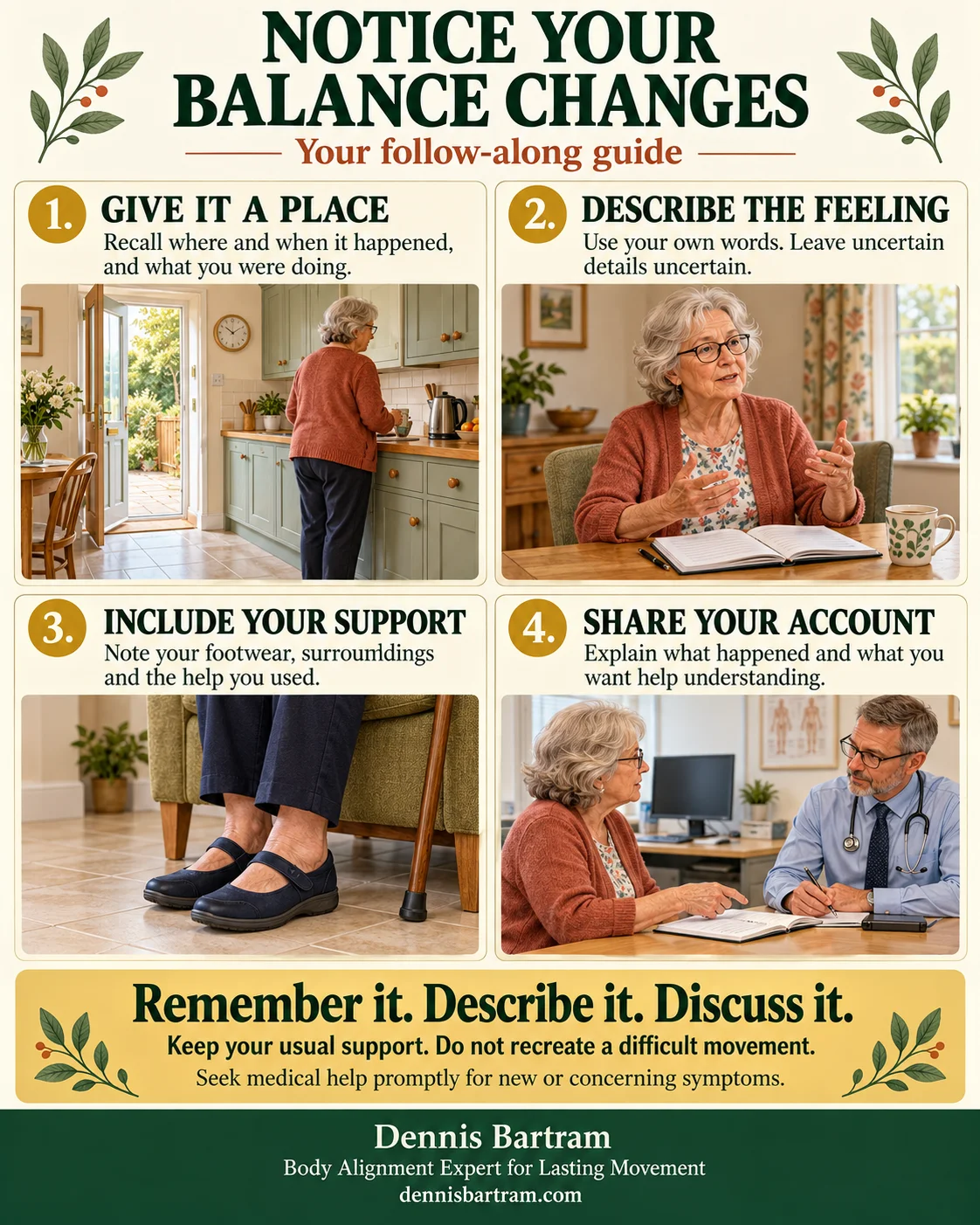
By now, the reader record has developed beyond a sentence about feeling wobbly. Margaret can describe a particular occasion, the sensation she remembers, her response and the circumstances around it. She might take this account to her GP: “On Thursday, turning away from the kitchen sink, I felt unsteady and held the worktop. I was wearing my usual slippers. I don’t remember feeling faint or seeing the room spin. I stopped preparing lunch for a while, and I’m now worried about cooking alone.” This is a hypothetical example, not a model diagnosis. Its strength is that it preserves the event and the concern without deciding what caused them. It also gives the professional listening a clear everyday activity around which to organise further questions. To understand your movement support, describe the task, the surroundings and the assistance you used together.
Keep the record short enough to use. A few relevant sentences will usually communicate your concern more clearly than pages of guesses copied from websites. Separate what you know from what you would like explained. You might write, “I know I reached for the worktop; I don’t know why I felt unsteady.” Suppose somebody has suggested a possible cause, label that as a suggestion rather than inserting it as fact. The same applies to any text organised by an AI assistant: check that it hasn’t changed your sensation, invented a duration or turned uncertainty into a conclusion. You remain the source of your experience. The purpose of wording assistance is to make that experience easier to share, not to make it sound more certain or more medical.
Your Reader Task: Build One Useful Movement Record
Open to See This Video, And This Is What’s Already Built,
Trained & Waiting For Your First Command.
Your Reader Task: Build One Useful Movement Record
Choose one remembered experience and put the whole account in one place. Include where and roughly when it happened, what you were doing, what you felt and what you did next. Add the support, footwear and surroundings you remember, then explain what the experience interrupted or made you concerned about. You can write, dictate or ask somebody to help. Do not repeat a difficult movement, remove assistance or delay seeking advice while completing the task. The NHS recommends seeing a GP if you are worried about your balance or mobility, or if you have had a fall. Your record can support that conversation; it does not replace it. If you already have professional guidance, bring questions about changes or uncertainty back to the appropriate person. NHS
The finished page should let you say three things clearly: this is what happened, this is how the task currently works for me, and this is what I want help understanding. When you notice your balance changes and understand your movement support, you can describe your daily life with greater precision while keeping uncertainty where it belongs. You don’t need to prove independence by doing without help, or prove a difficulty by making it happen again. Bring an honest account and a meaningful question. What would I like to do more comfortably, and what do I need to understand before changing how I do it? That gives any future routine a purpose grounded in your own life.