
Reframing Stiffness Restores Mobility Without Forcing The Body
Change the message before you change the movement.
Reframing Stiffness Restores Mobility By Calming Protective Tension
Safety first, ease second, confidence next.
Reframing Stiffness Restores Mobility Through Small Daily Proof
One comfortable movement can rewrite an old expectation.
Part 1 – THE STORY WE TELL OURSELVES ABOUT STIFFNESS
Reframing stiffness restores mobility because the meaning you give a sensation can change what you do next. Many people over sixty wake up, feel resistance in their backs, hips, shoulders, or knees, and immediately decide that age has finally caught up with them. Within seconds, a temporary sensation becomes a gloomy forecast for the day.
That conclusion may feel sensible, but it can encourage less movement, more guarding and a steady loss of confidence. The useful question is not simply, “Why am I stiff?” It is, “What is my body asking me to notice before I move?”
Reframing Stiffness Restores Mobility When Stiffness Stops Meaning Damage
Stiffness is a sensation, not a diagnosis. It can appear after sleep, during long periods of sitting, after unfamiliar activity, due to stress, tiredness, or simply moving less than usual.
Sometimes it needs professional attention, but it does not automatically mean the joint is worn out or the body has become too old to improve.
Picture a familiar morning. You sit on the edge of the bed, place both feet on the floor and notice that your back does not fancy joining the day yet. The first thought may be, “Here we go again.”
You brace your stomach, hold your breath and rise as though carrying a tray of priceless china. The body then receives a powerful message: movement is risky, so tighten everything.
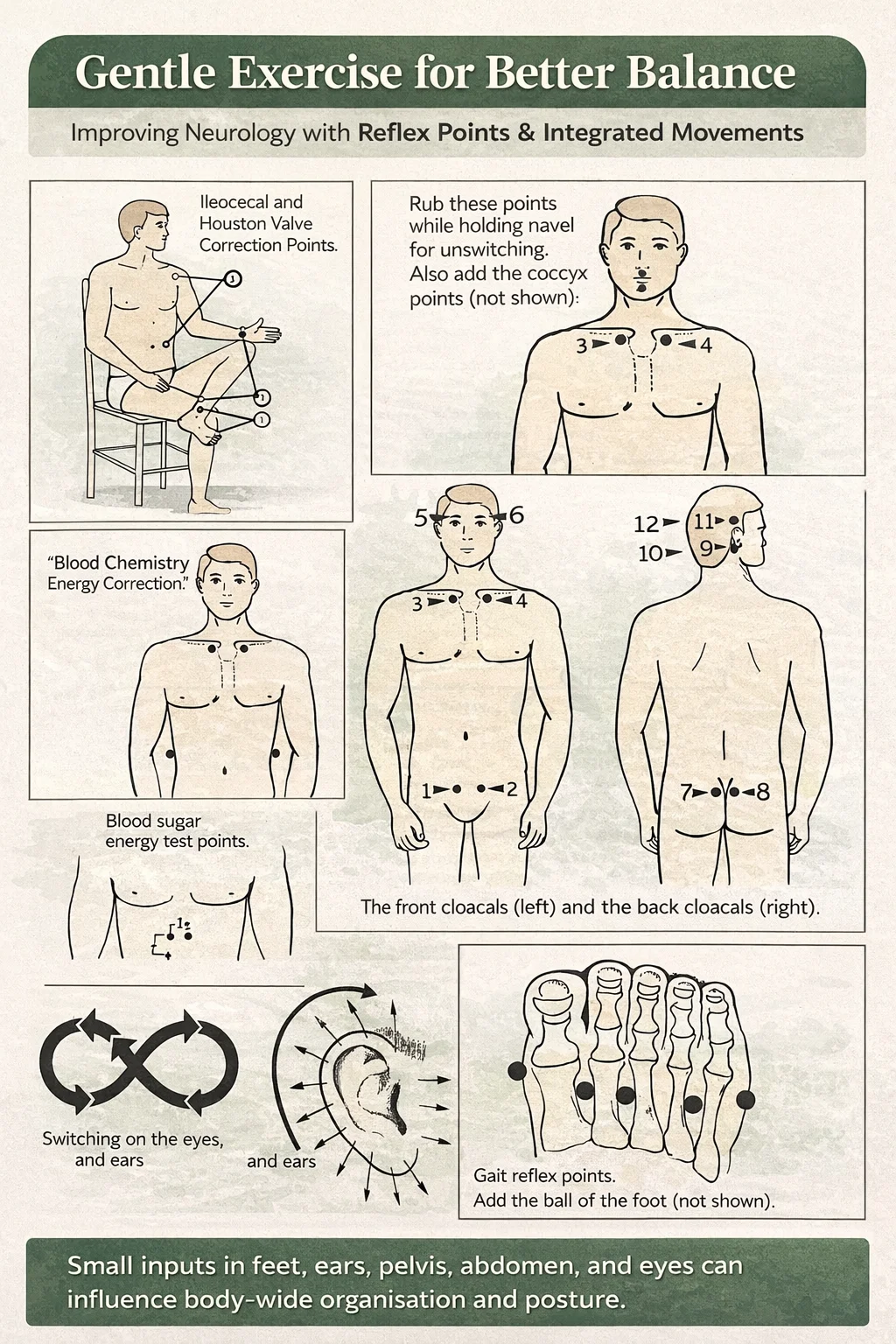
Dennis Bartram’s Active Balance philosophy begins from a different place. Rather than attacking the stiff area, it asks whether the nervous system is creating protective “nuisance noise” around movement.
Balance comes first because a body that feels safer often moves with less unnecessary effort.
Reframing stiffness does not mean pretending symptoms are imaginary or ignoring a genuine medical problem. It means refusing to turn one sensation into a verdict before gathering better information.
That single change matters.
Instead of saying, “My back is going,” you might say, “My back feels guarded this morning.”
Rather than declaring, “My knees are worn out,” you could observe, “My knees need a few careful movements before they feel ready.”
The first version closes the case. The second allows you to investigate.
The Mind Can Turn A Sensation Into A Stop Sign
 The body and mind are not separate departments working at opposite ends of the building. Every movement is influenced by what you expect, remember and fear.
A person who believes bending will cause damage is likely to bend less. Someone who expects the first steps to hurt may shorten their stride, stiffen their shoulders and grip the floor with their toes.
Those protective choices can make movement feel more awkward, which then appears to prove the original belief. Research involving older adults has found that greater fear of movement is associated with lower physical activity and poorer measures of physical function. Another study found that fear-avoidance beliefs predicted future activity levels more strongly than several pain characteristics in older people living with chronic pain.
This does not prove that every stiff body is driven by fear. It does show why confidence and interpretation deserve a place beside physical movement.
Consider the difference between these two statements:
“I am stiff because my body is failing.”
“My body feels guarded, so I will give it a calm reason to move.”
The first statement closes the door. The second leaves it open without making a reckless promise.
That is psychological reframing.
You are not talking yourself out of reality. Instead, you are choosing a more useful explanation until the body gives you further evidence.
Pain, stiffness and restriction are real experiences. However, the story built around them can either encourage sensible exploration or produce an immediate retreat.
Reframing Stiffness Restores Mobility With One Better Question
Most people respond to stiffness by asking, “How do I stretch this away?”
That can lead to harder pulling, deeper bending or forcing a joint that already feels uncertain. It is the bodily equivalent of shouting at someone who is already nervous.
A calmer route begins with three questions.
1. What Changes After Three Slow Movements?
Move only within a comfortable range and notice whether the sensation stays the same, eases slightly or becomes sharper.
You are not attempting to prove how flexible you are. The purpose is to discover how the body responds.
2. Where Can I Move Without A Struggle?
Perhaps the stiff hip dislikes a large step but accepts a small weight shift. Maybe the shoulder resists lifting overhead but tolerates a gentle roll.
Begin where movement is still available, rather than repeatedly attacking the place that feels blocked.
3. Can I Make The Movement Slower, Smaller Or Supported?
A hand on the chair, a shorter range or a quieter pace can reduce the sense of threat without abandoning movement.
These questions turn the morning into a conversation rather than a wrestling match. They help separate “I cannot move” from “I cannot move in that particular way yet.”
Notice the final word: yet.
It creates room for change without demanding instant success.
Reframing Stiffness Restores Mobility Through Evidence, Not Pep Talks
Positive thinking alone will not restore a hip, shoulder or spine. The nervous system usually wants evidence.
Evidence arrives when you perform a small movement safely, and nothing terrible happens. It grows when the second repetition feels more organised than the first.
Confidence returns when you can stand, turn or walk with a little less bracing.
This is why Dennis’s work does not begin with heroic effort. It begins by reducing unnecessary noise and allowing natural movement to reappear.
The goal is not to conquer the body before breakfast. It is to show the body that movement can be calm, measured and trustworthy.
A 2024 review of non-drug approaches for chronic pain in older adults found modest benefits from programmes combining psychological approaches with physical activity.
The findings support the practical idea behind this article: changing beliefs works best when paired with appropriate movement, not as a substitute for it.
Your First Reframing Stiffness Restores Mobility Task
Tomorrow morning, do not rate your body as good or bad the moment you wake.
First, describe the sensation neutrally:
“My right hip feels resistant.”
Or:
“My shoulders feel slow today.”
Next, take three comfortable movements without forcing the range.
Finally, ask:
“What changed?”
Your answer may be, “Not much.”
That is still useful information. A warmer feeling, an easier breath or a slightly smoother second movement counts as evidence too.
Ignore heroic stretching, frightening internet diagnoses and comparisons with the body you had at thirty. Today’s task is to replace judgement with observation.
New, severe or rapidly worsening stiffness, a hot or swollen joint, fever, feeling generally unwell, or symptoms following a fall or injury should be medically assessed. NHS guidance also recommends seeking help when joint symptoms stop normal activities, worsen, recur or fail to improve.
Stiffness may be the first sensation you notice, but it does not have to write the rest of your day.
Reframing stiffness restores mobility by giving the body a calmer starting point—and giving you a fairer chance to discover what movement is still available.
Part 2 – TEACHING THE BODY THAT MOVEMENT IS SAFE AGAIN
Understanding stiffness differently is only the beginning. The next step is giving the body repeated evidence that ordinary movement can still be comfortable, controlled and dependable.
That evidence rarely comes from one heroic exercise session. It usually arrives through small movements performed calmly enough that the nervous system notices.
This is where reframing stiffness restores mobility in practical everyday life. You stop treating the body like a faulty machine that needs forcing and begin treating it like an intelligent system that needs clearer information.
The change may look small from the outside.
Inside the body, however, it can be the beginning of renewed trust.
Reframing Stiffness Restores Mobility Through Familiar Movement
Many people search for complicated exercises when the most useful starting point is already part of their day.
Standing from a chair, turning to look behind, reaching for a cup, walking across the kitchen and stepping into the garden are all movement lessons.
The body practises them whether you are paying attention or not.
If each movement is performed with a clenched jaw, held breath and fearful expectation, the nervous system repeatedly learns that movement requires protection.
A different lesson appears when the movement becomes slower, easier and better supported.
Imagine reaching into a low cupboard.
A person expecting back trouble may tighten before moving, hold the breath and bend as one rigid block. The movement then feels awkward, which seems to confirm that the back is getting worse.
Now imagine placing one hand on the worktop, softening the knees and allowing the hips to move backwards slightly.
The cupboard has not changed. The body has not suddenly become twenty years younger.
What has changed is the quality of the information entering the system.
Support reduces uncertainty. Breathing lowers unnecessary effort. A smaller movement gives the brain time to organise balance.
That is how reframing stiffness restores mobility without requiring you to ignore what you feel.
The Body Needs Better Experiences, Not Bigger Effort
Older adults are often told to push through discomfort, strengthen everything or stretch until the stiffness gives way.
Occasionally, effort is useful. Yet effort applied at the wrong time can increase guarding rather than reduce it.
Dennis Bartram’s approach is based on restoring balance and coordination before asking the body for more work. When movement is poorly organised, adding force can strengthen the compensation.
Think of a shopping trolley with one wheel pulling sideways.
Pushing harder may get it through the supermarket, but it does not correct the wheel. You arrive at the checkout more tired and slightly annoyed with the frozen peas.
The body can behave similarly.
If the feet are gripping, the hips are guarded, and the head is carried forward, a determined exercise may place more demand on the existing pattern. The person becomes stronger at struggling than at moving.
A calmer approach begins with quality.
Ask whether the movement feels balanced, whether the breath continues naturally and whether another part of the body is working harder than necessary.
Those observations provide more useful information than counting twenty repetitions performed through tension.
Reframing Stiffness Restores Mobility In Three Simple Steps
There is no need to inspect every muscle or understand the entire nervous system before beginning.
Use one clear route:
Notice the movement, reduce the effort and repeat the easier version.
Step One: Notice Without Judging
Choose one everyday movement that feels stiff.
It might be standing from a chair, turning the head, lifting one arm or taking the first few steps after sitting.
Perform the movement once and observe it.
Do not immediately label it bad, damaged or useless. Notice where the effort begins, whether you hold your breath and which part of the body tightens first.
This neutral observation prevents the first sensation from becoming the conclusion.
Step Two: Make The Movement Smaller Or Better Supported
Repeat the movement with less ambition.
Use the chair arms when standing. Turn the head only as far as it travels comfortably. Rest the hand on a wall while shifting weight from one foot to the other.
A smaller movement is not a failure.
It gives the nervous system a cleaner experience without the confusion caused by strain, panic or excessive effort.
Support can be gradually reduced when confidence improves. There is no prize for removing it too early.
Step Three: Repeat And Compare
Perform the easier movement two or three times.
Then compare the final repetition with the first.
Perhaps the range is unchanged, but the breath is quieter. Maybe the shoulders are less tense, or the movement begins with less hesitation.
These details matter because improvement is not always measured in inches.
Reframing stiffness restores mobility by helping you notice better organisation before expecting dramatic flexibility.
See why over 12,415 people have already unlocked their personalised Ultimate Astrology Reading. Yours Is Waiting.
Your Reframing Stiffness Restores Mobility Apprentice Task
Choose one movement you perform every day.
Use standing from a chair, turning your head, reaching into a cupboard or beginning to walk after sitting.
Perform it once normally.
Next, make one helpful change. Slow it down, reduce the range, add support or continue breathing throughout the movement.
Repeat it three times and compare the final attempt with the first.
Write down one honest observation:
“The movement felt smoother.”
“I used less effort.”
“My breathing stayed calm.”
“Nothing changed yet, but I felt less worried.”
Every answer is useful.
Do not chase pain, force the range or attempt to prove that nothing is wrong. New, severe or worsening symptoms, unexplained weakness, numbness, swelling or difficulty following an injury should be discussed with an appropriate healthcare professional.
For ordinary guarded movement, however, begin with curiosity.
Stiffness does not always mean the body has forgotten how to move. Sometimes it means the nervous system needs a calmer reminder.
Reframing stiffness restores mobility by replacing fear with observation, force with organisation and hesitation with small pieces of trustworthy evidence.
Balance first.
Everything else follows.


