Active Balance Floor Mobility: Getting Down And Up
Active Balance Floor Mobility
Active Balance Floor Mobility Begins With The Whole Journey
Getting down is only half the story.
When Did The Floor Become Somewhere You Had To Plan For?
An ordinary movement can gradually become a complicated expedition.
Look At The Return Before Judging The Descent
A useful plan includes getting back up.
The bedroom floor hadn’t moved an inch. Still, in his early seventies, Alan found that reaching it required something to hold on to. Getting back up was still a bigger struggle. No dramatic sporting ambition drove his concern. He wanted his body to manage a journey it had once handled without a committee meeting. That experience provides a practical starting point for Active Balance Floor Mobility, because it makes the subject specific. This wasn’t a vague wish to become fitter or a passing interest in better posture. It was the discovery that an ordinary movement now demanded support and effort. The floor was close enough to touch, yet getting there and standing up again had become two very different propositions. For Alan, that was a reason to learn more about what he could do.
His account today is different. After doing the floor exercises Dennis teaches as part of his morning routine, Alan says he no longer needs to hold on to anything when getting up and down. He gives his body twenty minutes before leaving the bedroom and describes greater flexibility, no pain and a “float” in his walk. Perhaps the most revealing detail is that he no longer has to think about the movement in the way he once did. These are his personal observations, not a timetable or a promised result for anyone else. However, they explain why this subject matters to him. He values his morning appointment because of how it makes him feel throughout the day. The story begins with a struggle near the bedroom furniture and reaches into his experience of walking, moving and getting on with ordinary life.
Active Balance Floor Mobility Includes The Return Journey
When somebody says, “I can’t get down on the floor any more,” it sounds like a complete explanation. In fact, it leaves several useful questions unanswered. Is lowering themselves the difficult part? Can they reach the floor but struggle to find a comfortable position? Does moving once seated cause trouble? Or does the thought of getting back up make them avoid the whole business? Each account deserves to be heard in its own terms. However, the familiar sentence bundles them together, rather like telling a mechanic that the car is “a bit funny” and expecting an immediate answer. A clearer description won’t diagnose the cause, but it can identify the part that needs discussion. That is the first useful distinction: difficulty with one part of a journey doesn’t describe every other part equally well, even when the whole task feels daunting.
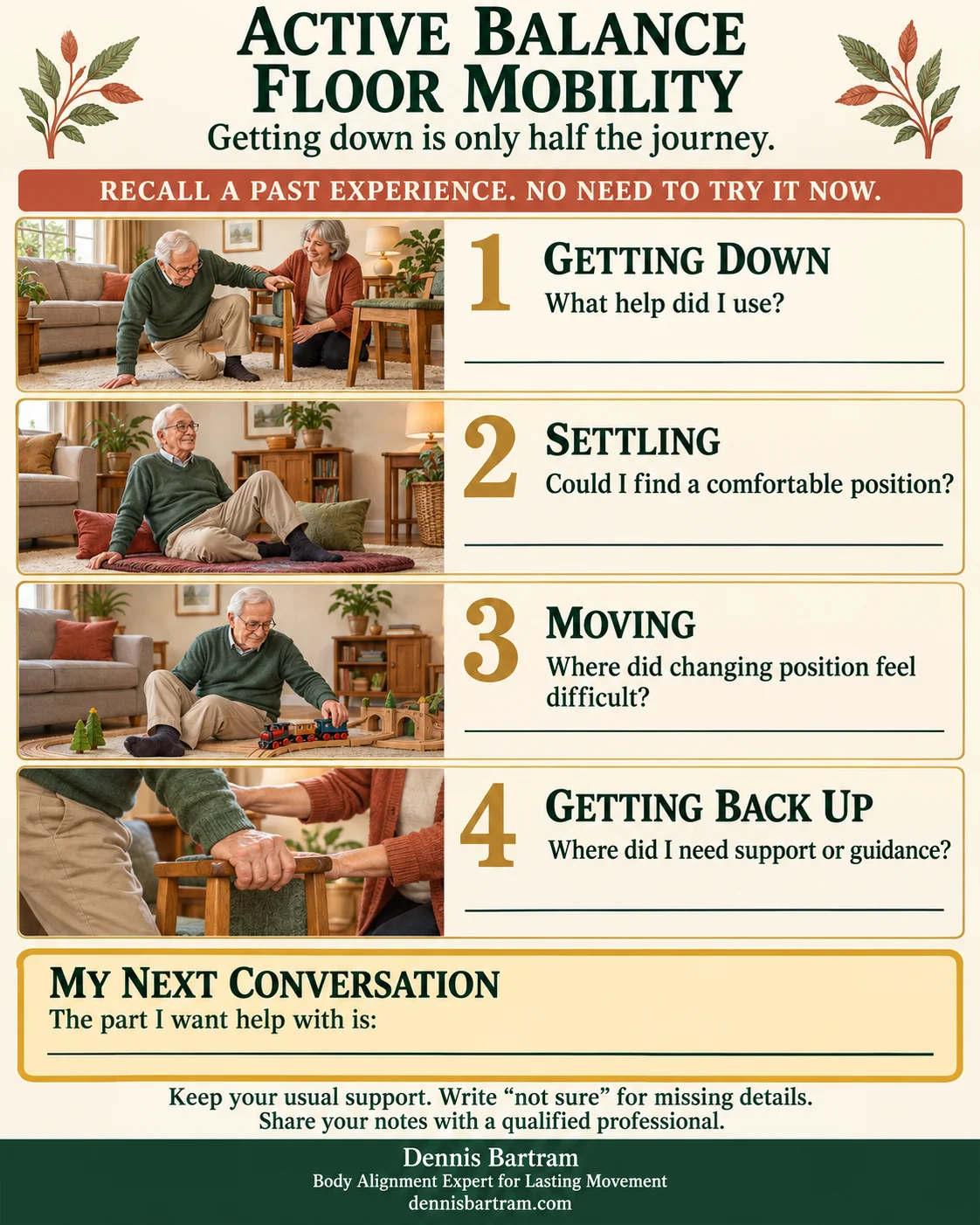
Consider the four parts separately: getting down, settling, moving on the floor and returning to standing. These headings help us understand an experience, rather than instruct us in performing an exercise. Their purpose is to stop one moment from representing the entire task. A person may remember lowering themselves with their usual assistance and then sitting comfortably for several minutes. That tells us something about the descent and the position they reached. However, it doesn’t show how they changed position or returned to standing.
Active Balance Floor Mobility becomes easier to discuss when those details remain visible. Instead of giving yourself a pass or fail, describe what felt familiar and where you needed help. The resulting account is more useful than either declaring that everything went well or dismissing the whole experience as a failure.
Reaching The Floor Doesn’t Describe What Happens There
Settling deserves attention because arriving and being comfortable are separate experiences. Imagine someone who gets onto the floor with assistance but immediately starts searching for another position. Perhaps they keep adjusting where they sit, or decide they would rather stand again. We don’t know the reason from watching that alone. Nevertheless, their experience differs from someone who sits comfortably but struggles to get up. If both people say only, “Floor work doesn’t suit me,” the distinction disappears. There is also a practical consequence. A conversation focused entirely on the descent may overlook what happens after arrival. When describing a previous attempt, include whether the position itself felt manageable and whether you wanted or needed to change it. You don’t need technical language to make that point clear. “Getting there was manageable, but I couldn’t settle comfortably” says something useful.
Movement on the floor adds another part to the picture. Sitting beside a grandchild might feel quite different from turning to reach a toy behind you. Similarly, the position used during a familiar exercise may feel manageable while changing into or out of it requires help. The transition belongs in the account too. Otherwise, someone listening might assume that the exercise itself caused the difficulty, when the person was actually describing the moment before it began. Within Active Balance Floor Mobility, this is a useful habit of observation: distinguish being in a position from moving between positions. There is no need to turn every small adjustment into a fault. Notice which part of the remembered experience you mean. That precision can help a suitable professional understand your concern without requiring you to arrive with a theory about muscles, joints or alignment.
The Way Back Up Deserves Its Own Attention
For Alan, getting back up was the real struggle in those early days. His experience illustrates why the return should be considered before beginning floor practice. Lowering yourself doesn’t prove you have an appropriate way to rise again, especially if you relied on assistance to descend. Watching somebody else perform a smooth demonstration doesn’t answer that question either. The person on screen may have different abilities, experience and support needs. If you aren’t sure how to manage both directions, suitable individual guidance is a better starting point than an improvised trial alone. Keep existing assistance part of the conversation. Its presence gives useful information about how you currently complete the task. The aim is to understand the journey you can manage, including the help you use, rather than borrow someone else’s performance and hope it works out.
This gives us a more productive question than, “Am I too old for this?” Ask instead, “Where does the journey become difficult for me?” You might remember being comfortable once seated but uncertain about starting to rise. You might recall needing help throughout, or you might know you haven’t tried it recently enough to describe it. Each answer tells a different story, and “I’m not sure” is a perfectly useful answer when information is missing. Active Balance Floor Mobility doesn’t need to begin with a test on the bedroom carpet. It can begin with a clear account of something you already remember. Alan’s starting point was concrete: he needed support going down and struggled coming back up. Describing that experience kept the problem he wanted help with clear. Before choosing what to practise, name the part that concerns you.
Active Balance Floor Mobility Starts With A Clearer Account
Imagine Margaret sitting beside her grandson while he builds a railway across the living room carpet. This is an illustrative example, but many grandparents will recognise the situation. She enjoys being close enough to join in, even if her main job is to keep the express service from disappearing beneath the sofa. Her daughter helps her down, and sitting feels comfortable. However, when the game ends, Margaret is uncertain about standing up again. Later, she tells a friend that she is “hopeless on the floor”. That verdict leaves out most of what happened. With assistance, she reached the floor and enjoyed the activity. Getting up was what troubled her. Active Balance Floor Mobility becomes more useful when the description preserves those differences, because the next conversation can address her actual difficulty rather than a general judgement about her capabilities.
Now change one detail. Suppose Margaret finds sitting uncomfortable and keeps shifting position throughout the game. She can return to standing with her usual help, but she doesn’t enjoy the time spent on the carpet. The same sentence, “I’m hopeless on the floor,” now describes a different concern. Advice devoted entirely to standing up would miss what she wants addressed. This is why the four parts matter: getting down, settling, moving and getting up. They give a person room to describe an experience accurately. They also help separate what someone wants to do from what gets in the way. Margaret’s goal is to enjoy time with her grandson. Understanding which part troubles her can help a suitable professional discuss how she might participate, including alternatives that don’t require sitting on the floor at all.
Give The Awkward Moment A Name
Everyday language can be surprisingly precise when we let it do its job. “I can sit comfortably, but I don’t know how to begin getting up” tells a listener more than “my mobility is terrible”. Similarly, “I needed help changing position” identifies something different from “I needed help throughout”. Neither statement supplies a diagnosis, and neither needs to. The purpose is to describe the experience before trying to explain it. People sometimes reach for an anatomical answer because they feel an ordinary account sounds inadequate. Yet guessing that a joint is misaligned or a muscle has stopped working can distract from the detail they actually know. Begin with what happened, where it happened and what help was involved. If the cause needs assessment, a clear description gives that assessment a useful starting point without pretending the answer has already been found.
The moments between positions deserve the same attention as the positions themselves. Someone may remember sitting comfortably and standing comfortably, but find the transition between them difficult. That experience can disappear from the story if we ask only whether they could sit or stand. For Active Balance Floor Mobility, a useful description might be, “Once I was sitting, I felt settled. When I wanted to change position to get up, I needed assistance.” Notice how little technical language is required. There is no claim about why the difficulty occurred, and no attempt to grade the person. Instead, the account identifies the transition worth discussing. This is especially helpful when somebody dismisses their experience because they eventually completed the task. Finishing tells us the journey ended. It doesn’t tell us how much help, discomfort or uncertainty accompanied the route.
Keep Support In Your Active Balance Floor Mobility Story
Include assistance in the description, rather than leaving it out. If another person helped, say so. If you used your usual support, include that too. Otherwise, “I managed it” could give a misleading impression of what happened. Alan’s report that he can now get up and down without holding furniture is part of his personal story. It doesn’t set an entry requirement for somebody beginning their own discussion with Dennis or another appropriate professional. Readers may have different health conditions, abilities and needs, and their assistance may remain important. The useful comparison is with a person’s own experience, described honestly. Removing support to make it look more impressive changes the task and may make it unsafe. A clear account should preserve the circumstances under which something was manageable, including the assistance that helped make it possible.
This also has a social side. People may soften a concern. They don’t want to worry their family or exaggerate a difficulty because they feel nobody understands it. A specific account reduces the need for either approach. “I enjoyed sitting there, but I needed your help when I wanted to rise” makes both parts visible. It acknowledges what went well while naming the help required. It also gives the other person something concrete to remember when discussing future arrangements. However, needing help after an unexpected fall is a different situation from planning a floor session. An injury or feeling unwell changes the circumstances, so a familiar exercise demonstration should never be treated as an automatic answer. The lesson here is to understand and plan ordinary floor activity with appropriate guidance, rather than improvising an emergency response.
Twenty Minutes Is Alan’s Appointment, Not Everyone’s Prescription
Alan gives his body twenty minutes before leaving the bedroom because that routine has become valuable to him. He describes feeling flexible, walking with a “float”, and no longer having to plan how to get up and down the stairs the old way. Something about the ordinariness of that commitment is encouraging. No grand announcement is required each morning, and the bedroom doesn’t need to become a television fitness studio. Nevertheless, copying the duration wouldn’t tell another reader which movements suit them or how to approach the floor. His routine reflects one person’s experience, shaped by the exercises Dennis teaches. The transferable point is that he recognised a practical difficulty and made room to address it. For someone else, the first useful appointment may be a conversation about their abilities, support needs and the specific activity they want to enjoy.
Keeping the purpose clear also helps prevent the routine from becoming an end in itself. Alan values how he feels during his day. In our example, Margaret wants to join the railway construction without returning to standing, which becomes an unresolved worry. Another person may want to understand how to take part in a suitable exercise session. These aims differ, but floor mobility connects them. Active Balance Floor Mobility gives us a subject; the individual gives it a purpose. That purpose should help shape the discussion about what is appropriate. An unsupported movement isn’t automatically a more meaningful achievement than participating comfortably with assistance. What matters is understanding the person’s circumstances and what they hope to do. Once those details are clear, advice can address a real situation instead of an imagined standard everyone is expected to meet.
Open to See This Video, And This Is What’s Already Built, Trained & Waiting For Your First Command.
Active Balance Rebalance Body, Reduce Pain, Improve Wellbeing Naturally at Home or Office
Use a remembered experience for today’s task; you don’t need to get onto the floor. Write four headings on a piece of paper: getting down, settling, moving and getting up. Under each, add one sentence about what you remember feeling able to do and any help you used. Write “not sure” wherever the memory is unclear. Then identify the point where manageable became difficult or uncertain, including a change between positions if that was the problem. Finish with one sentence explaining what you wanted to do, such as joining a grandchild’s game or taking part in a familiar floor session. You now have a short account to discuss with a qualified professional who can assess what is appropriate for you. Keep the task descriptive. There is no need to identify a medical cause, remove assistance or repeat a difficult movement to fill a gap.
Getting down is only half the journey, and reaching the floor doesn’t settle the question of getting back up. Describe the whole experience, including the support that makes participation possible. Alan’s story began with a practical struggle; your own starting point deserves the same attention to detail. Before asking which exercise comes next, ask which part of the journey you need help understanding.
Active Balance Floor Mobility Getting Down And Up
Spread the love
Dennis Bartram
Dennis Bartram is the Director of the Active Balance Home or on the Go System Dennis’ journey began in 1969 when he qualified in Swedish remedial massage and in 1974, he began his practice in remedial sports massage and manipulative
Subtalar Joint Balance Explained for Natural Movement Subtalar Joint Balance Explained for Natural Movement Why Your Balance Feels Off and Never Fully…


 When somebody says, “I can’t get down on the floor any more,” it sounds like a complete explanation. In fact, it leaves several useful questions unanswered. Is lowering themselves the difficult part? Can they reach the floor but struggle to find a comfortable position? Does moving once seated cause trouble? Or does the thought of getting back up make them avoid the whole business? Each account deserves to be heard in its own terms. However, the familiar sentence bundles them together, rather like telling a mechanic that the car is “a bit funny” and expecting an immediate answer. A clearer description won’t diagnose the cause, but it can identify the part that needs discussion. That is the first useful distinction: difficulty with one part of a journey doesn’t describe every other part equally well, even when the whole task feels daunting.