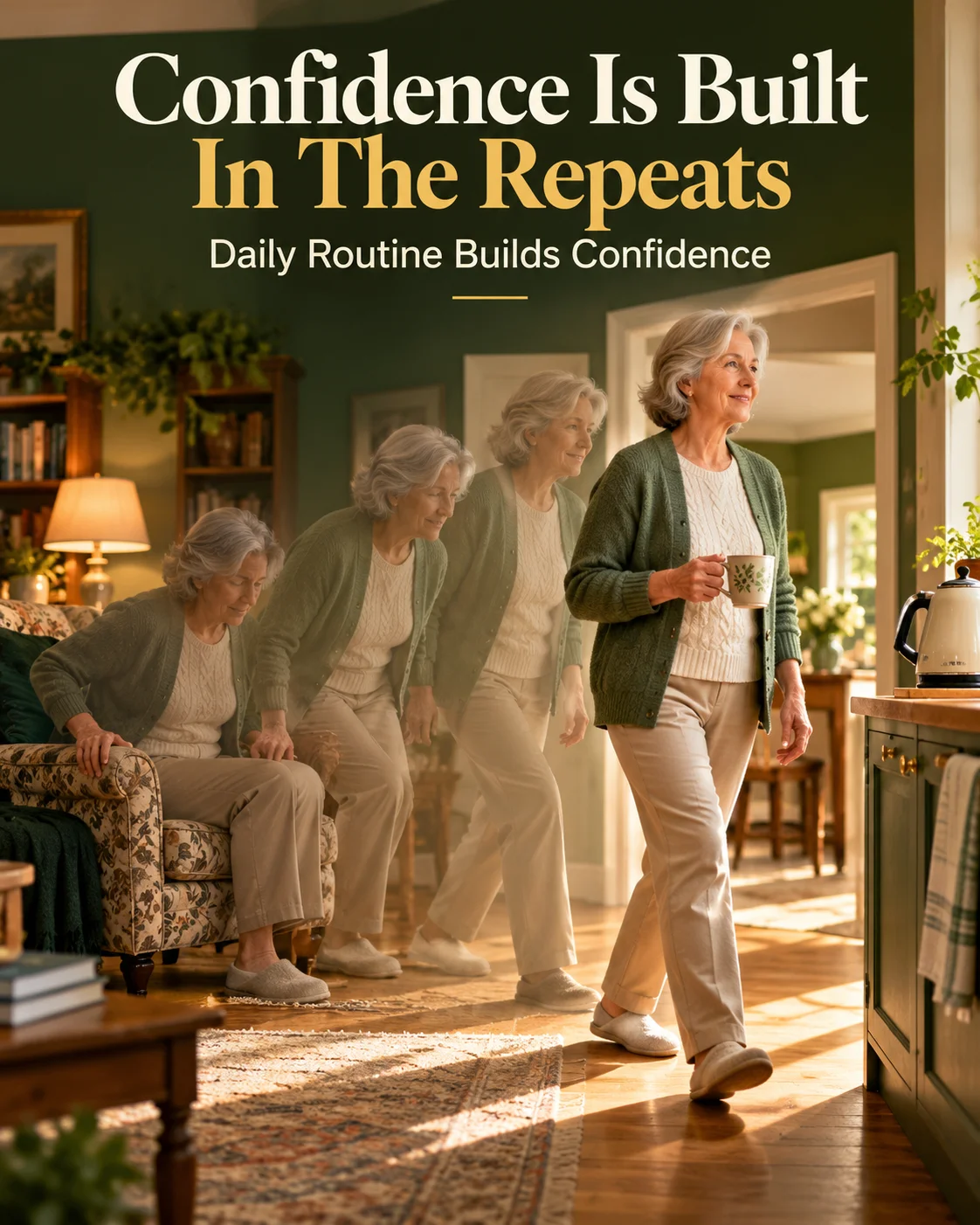
Daily Routine Builds Confidence
Daily Routine Builds Confidence Through Familiar Movement
Confidence often grows when ordinary movement stops feeling like a fresh test every time.
Repetition Can Reduce The Uncertainty
A familiar task may become easier to approach when you know roughly what to expect.
Repeatable Success Beats Occasional Effort
The best confidence-building routine is often the one you can comfortably return to tomorrow.
Daily Routine Builds Confidence When Progress Feels Ordinary
One of the strangest things about useful progress is that it often stops looking dramatic just as it starts becoming dependable. The first time someone manages a movement they have been avoiding, everybody notices. The tenth time, nobody does. By the twentieth, it may simply be how they move now. That’s when confidence can begin slipping quietly into everyday life, not as excitement, but as less fuss. The task no longer needs a speech beforehand.
This matters because people often overlook the kind of progress a daily routine produces best. They look for a bigger range, faster movement, less support, or some obvious visible improvement. Those things may matter, but they are not the only signs worth watching. Sometimes the useful change is that the person gets on with it. Fewer hesitations. Less checking. Less mental preparation. Fewer negotiations with the chair, the step, the sock, or the floor.
That gives us another useful distinction: visible improvement and felt familiarity are not always the same thing. A person may still move slowly and yet feel much more certain. They may still use the bannister but no longer approach the stairs with the same caution. They may still lower themselves carefully towards the floor, but the route no longer feels mysterious. If you only judge the movement from the outside, you can miss the growing confidence inside the task.
The Routine Should Lower Friction, Not Raise The Stakes
 A confidence-building routine works best when it reduces the number of reasons to avoid the movement. That is why simplicity matters. If the routine requires special equipment, a large block of time, several instructions, precise counting and enough enthusiasm to launch a small business, it may be technically impressive and practically useless. The more friction around the routine, the more likely the person is to postpone it until conditions are perfect.
Ordinary life rarely provides perfect conditions. The phone rings. Somebody knocks at the door. The dog wants out. The kettle boils over. The post arrives. Confidence grows more reliably when the routine can survive those interruptions. That means the task should be recognisable, brief enough to repeat, and attached to a part of the day that already exists.
A chair near the breakfast table can become a useful reference point. So can the first stair, the back door, the edge of the bed, or the kitchen worktop. The routine does not need to announce itself as exercise. In some cases, that is one of its strengths. The person is not stepping into a separate performance. They are using everyday life as the practice ground.
Daily Routine Builds Confidence Through Predictable Repetition
Predictability matters because uncertainty can change behaviour. If a person does not know how difficult a movement will feel, they may prepare for the worst. They grip harder, brace earlier, hold their breath, or delay starting. Those reactions may alter the movement before it even begins. A familiar routine can sometimes reduce that uncertainty because the person knows what usually happens.
Imagine someone using the same first stair each morning. They place one hand on the rail, step up, pause, step down, and continue with the day. Nothing heroic. Nothing forced. After enough repeats, they may know exactly where their foot goes, how much support helps and how the movement normally unfolds. The task becomes less of a question.
Now compare that with attempting a full flight of stairs only occasionally, particularly when already tired or rushed. The person has less recent evidence. The task may feel more demanding before it has even started. Confidence suffers not because the body has necessarily lost capacity, but because the experience is less familiar. That is why frequency can matter even when practice is limited.
One Change At A Time Keeps The Evidence Clear
There is another trap worth avoiding. People often change several things at once and then cannot tell what helped. They move their feet, remove hand support, increase repetitions, speed up the task and add a second exercise, all in the same morning. If the movement feels better, they do not know why. If it feels worse, they still do not know why.
A clearer approach is to keep most of the task familiar and change only one element at a time. If someone normally stands from a chair using both hands, the first step might be to observe the same movement for several days. Then, if appropriate and safe, they might experiment with foot position while leaving everything else alone. The comparison remains meaningful because the movement hasn’t been completely redesigned.
This echoes an old practical habit from trades work. If a system has changed, you do not start twisting every valve and replacing every component at once. You change one thing, observe what happens, and track the effect. Otherwise, you end up with more activity and less understanding. Movement deserves the same discipline.
Daily Routine Builds Confidence By Leaving Evidence
Confidence becomes stronger when it has evidence behind it. That evidence does not need to be dramatic. It can be as simple as noticing, “I started sooner today,” or “I did not grip the armrest as hard,” or “I stepped into the garden without thinking about it first.” These small observations matter because they give the person something concrete to remember.
That memory can influence the next attempt. Instead of facing the movement with only uncertainty, the person brings recent experience with them. Yesterday becomes part of today’s starting point. Over time, repeated evidence can make it feel less like a test and more like something known.
This is why a useful routine should include observation, not just completion. The task is not only to do the movement. It is to notice what the movement now asks of you. Was there less hesitation? Did support change? Was the sequence smoother? Did the task feel less mentally demanding? Those questions turn repetition into information.
Confidence Can Grow Before The Movement Looks Different
This is perhaps the most important point. Confidence may begin changing before the movement looks dramatically different to somebody watching from across the room. A person can still use a support and yet feel less uncertain. They can still move slowly and yet start without delay. They can still choose caution without fearing the task.
That is why confidence should not be measured only by removing support, increasing speed or making the task harder. Those may become appropriate later, but they are not the only signs of progress. Familiarity itself is useful. A known route through the task can make the next attempt easier to approach.
There is a quiet strength in that. It is not dramatic enough for before-and-after advertising, but it is useful in real life. The person does not need to feel fearless. They need enough evidence to know what usually happens and enough familiarity to begin.
Routine Gives Difficult Days Somewhere To Sit
A daily routine also provides context for the days when movement feels less comfortable. Without recent comparison, one difficult morning can feel alarming. The person may think, “I was better last week. Something has gone wrong.” But if the task has been repeated regularly, one awkward day sits inside a larger pattern.
Yesterday may have been smooth. Today may be slower. Tomorrow may feel easier again. The difficult attempt is still real, but it doesn’t have to become the whole story. Routine allows variation to be seen as variation rather than immediate failure.
That is another way confidence becomes more robust. It is no longer built on every attempt going well. It is built on repeated experience showing that movement can vary and remain familiar. The person learns that one poor attempt does not erase the skill.
Daily Routine Builds Confidence When The Task Transfers
A good routine should eventually make ordinary life feel easier to approach, even if the practice itself remains simple. This is where transfer matters. When the morning routine involves standing from a chair, does standing later in the day feel more familiar? If the routine includes stepping up and down one stair, does that reduce hesitation when facing the staircase? If it involves reaching and turning, do similar movements around the kitchen feel less awkward?
The routine does not need to reproduce every real-life task exactly. But it should have some connection to the movements the person actually values. Confidence built in a completely separate exercise has less practical meaning if it never appears in ordinary life. The aim is not to become brilliant at the routine. The aim is for the routine to make daily movement feel more recognisable.
That gives us a strong way to judge whether the practice is earning its place. Ask, “Is this helping tomorrow’s ordinary movement feel easier to approach?” If the answer is yes, the routine has practical value. If the practice gets more elaborate while everyday movement stays just as uncertain, it may be time to simplify and reconnect it to real tasks.
Don’t Chase Confidence Directly
Confidence is a poor target when you treat it as an emotion you must produce on command. Telling yourself to be confident can become another form of pressure. A better approach is to create conditions where confidence has a reason to appear.
Repeat a familiar task. Keep the demand manageable. Notice what changes. Allow ordinary successful experiences to accumulate. Keep enough of the task the same that comparisons remain useful. Let one awkward day sit beside the rest rather than dominate the story.
That process may not produce excitement, but it can produce something more useful: trust in the task.
And trust is often what people mean when they say they want more confidence.
Open to See This Video, And This Is What’s Already Built,
Trained & Waiting For Your First Command.
Unlock Vagus Nerve Function Simple Neck Reset Exercises At Home

Today’s Apprentice Task: Build One Front Door
Daily Routine Builds Confidence One Known Movement At A Time
The practical rule is simple: choose a movement you already need in ordinary life, make the daily version small enough to repeat, and judge progress by familiarity before difficulty. If the task becomes more recognisable, less mentally expensive and easier to begin, the routine is doing useful work.
You do not need to make every session harder. There is no need to remove support before it is sensible. You do not need to prove anything to the chair, the staircase or the garden gate.
Ensuring enough successful, familiar encounters with the movement will make tomorrow’s attempt feel less unknown.
That is how routine becomes evidence.
And evidence gives confidence somewhere solid to stand.
Apprentice Task: Choose one normal, safe movement you already do every day, such as standing from your usual chair, stepping onto the first stair, walking to the kitchen or moving through the garden doorway. Repeat it naturally once and notice only three things: how long you hesitate before starting, how much support you use, and whether the task feels familiar or uncertain. Do the same movement again tomorrow without deliberately making it harder. After several repeats, ask: “Is this movement becoming easier to approach, even if it is not yet easier to perform?”