Mind Body Reeducation Coaching for Effortless Movement and Balance
Mind Body Reeducation Coaching:
A Day That Rebuilds How You Move
 However, Most people live in habits they never meant to build. They twist a certain way to get into the car. They lean on one hip while standing or reach the same arm first.
Over time, those small choices harden into patterns the brain calls normal.
Mind Body Reeducation Coaching exists to rewrite that story. It isn’t about fitness or flexibility; it’s about restoring the natural intelligence that lets the body move as one piece again.
When you spend a full day in coaching, you’re not just stretching muscles; you’re retraining the nervous system to remember freedom.
“We don’t push the body into change. We show it how to let go.”
As a result, a single coaching day blends hands-on correction, guided awareness, and simple home routines. You leave with a personal video, a plan, and the unmistakable feeling that gravity’s working for you again, not against you.
Why a single coaching day can reset years of tension.
How Mind Body Reeducation Coaching Works in Practice
What happens during a full coaching day
 A Mind Body Reeducation Coaching day runs about six hours.
We start with two hours of gentle assessment and hands-on release work, followed by a lunch break where we talk through what you’ve noticed and what you want to reframe in the afternoon. The rest of the day builds a personal movement plan, your own map back to ease.
Most people come in carrying habits they didn’t realise had formed.
Take one client: a community nurse who climbed in and out of her car eight times a day. She always turned the same way, led with the same leg, and reached with the same arm. That repetition built micro-traumas that slowly limited her hips and back.
During coaching, each participant also leaves with a short, personalised video recording… we find those patterns. As a result, live sessions let me find the restrictions through touch. Then I teach you simple releases that restore movement… The difference is immediate: hips open, breath deepens, and coordination returns.
“Every joint tells you what the nervous system believes about safety.”
For online sessions, the work shifts slightly. You describe sensations, I interpret movement, and we adapt using visual feedback. It’s effective but never as precise as hands-on guidance. When you’re here in the studio, we can adjust pressure, alignment, and rhythm in real time so the nervous system learns faster.
Each participant leaves with a short, personalised video recording, a tick-box checklist, and notes that explain why each movement matters. That way, you’re not guessing later; you’re continuing the exact neuro-muscular re-education we began together.

The Science Behind Mind Body Reeducation Coaching
Why the nervous system, not the muscle, decides how you move
 When someone says their body feels stiff, it’s rarely the muscle’s fault. The brain governs tone, tension, and balance through a vast electrical network. Mind Body Reeducation Coaching works because it retrains that network, not just the tissue.
Each muscle movement begins as a signal from the motor cortex and is fine-tuned by the cerebellum. Because of this, you can stretch that muscle all day. When repetition or pain teaches the brain that a certain motion equals danger, it limits the range. You can stretch that muscle all day. But until the brain feels safe, it won’t release.
Therefore, hands-on work interrupts that loop. As the practitioner applies gentle pressure, mechanoreceptors in the fascia send new information up through the spinal cord. The brain interprets this as “safe movement,” and old restrictions begin to unlock.
“Pain is often not damage; it’s a memory of protection.”
The science calls this neuroplasticity, the brain’s ability to change its wiring in response to new input. When a client experiences freer motion, the nervous system updates its map. In that moment, you’re not learning to move differently; you’re remembering how it feels to move naturally.
As a result, during a coaching day, we use precise touch, guided awareness, and mirrored movement to accelerate this learning. Within minutes, the body begins to self-correct. That’s why clients leave feeling taller, lighter, and more balanced; their posture is no longer a fight.
Also, once the brain trusts new pathways, inflammation tends to ease. The autonomic nervous system shifts toward rest-and-digest mode, dropping heart rate and releasing endorphins. It’s the biology of calm, achieved not through stillness, but through precision.
Who Benefits from Mind Body Reeducation Coaching
From nurses to athletes, anyone caught in repetition
 The people who get the most from Mind Body Reeducation Coaching aren’t defined by age or fitness. They’re united by repetition.
The nurse who climbs in and out of her car eight times a day.
The office worker who leans into one hip while answering emails.
The runner who lands harder on one leg than the other.
Every day of life trains the body into imbalance. One side dominates, the other goes offline, and the brain quietly accepts this new symmetry as normal. The result isn’t just stiffness; it’s reduced awareness. You stop noticing how you move until pain reminds you.
“The body adapts to survive; coaching teaches it to thrive.”
This work is ideal for people who:
-
Feel one-sided or “crooked” in daily movement.
-
Experience recurring tightness in the hips, shoulders, or lower back.
-
Want to move with less effort and more balance.
-
Prefer education over dependence; learn what to do, not wait to be fixed.
In other words, for some, it’s a return to physical confidence after injury. Therefore, awareness becomes the starting point for lasting balance. For others, it’s a way to reclaim grace and energy that got buried under years of habitual tension. Either way, the process is tailored. The movements are simple but targeted, designed to remind the nervous system what balance feels like.
The best part? It’s not about strength or flexibility. Clients often say, “I thought I had to get fit before I could feel better.” In truth, the change begins with awareness, not muscle. When you start listening to what your body already knows, it responds fast.
What a Coaching Day Feels Like
Realigning, releasing, and rediscovering how effortless movement can be
A Mind Body Reeducation Coaching day feels less like a workout and more like a quiet reset.
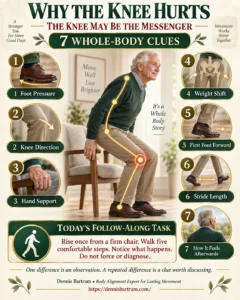
We begin with assessment, standing, sitting, and gentle motion. I look for the small signals the body sends: how your weight shifts from heel to toe, how one shoulder hangs slightly higher, how breath stops just before the exhale finishes. These cues reveal the story of your movement.
Then we start the hands-on phase. Meanwhile, the body begins adjusting on its own as pressure invites release. Using subtle pressure and directional touch, we invite each restricted area to let go. The sensations aren’t painful. They feel like the body taking a long breath after years of holding.
Meanwhile, warmth may spread through the tissue. Sometimes you’ll feel warmth spread through the tissue. Other times, a wave of lightness or even laughter as the nervous system resets.
“When the body learns to trust, movement becomes art again.”
After a short break, we rebuild. You’ll practice specific patterns, often the opposite of your habits, to balance both sides of your body. If you always step out of the car leading with your right leg, we’ll explore how to move just as easily with your left. These mirrored sequences teach the brain symmetry and flexibility.
By afternoon, the difference is clear. Your stride lengthens, breath deepens, and posture organises itself without effort. Many describe feeling taller, lighter, and oddly calm, as if gravity has softened its pull.
Finally, before you leave, we film your new movement plan… and outline a short, 10 to 20-minute routine to maintain it. You’ll take home a video, a written checklist, and a clear sense of how to keep the progress alive. The aim is independence, not dependence on sessions, but ownership of your own body’s intelligence.
Results, Integration, and Long-Term Change
From first release to lasting transformation
By the end of a Mind Body Reeducation Coaching day, most people describe three immediate sensations: lightness, calm, and connection. They walk out taller, move more easily, and breathe as if more space has appeared inside their ribs. The real work, though, starts once you take that awareness home.
Afterwards, your nervous system continues to adjust for days. New movement patterns consolidate while old ones fade. If you repeat the 15-minute maintenance sequence three times a week, these changes embed deeply into muscle memory. Over a month or two, you’ll notice less fatigue, fewer flare-ups, and a steadier mood.
“Awareness practiced becomes stability earned.”
The science calls this long-term potentiation; the brain’s way of strengthening the new connections that serve you better. Each repetition tells your system, this is the new normal.
Clients who integrate the coaching into daily life notice other benefits. Balance improves. Breathing gets easier. Joint pain reduces, and focus sharpens. The reason is simple: when the body isn’t constantly compensating for tension, the brain has more bandwidth for everything else.
In summary, to keep progress alive:
-
Use micro-awareness moments; brief scans during routine tasks.
-
Alternate sides for daily habits like carrying a bag or getting into a car.
-
Revisit your personal video monthly to refresh precision.
-
Book a refresher session once or twice a year to recalibrate deeper layers.
Ultimately, Mind Body Reeducation Coaching isn’t a technique; it’s an education in presence. The goal isn’t to move perfectly but to move consciously, to understand how awareness directs healing and how balance maintains itself once the body remembers its design.
The Philosophy Behind Mind Body Reeducation Coaching
Why the body already knows what the mind is trying to learn
Every principle behind Mind Body Reeducation Coaching rests on a quiet assumption: the body isn’t broken, it’s misunderstood.
Pain, stiffness, or fatigue aren’t mistakes; they’re accurate reports from a system doing its best with the information it has. The goal of reeducation isn’t to override that system but to update its data.
Because of this, we start from the premise that movement is thought in action. When awareness reconnects to motion, the nervous system receives clearer feedback. Over time, precision replaces force. Ease replaces effort. You can feel the difference instantly. The body begins to act like it remembers something ancient.
“The body never lies, but it often needs a better listener.”
Furthermore, this philosophy draws on somatic science and mindfulness. This philosophy draws on somatic science and mindfulness, but keeps its feet on the ground. It isn’t abstract; it’s practical. You learn how to recognise when the nervous system is bracing, how to invite release, and how to stabilise without rigidity.
That’s what separates Mind Body Reeducation Coaching from traditional exercise or therapy. It doesn’t chase outcomes; it restores awareness. The change you notice in movement is a side effect of improved communication between mind and body.
The longer you work with this approach, the more you notice its reach. Stress responses ease faster. Emotional triggers lose intensity. Creative thinking expands because less energy is spent on unconscious contraction. You become not just stronger but clearer, anchored in the present moment through sensation itself.
How to Prepare for Your Coaching Day
Simple steps that make your Mind Body Reeducation Coaching day effortless
Preparation for a Mind Body Reeducation Coaching session isn’t complicated, but a few small choices make a big difference. The day works best when you arrive rested, curious, and ready to notice details most people rush past.
To begin with, wear comfortable clothes that let you move freely, nothing tight or restrictive. Avoid heavy meals or caffeine right before the session. The aim is to help the nervous system stay calm and responsive, not agitated or dull.
Instead, the work doesn’t rely on pushing through pain or chasing big sensations. Bring an open mind. The work doesn’t rely on pushing through pain or chasing big sensations. Sometimes the subtlest release signals the biggest change. It might be a deeper breath or a weight shift in your hips.
“Curiosity heals faster than control.”
If you’re travelling from out of town, give yourself time before and after. Arrive early enough to settle, and don’t plan anything demanding that evening. The body often wants quiet after deep recalibration.
You’ll also want to bring a notebook or use your phone to jot key observations during breaks. Writing down what you feel helps the brain reinforce new neural maps. After the session, your personal video and checklist become your at-home teacher, private reference you can revisit anytime you drift from balance.
Lastly, come with a small question in mind, something about your movement, energy, or posture that feels like a puzzle. The day will likely answer it, but even more valuable, it will show you how to find the next answers yourself.
Link: Psychology Today; “How Curiosity Affects the Brain’s Learning State.”
#MindBodyReeducationCoaching, #MovementAwareness, #SomaticTherapy, #PostureAlignment, #MindBodyIntegration, #Neuroplasticity, #GentleMovement, #BalanceAndEase, #BodyIntelligence, #SomaticHealing, #MovementEducation, #HolisticWellbeing,