Improve Balance After 50 Naturally & Safely At Home Or Work
Improve Balance After 50 by noticing how you stand, shift, turn, and move through the ordinary moments already built into your day.
Improve Balance After 50 Before A Wobble Becomes A Worry
Better balance often begins with noticing movements most of us stopped noticing years ago.
Improve Balance After 50 Through Everyday Movement
You do not necessarily need a gym floor, complicated equipment, or an hour carved out of the day.
Improve Balance After 50 With Calm Body Awareness
Small, controlled movements can tell you a surprising amount about how confidently your body is organising itself.
Many people recognise a moment but rarely discuss it. You step away from the kitchen worktop, turn quickly from a desk or change direction on the pavement and, for half a second, the body seems to arrive slightly later than the rest of you. Nothing dramatic happens. No fall. No flashing warning light. Just a hand touching the chair or a foot taking a small extra step to correct. Then life carries on. Yet those tiny moments can be useful information. To Improve Balance After 50, the first job may not be exercising harder. It may simply be noticing more.
Balance is not one muscle sitting somewhere behind the left ear waiting to be strengthened. It is a conversation involving vision, the inner ear, muscles, joints, sensation and the brain’s constant assessment of where the body is in space. That is why balance can feel perfectly ordinary one moment and less certain during another task such as turning, stepping backward or moving after sitting for a while. The encouraging part is that we can keep practising balance. It does not have to be treated as a mysterious ability that either survives ageing or quietly disappears.
Balance Is Happening Long Before You Call It Exercise
 Watch somebody make a cup of tea, and there is more balance work going on than the word “exercise” might suggest. Weight moves from one foot to the other. The body reaches. The head turns towards the cupboard. A hand carries the mug while the feet change direction. The eyes scan the worktop and floor. None of this earns a medal, and nobody changes into Lycra first, but the nervous system is continually solving small movement problems. Dennis Bartram’s approach has long focused on this ordinary territory: how the body organises itself during the movements real people actually perform.
That matters because people can become so concerned about losing balance that they gradually stop giving the body opportunities to practise it. A slightly uncertain step encourages more sitting. A fear of wobbling makes movements smaller. Activities that once happened without thought begin to be avoided. Of course, caution has its place, particularly after a fall or when dizziness or a health condition is involved. But ordinary movement performed within a person’s safe ability can remain valuable. The aim is not to prove how adventurous you are. It is to keep giving the body sensible opportunities to organise, adjust and respond.
Improve Balance After 50 Without Turning Home Into A Gym
The kitchen worktop may be more useful than an expensive piece of fitness equipment for someone just starting. So may the back of a solid chair. Standing comfortably and slowly shifting weight from one foot towards the other can reveal whether one side feels easier, steadier or more familiar. Simply rising from a chair with control, where appropriate for the individual, asks the legs and trunk to cooperate. Even slowing down an ordinary turn can make you notice whether your head, shoulders, hips and feet move together or whether the feet seem to scramble after everything else.
The important word is controlled. This is not about seeing how long somebody can wobble on one leg while the dog, coffee table and family china wait for the inevitable. Safety comes first. Current NHS guidance on home balance exercise recommends building up gradually and using a wall or stable chair for support when needed. That suits the philosophy here beautifully. A useful movement does not have to look heroic. It has to be appropriate, repeatable and calm enough for the person performing it to notice what their body is actually doing rather than merely surviving the attempt.
Your Feet Are Constantly Reporting Back To The Body
It is easy to think of feet as two platforms at the bottom of the legs whose main job is fitting inside shoes. In movement, they are much busier than that. Contact with the ground changes as weight shifts forwards, backwards and sideways. Ankles adjust. Knees respond. The body above makes countless tiny corrections. That makes the feet an interesting place to start observing balance. Are both feet carrying weight comfortably? Does one side feel more secure? When you stand up, do you immediately lean one way? These are observations, not diagnoses, but they can make previously invisible habits easier to notice.
This is where natural movement becomes more interesting than a collection of isolated exercises. A person does not walk through the supermarket balancing on one leg for thirty seconds at every aisle. Real balance involves starting, stopping, turning, reaching, looking, stepping around obstacles and adapting to surfaces that are not always perfectly level. Practising awareness during ordinary movement therefore has a practical purpose. The question becomes less, “Can I perform this balance exercise?” and more, “Can I move through my normal day with a little more control, awareness and confidence?” That is a far more useful conversation for most people.
Small Daily Checks Can Reveal More Than One Big Test
There is no need to turn balance into an examination you either pass or fail. In fact, that may be one of the least helpful ways to approach it. Bodies vary from day to day. Tiredness, footwear, attention, surroundings and how long somebody has been sitting can all affect the way movement feels. A small daily check can therefore be more informative than one grand test performed once a month. Stand comfortably near support. Notice your weight. Take a few easy steps. Turn. Sit and rise if that is comfortable for you. The aim is curiosity, not judgement.
If balance has changed suddenly, dizziness is involved, falls are becoming frequent, or an existing condition affects safe movement, that belongs in a conversation with an appropriate healthcare professional rather than an online experiment. For everyone else, the quieter lesson is worth remembering: Improve Balance After 50 doesn’t have to mean fighting age or trying movements designed to impress somebody on social media. It can begin with learning how your own body responds to simple, familiar tasks and gradually giving it more opportunities to move well.
Improve Balance After 50 By Practising Ordinary Transitions
Some of the most useful balance practice happens during the movements people perform dozens of times without giving them a name. Standing up from a chair. Pausing before taking the first step. Turning towards a doorway. Reaching for something on a shelf. Stepping around a table rather than walking straight ahead. These transitions ask the body to shift weight, organise the feet and adjust the trunk before movement continues. When they are rushed, small compensations can easily disappear unnoticed. Slow them down slightly, and the body begins telling you much more about where confidence, control or hesitation may be hiding.
That does not mean moving through the day as though somebody has pressed the slow-motion button. The aim is awareness, not caution for its own sake. Try standing from a stable chair and noticing whether both feet contribute. Pause for a moment before walking away. When turning, allow the feet to participate rather than twisting entirely through the upper body. If you need support, use it. These are ordinary movements, not competitive tests. The useful information comes from noticing how the movement feels and whether a small adjustment makes the next attempt calmer, smoother or more controlled.
Let The Feet Start The Conversation With The Ground
The feet deserve more attention because balance begins with the body’s relationship to the surface beneath it. Shoes, flooring, posture and long-standing movement habits can all change the way weight is distributed. A simple standing check can be surprisingly revealing. With safe support nearby, notice whether the pressure under both feet feels roughly even. Does one heel feel more planted? Does the body drift towards one side? Do the toes grip unnecessarily? Use none of these observations to diagnose a problem, but they can help someone become more aware of habits that have gradually become so familiar they no longer get noticed.
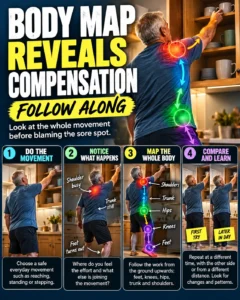
That awareness leads naturally towards alignment. The body does not operate as a stack of independent spare parts. When the feet change, the ankles respond. The knees, hips and trunk adapt above them. Dennis Bartram’s work has repeatedly explored that relationship between the ground, alignment and natural movement. For the reader, the practical lesson is simple: do not stare only at the part that appears to wobble. Look at the whole movement. A turn that feels uncertain may involve the feet, the speed of the movement, where the eyes are looking and how the body transfers weight before the next step begins.
Use Support To Build Confidence Rather Than Prove A Point
There is no prize for refusing a chair, wall or worktop when a little support makes practice safer. In fact, support can help someone focus on movement quality instead of spending the whole exercise worrying about falling. A fingertip on a solid surface may be enough. As confidence improves, you can sometimes reduce assistance gradually, where appropriate. The important point is that progression should come from greater control, not from bravado. Better balance isn’t shown by taking unnecessary risks. It is demonstrated when ordinary movement becomes more organised, dependable and comfortable.
This is also why comparing yourself with somebody else is rarely useful. One person may comfortably stand with a narrow base while another needs the feet farther apart. Somebody recovering from illness or inactivity may require more support than they did six months earlier. Another person may have excellent strength but feel uncertain when turning quickly. Starting points vary. The sensible question is not, “Can I do what that person can do?” It is, “Can I perform this movement safely and with a little more control than before?” That turns progress into something personal, not another scorecard.
Improve Balance After 50 With A Simple Daily Movement Check
A daily check does not need to become a twenty-minute exercise programme. You can weave it into ordinary life. Stand comfortably near support and notice your feet. Gently shift your weight from side to side. Take several normal steps and pay attention to the first one. Turn slowly in both directions. If appropriate, sit down and rise again with control. Reach for something at a comfortable height without rushing. The purpose is not to complete a prescribed number of repetitions. It is to notice whether today’s movement feels familiar, easier, stiffer, more hesitant or different from yesterday.
That information becomes useful because patterns begin to appear. The first steps after sitting always feel less certain. One direction of turning feels easier. Tiredness changes how confidently the feet move. Once you notice a pattern, you can work with it rather than simply accepting a vague feeling that balance is “not what it used to be.” Observation does not replace professional assessment when there is a medical concern, but it can help people describe what they are experiencing more clearly and can encourage them to pay attention before an awkward movement becomes an established habit.
Better Balance Is Usually Built Through Repetition, Not Heroics
The nervous system likes useful repetition. A calm movement performed regularly gives the body another opportunity to organise the task. That is very different from pushing into difficulty simply because an exercise looks impressive. The best practice is often almost boring to watch. Stand. Shift. Step. Turn. Pause. Repeat another day. Yet those ordinary movements are the ones that eventually have to work when carrying a shopping bag, walking across a car park, getting out of a chair or turning because somebody called your name. Training becomes valuable when it improves the movements life actually asks you to perform.
And this is where patience earns its place. Nobody should expect years of movement habits to disappear because they concentrated particularly hard on Tuesday morning. Some changes will feel immediate; others may take time to become familiar. The aim is not perfection. It is a relationship between awareness and movement that is gradually improving. If somebody notices that they are more deliberate when standing, more confident when turning, or less inclined to grab for support during an ordinary task, that may be meaningful progress. Small improvements become valuable because they carry into everyday life.
Know When Balance Needs More Than An Online Article
Keep one important boundary clear. Sudden changes in balance, new or persistent dizziness, repeated falls, fainting, unusual weakness, new neurological symptoms, or concerns related to medication or an existing condition should not be treated as something to be solved on a website. Those situations deserve appropriate professional assessment. The same applies when somebody does not feel safe attempting even simple movements without assistance. A useful wellbeing site should encourage curiosity and sensible self-maintenance, but it should also know when the safest advice is to involve a doctor, physiotherapist or another appropriately qualified healthcare professional.
For the many people simply noticing that movement no longer feels quite as automatic as it once did, however, there is plenty to learn from the quieter approach. Begin where you are. Use support when needed. Observe the feet. Notice the first step. Pay attention to turning. Give ordinary movement time to organise the body. To Improve Balance After 50 does not require declaring war on ageing. It means remaining interested in how the body moves today and giving it regular, sensible opportunities to keep doing the jobs that matter.
When the foundation becomes stable, the mind becomes stable.
Body Alignment: Fix Your Pain At Home Or On The Go
[Premium Quality Paperback Book]
Your Active Balance Task: Notice One Movement Today
Choose one ordinary movement you perform several times today: standing from a chair, taking the first few steps, turning through a doorway or reaching across a worktop. Do not try to correct everything. Notice it. Where does your weight go? What do the feet do? Does one side feel different? Are you rushing the transition? If it feels safe, repeat the movement once more with slightly greater awareness and control. That is enough for today. Tomorrow another small observation can be added. Balance is not one spectacular achievement. It is thousands of small adjustments quietly helping us move through life.
And that is where Pillar One begins. We are not asking readers to become athletes or biomechanics students. We are helping them understand the ordinary movements that support confidence, independence and everyday activity. From here we can explore fascia, alignment, walking, gravity, daily movement routines and the Active Balance approach in greater detail. Each subject is another piece of the same picture. For now, the first lesson is deliberately simple: Improve Balance After 50 by becoming curious about the movements already happening beneath your feet. Sometimes the first useful change begins not with doing more, but with finally noticing what is already there.